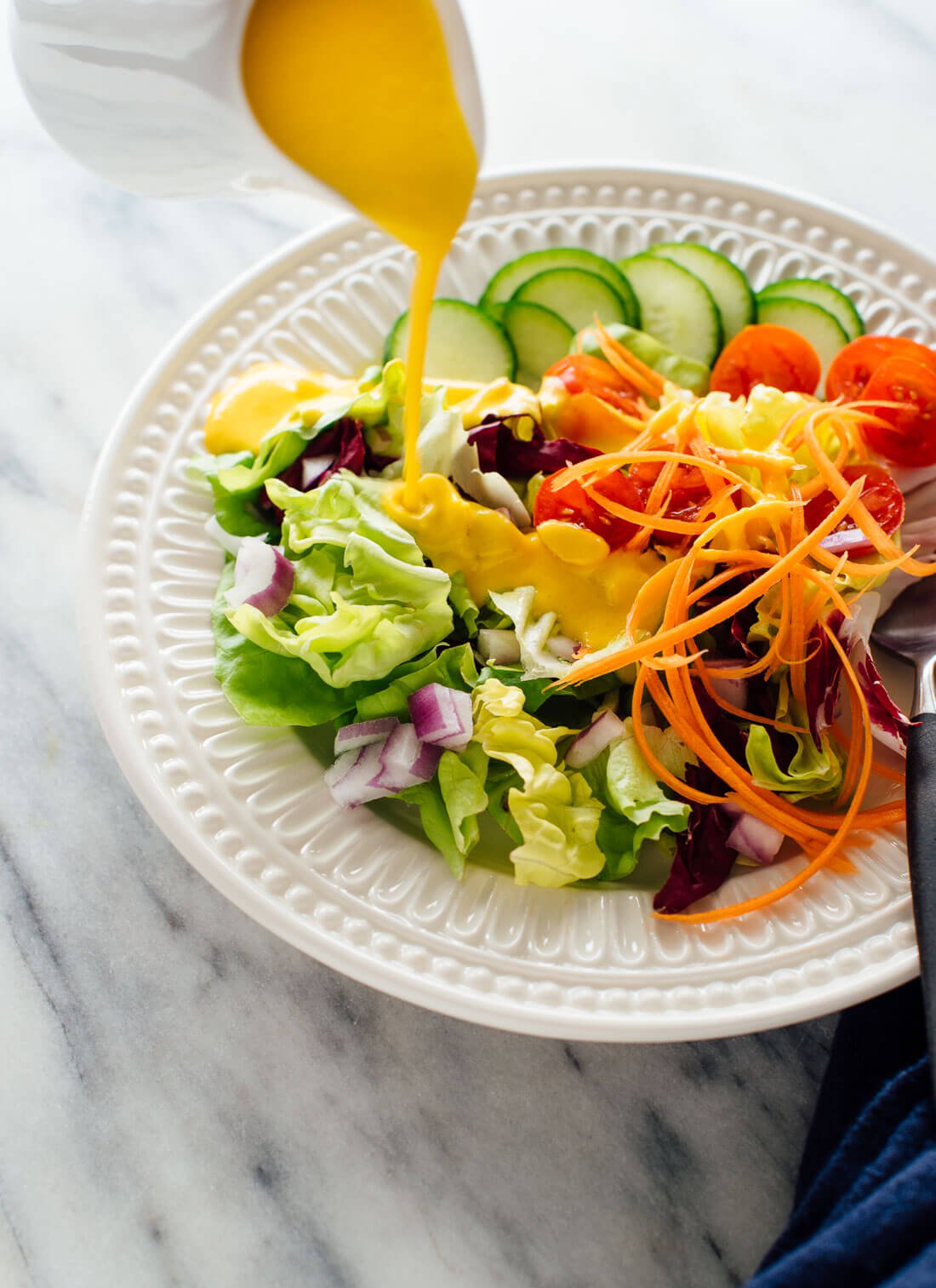
Interest in salads, a dietary staple for those concerned about long-term health and weight management, can flag, unless the salads are enhanced by flavorful, low-cal dressings. Through bold use of herbs and spices, AICR has developed three intensely-flavored dressings that actually raise a salad’s health quotient.
“People should concentrate on getting the maximum in flavor and health benefits through the generous use of herbs in their salad dressings,” according to Melanie Polk, R.D., AICR’s Director of Nutrition Education. As most commercial salad dressings contain a low proportion of herbs, if any, AICR has developed distinctive salad dressings that are intensely flavored with health- and cancer-protective herbs like basil, mint and cilantro.
“A dressing is usually thought of as something that simply adds a little flavor and incentive to eat more salad,” says Polk. “But a salad dressing with a large proportion of herbs, which are virtually calorie-free, offers powerful, health-protective benefits as well as rich taste.”
Used to their maximum advantage, flavor-intense herbs give a dressing “more bang for the buck,” according to Polk, and a small amount can go a long way. She notes that herbs have antioxidant powers that protect our health in many ways, including the ability to help lower our risk of different kinds of cancers.
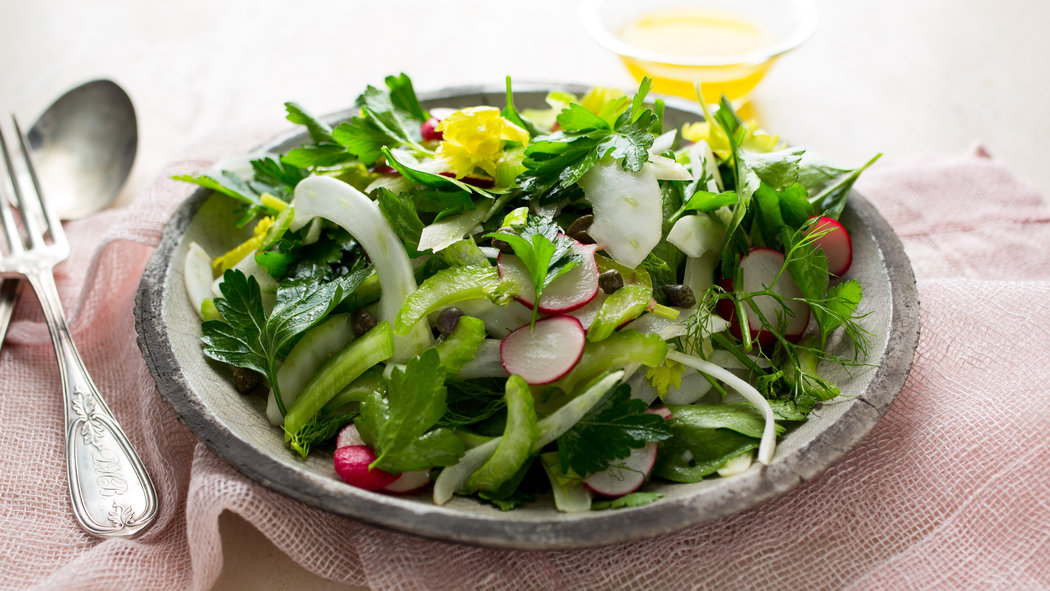
Herbs Do Far More Than Boost Flavor
“Herbs can be very different in the kinds of health-protective substances they contain,” says Polk.
“Those substances, called phytochemicals (phyto means plant in Greek), number in the thousands, and they are highly specialized in the way they can protect our health.” Scientists have found that phytochemicals can protect against many chronic diseases and actively fight cancer as well. Through laboratory and animal studies, scientists across the country are just beginning to understand the complex ways phytochemicals work, both independently and with each other, to produce anti-cancer effects.
“Researchers believe that one day phytochemicals will be used as powerful and precise tools in the fight against cancer,” Polk observes. “But for the moment, our best health insurance is eating a wide variety of plant-based foods, including herbs and spices.” AICR’s new salad dressings feature mint, basil, parsley and cilantro, also known as coriander.
- Cilantro is rich in coriandrol, a potent anticarcinogen. It is believed to help combat breast and liver cancers.
- Mint contains limonene, a powerful anti-cancer agent that studies suggest can block the development of breast tumors and shrink them. Mint contains luteolin, which is also believed to fight breast cancer.
- Basil boasts significant levels of antioxidant vitamins A and C. It is also considered an immune stimulant and cancer-protective. Mint, basil and parsley are all high in monoterpenes, which are thought to have cancer-delaying properties, especially with breast tumors.
- Parsley is also high in coumarins, which are noted for their anti-coagulant and anti-bacterial properties. It is also rich in lutein and zeaxanthin, which are associated with a reduced risk in liver cancer as well as age-related macular degeneration, a leading cause of blindness in people over 65.
AICR Salad Dressings Provide Added Value
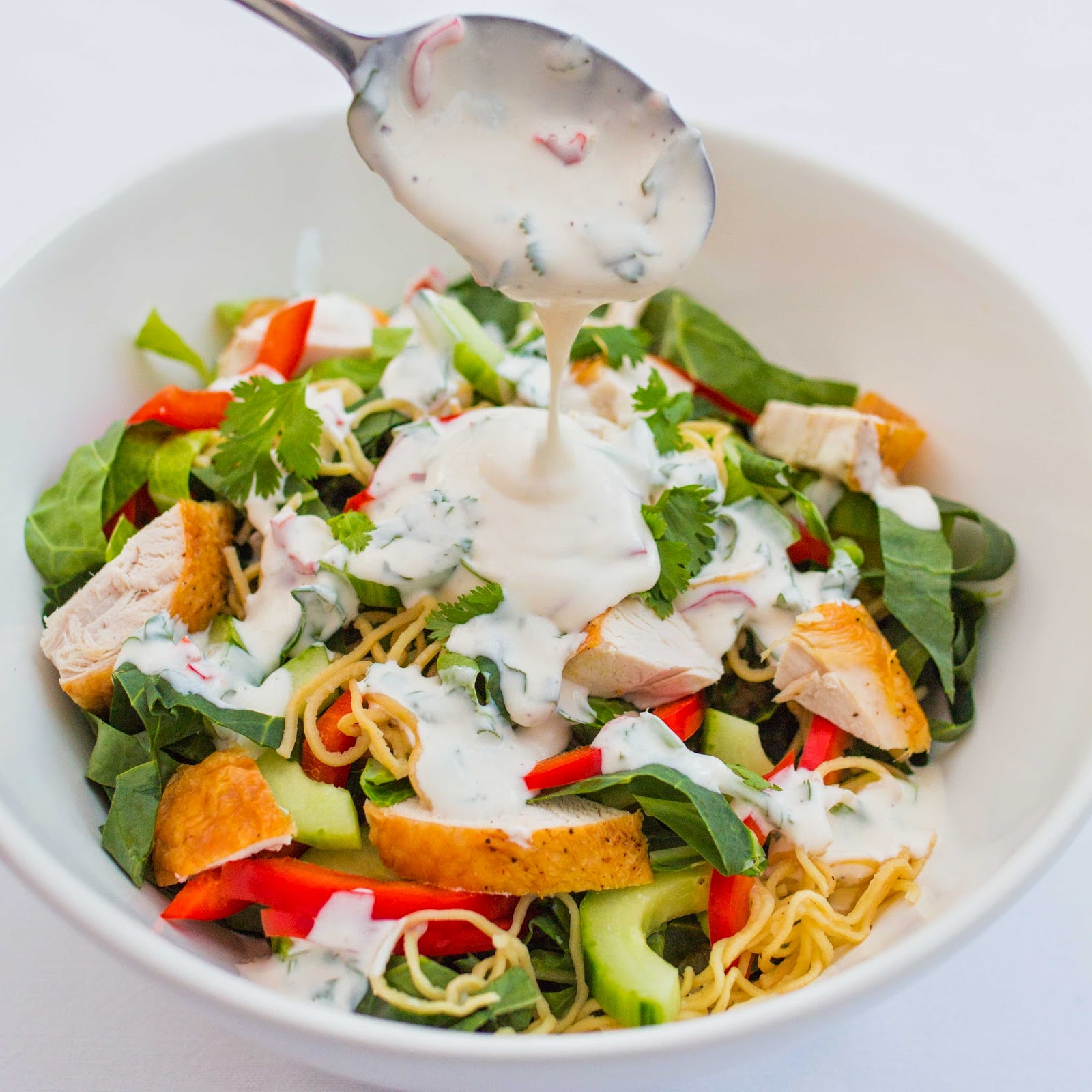
“Besides being rich-tasting and health-protective, AICR’s new herb-based dressings are low in calories and fat,” observes Polk. Commercially-prepared salad dressings may range from 35 calories per standard serving (two tablespoons) for a “fat free” version to 170 calories and 18 grams of fat for a “regular,” creamy dressing. By contrast, AICR’s herb-based dressings range from 22 to 45 calories and five grams or less of fat per tablespoon.
The herb content of commercial dressings is proportionately very low. AICR’s dressings have a flavor intensity that is exceptionally high, and less than the standard two-tablespoon serving is needed to achieve the same taste effect. Nutritional analysis, therefore, has been computed for a recommended one-tablespoon serving.
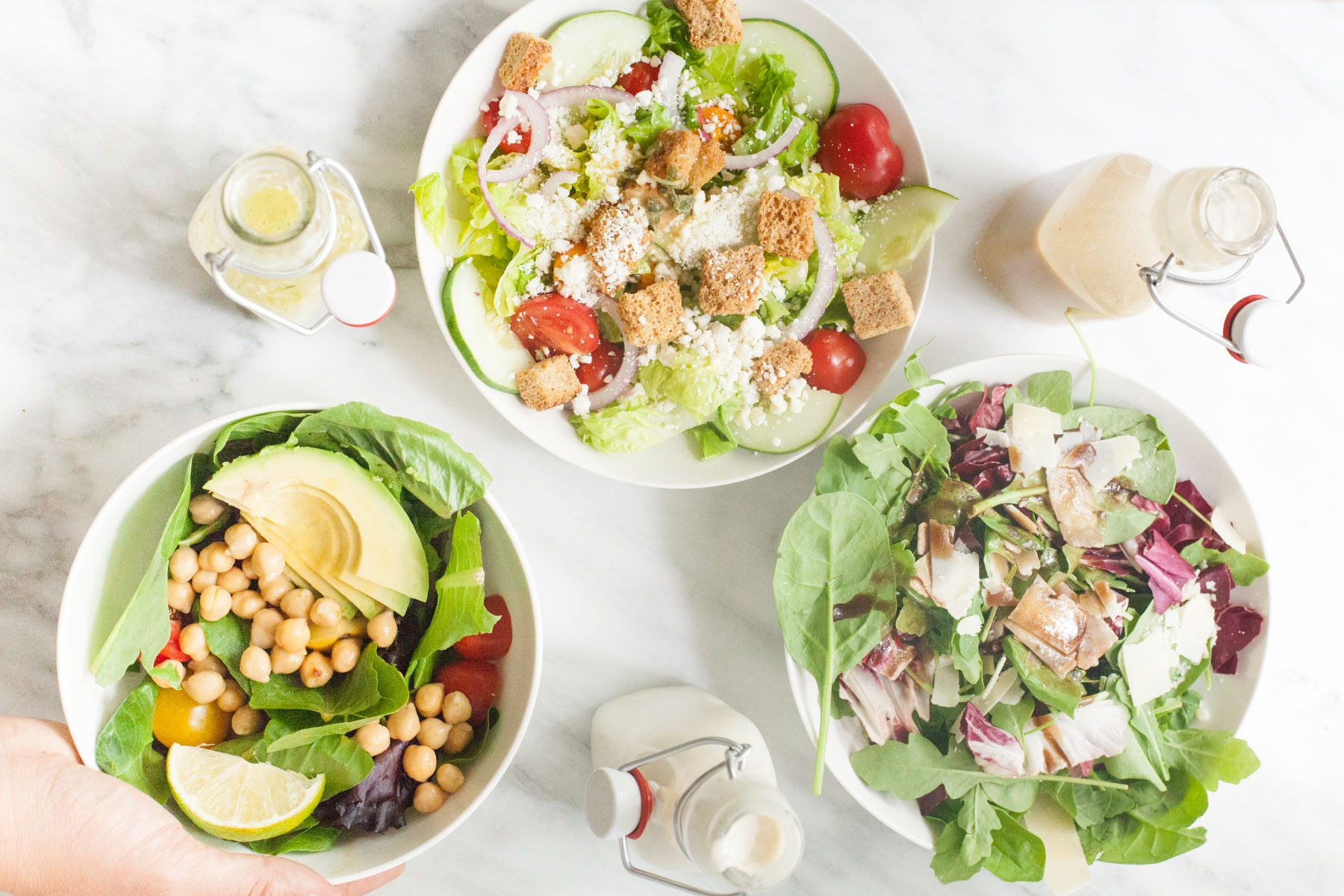
“Many people over-rely on dressings to add flavor, to the point of drenching their salads,” Polk says, noting that the ladle for dressings at salad bars often holds four tablespoons. She suggests that, “Since they are so richly flavored, AICR’s dressings need only be lightly drizzled over salads.”
The following dressing uses a French-style mustard as well as fresh basil and parsley for a rich, full-flavored taste. Mustard contains curcumin, a compound with anti-cancer and anti-inflammatory properties.
Dijon-Style Dressing
Makes 1/3 cup.
Ingredients:
- 3 Tbsp. Dijon mustard
- 1 Tbsp. white wine vinegar
- 1 Tbsp. extra virgin olive oil
- 2 Tbsp. chopped fresh basil (2 tsp. dried)
- 1 Tbsp. chopped fresh parsley
- 2-3 Tbsp. (about) half-and-half cream*
*For those who wish to keep fat content to the absolute minimum, non-fat dairy cream is another option.
Using a whisk and bowl or a blender, combine all ingredients except cream and blend until well combined and smooth. Blend in cream.
Nutritive Information Per 1 tablespoon serving:
- 45 calories
- 4 g. fat (less than 1g. saturated fat)
- 2g. carbohydrate, less than 1g. protein
- 0g. dietary fiber
- 230mg. sodium
The following Asian-style dressing is especially complimentary to salads containing mild-flavored vegetables.
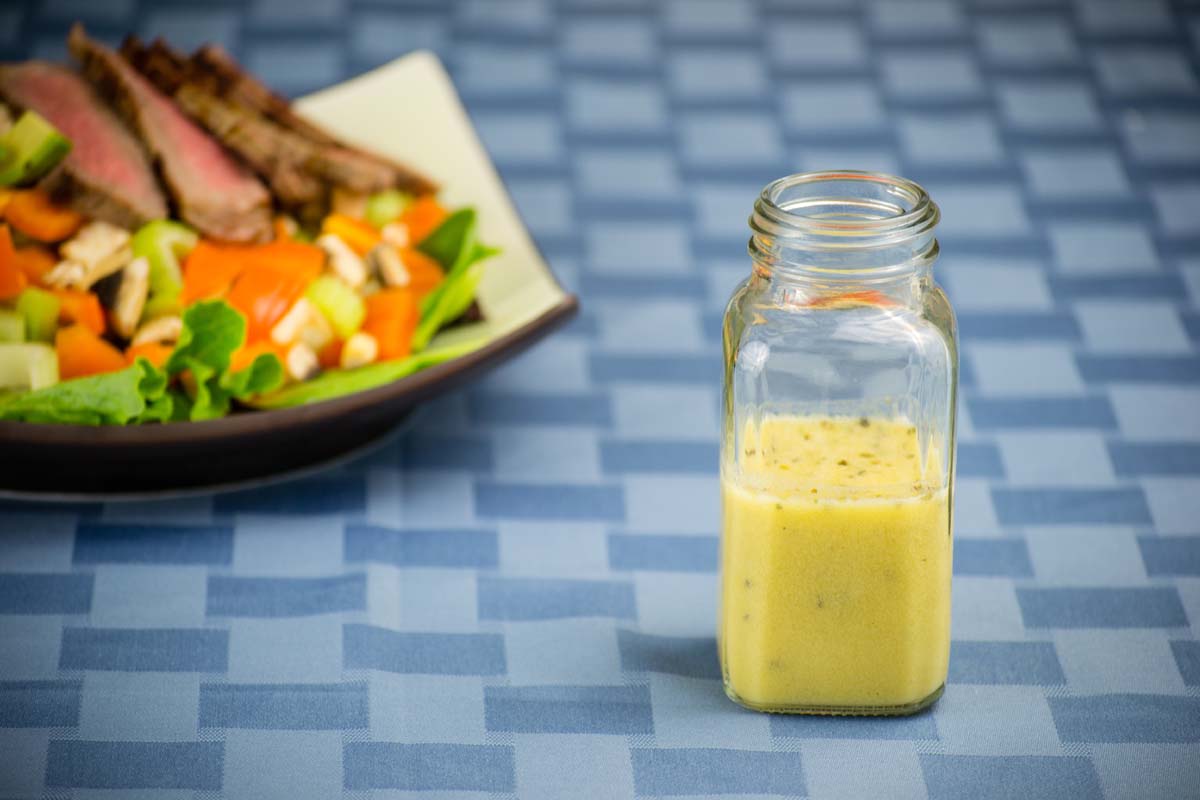
Tangy Pan-Asian Dressing
Makes scant 1/2 cup.
Ingredients:
- 3 1/2 Tbsp. fresh lime juice
- 3 Tbsp. Hoisin sauce
- 1/4 cup finely minced fresh cilantro or
- 2 Tbsp. finely-minced fresh mint
- 1/2 Tbsp. peanut butter*
- chives
*For those who wish to keep fat content to the absolute minimum, reduce-fat peanut butter is another option.
Using a whisk and bowl or a blender, combine all ingredients until well combined and smooth.
Nutritive Information Per serving:
- 22 calories
- Less than 1g. fat (0g. saturated fat)
- 4g. carbohydrate
- Less than 1 g. protein
- 0g. dietary fiber
- 103mg. sodium.
The “mystery” in this dressing involves the use of an Asian specialty with a name that may be off-putting to some but with a unique, piquant flavor that adds an extra zing to the taste. The dressing is especially well-matched to salads composed of fresh broccoli and other cruciferous vegetables with an assertive taste but equally strong health-protective phytochemicals.
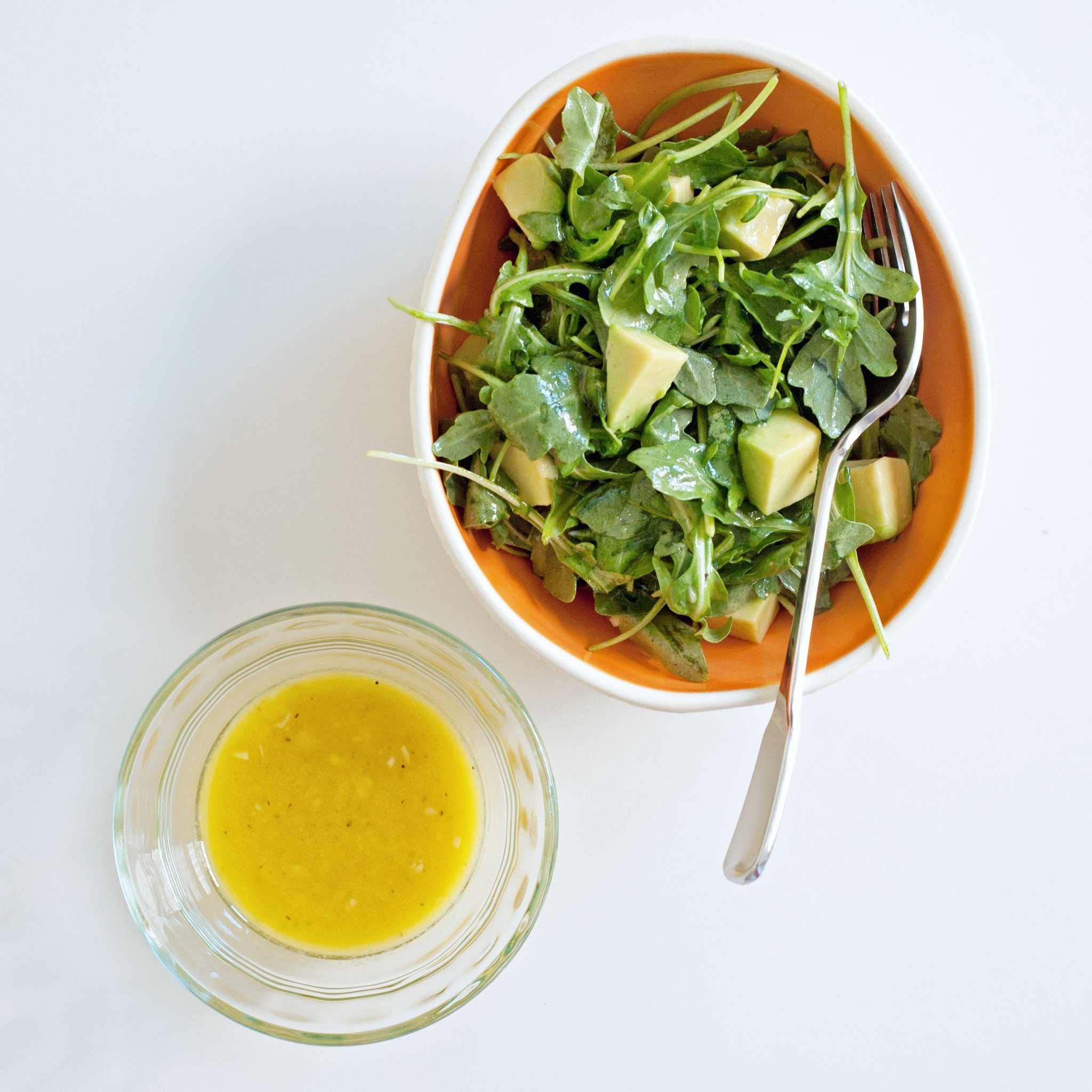
Mystery Dressing
Makes scant 3/4 cup.
Ingredients:
- 1/4 cup peanut or canola oil
- 1 garlic clove, finely minced
- 2 Tbsp. fresh lime juice
- 1 small shallot or white part of scallion, finely minced
- 1 Tbsp. Asian fish sauce*
- 3 Tbsp. finely minced fresh mint leaves
- 2 Tbsp. finely-minced fresh basil leaves
- 2 tsp. sugar
- *Asian fish sauce can be found in the Asian or specialty foods section of most supermarkets. It is often sold as “Thai fish sauce,” or “nampla.”
- Using a whisk and bowl or a blender, combine all ingredients until well combined and smooth.
Nutritive Information Per serving:
- 45 calories
- 5g. fat (less than 1g. saturated fat)
- 1g. carbohydrate
- 0g. protein
- 0g. dietary fiber
- 109mg. sodium.
The American Institute for Cancer Research (AICR) is the nation’s third largest cancer charity, focusing exclusively on the link between diet and cancer. The Institute provides a wide range of consumer education programs that help millions of Americans learn to make dietary changes for lower cancer risk. AICR also supports innovative research in cancer prevention and treatment at universities, hospitals and research centers across the U.S. The Institute has provided over $62 million in funding for research in diet, nutrition and cancer. AICR’s Web address is: www.aicr.org