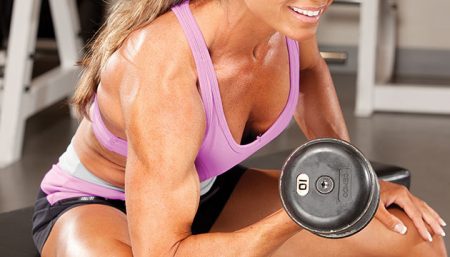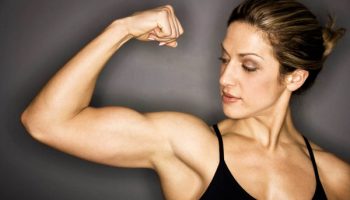
The biceps muscles make up the front of the arms and are used to flex the elbow joint and to supinate the wrist (turn it outward so that the palm is facing up).
Good bicep development is evident through full, round muscle bellies and a high peak. When viewed from the side as in a double bicep or a side tricep pose, the front and back of the arms should be of equal size and development.
Anatomy of the Bicep
The biceps brachii is attached to a forearm bone called the radius and originates at the scapula in two places. In fact the bicep gets its name from this two headed structure; we refer to it as the long head and the short head of the biceps.
The biceps brachii is attached to a forearm bone called the radius and originates at the scapula in two places. In fact the bicep gets its name from this two headed structure; we refer to it as the long head and the short head of the biceps.
Two additional parts of the bicep are called brachialis and brachioradialis. These are a little muscles on the outside of the bicep that contribute to elbow flexion. Typically there is no need to train these specifically, unless you are a bodybuilder.
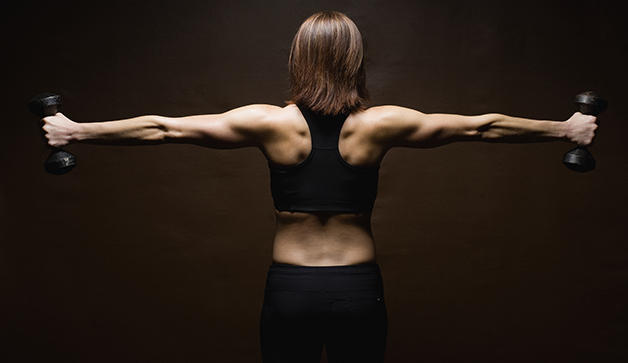
A combination of the following bicep movements can help you sculpt your arms.
- Bicep Curl with Tube: Stand in the basic step position. The front foot fixes the middle of the tube on the floor. The arms are at the sides of your body and bent so far that the tube is a little taut. Move both ends of the tube simultaneously upwards in an even movement. Only the forearm is moved, the upper arm rests on your body. Keep your elbows close to your body. You can also stand with both feet on the tube in the basic position with your feet parallel. Note: While performing, your hands should form a straight line with your forearms.
- Hammer Curl (Db): Stand at the end of a bench with your feet slightly apart. Hold a dumbbell in each hand, with your palms facing your body. Your shoulders should be back, your torso should be upright, and your back straight. Keeping your elbows at your sides, curl the dumbbells up to chest height. Hold for a brief second flexing your biceps. Your wrist should be locked and your palm should continue to face in toward your body as you lift. Lower the weight to the starting position in a slow, controlled manner.
- Hammer Curl (Db): Stand at the end of a bench with your feet slightly apart. Hold a dumbbell in each hand, with your palms facing your body. Your shoulders should be back, your torso should be upright, and your back straight. Keeping your elbows at your sides, curl the dumbbells up to chest height. Hold for a brief second flexing your biceps. Your wrist should be locked and your palm should continue to face in toward your body as you lift. Lower the weight to the starting position in a slow, controlled manner.
- Scott Curls: For the Scott curls, the back of your upper arms should be completely supported by the cushion on the special Scott bench. Grasp a barbell with your hands shoulder width apart, palms facing upwards, keep your arms slightly bent. Lift the barbell in a semicircular movement to a height where you can still feel the tension in the group of muscles bending the arm. Then lower the barbell smoothly back into the starting position with slightly bent arms. You can also perform the Scott curls with a dumbbell.
- Incline Curl (Db): To target the Biceps Brachii , sit back on 45-60 degree incline bench. With arms hanging down straight, position two dumbbells with palms facing inward. With elbows back to sides, raise one dumbbell and rotate forearm until forearm is vertical and palm faces shoulder. Lower to original position and repeat with opposite arm. Continue to alternate between sides.
- Chin Ups: Primarily targeting the Latissimus Dorsi, this exercise is good for working the biceps. To do the exercise, step up and grasp bar with underhand shoulder width grip. Pull body up until elbows are to sides. Lower body until arms and shoulders are fully extended. Repeat till fatigue.
These routines should be done twice a week.
Note: You will not bulk up with heavier weights. In order to force your body to bulk up, you’d have to be curling something like 100 pounds. Most women starting out will get a challenge with just a 30 pound barbell.
Disclaimer
The Content is not intended to be a substitute for professional medical advice, diagnosis, or treatment. Always seek the advice of your physician or other qualified health provider with any questions you may have regarding a medical condition.