Bad planning can be the downfall of many diets, so make sure your fridge and store cupboards are stocked with a variety of healthy ingredients so that you’ll always have the makings of a good nutritious meal or snack. Foods can be divided into five main groups – you need to eat some food from each of the groups each day – but the key to a healthy diet is getting the balance right.

Here’s some useful advice for a ‘well-balanced’ shopping basket. And a tip to start with is never go shopping on an empty stomach!
Fruit and Vegetables
These are the dieter’s best friend: apart from being excellent providers of vitamins and minerals, they are also wonderfully low in both fat and calories. It’s no coincidence that in Mediterranean countries, where people eat almost twice as much fruit and vegetables as compared to western countries, tend to live longer and healthier lives.
Look for recipes and ideas for new ways of cooking them – try poaching. Baking or grilling fruits as an alternative to eating them raw.
Although fresh are best, frozen and canned fruits and vegetables and dried fruits are also useful. The vitamin C in both fruit and vegetables is easily destroyed during storage, preparation and cooking. To help preserve the vitamins, buy little and often. Buy from a shop that you know has a quick turnover and stores vegetables in a cool dark place, ideally for no more than three days. Boiling vegetables in large quantities of water can destroy up to 70 percent of their vitamin C, so choose cooking methods that require little or no water. Aim to eat at least five servings a day.
Starchy Carbohydrates
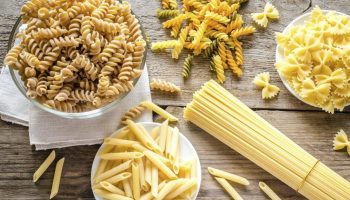
This group, which includes bread, grains, rice, breakfast cereals, pasta and potatoes, should provide at least 50 percent of our daily energy requirements. Unfortunately many people still believe that these foods are fattening, which is simply not the case. It’s only when they are eaten with lots of fat – a rich sauce with pasta or thickly spread butter on bread – that they become so. Choose fibre-rich varieties, such as wholemeal bread and wholegrain cereals, whenever possible, as they provide slow-release energy, which helps keep blood sugar levels stable. High-fibre foods are more filling than their fibre-depleted counterparts: they will help you feel full more quickly and will stop you feeling hungry for longer.
Bread, rice, pasta, potatoes, couscous, polenta and bulgur wheat are all naturally low in fat. These are the foods to fill up on – at least half of the calories on your plate should come from starchy carbohydrate foods such as these. Be careful not to add too much fat when you cook them – 100g/3¾oz boiled potatoes contains just 80 calories but the same weight of chips contains 240 calories, which is three times as many.
Protein Foods
Meat, poultry, fish, eggs, nuts and pulses (peas, beans and lentils) are all excellent protein foods. Healthy eating recommendations suggest we should eat two to four servings from this group a day. To avoid unwanted calories always choose lean meat and poultry; white fish and pulses are also particularly good choices for people who are trying to lose weight.
- Meat and Poultry
Red meat is an important source of iron, which can help prevent anaemia. Choose lean meat and trim away any visible fat before cooking. Pork, game and poultry all contain considerably less fat than lamb or beef. - Fish
Shellfish and white fish are both a particularly good choice for slimmers because they’re extremely low in fat. Although oil-rich fish, such as salmon, mackerel and tuna, contain more fat, the type of fat they contain is particularly healthy and nutritionists suggest that we eat at least two servings of oil-rich fish a week. Canned fish is a useful ingredient to keep in the store cupboard for sandwiches or salads – choose fish canned in brine or water rather than oil. - Eggs
A good source of protein, eggs also provide vitamin A, B1, B2, B12 and folic acid. Egg yolks are a rich source of fat and cholesterol; however it is the amount and type of fat in the diet rather than the level of cholesterol in individual foods that will affect blood-cholesterol levels.
Because of the risk of salmonella poisoning, it is recommended that dishes containing raw or lightly cooked eggs should be avoided, particularly by young children, the elderly, pregnant women and anyone with an immune-deficiency disease. - Nuts
Chestnuts are the exception to the rule that nuts are high in fat. However, the type of fat that nuts contain is mainly the “healthier” unsaturated variety, and they also provide good amounts of vitamin E and protein. Therefore, providing they are used in small quantities, there is no reason why you should completely exclude nuts from your diet unless, of course, you have an allergy to them. - Pulses
An excellent source of low-fat protein, peas, beans and lentils are also high in fibre and provide useful amounts of vitamins and minerals. Pulses are economical, nutritious and incredibly versatile. You can use them to make dips such as hummus, soups, salads or curries, or to add to stews and casseroles. High-fibre foods are a good choice for slimmers because they help to satisfy the appetite and keep you feeling full for longer.
All dried beans (with the exception of lentils and split peas) should be soaked overnight in plenty of cold water. The next day, drain, rinse and place them in a saucepan with fresh water, bring to the boil and boil rapidly for 10 minutes (this will destroy the toxins that are naturally present in some types of bean), and then simmer until tender. Salt should not be added to the water until the end of the cooking time, as it will cause the skins to toughen.
- Low-fat cheeses: There are an increasing number of low-fat cheeses available today. Interestingly, some traditional cheeses, such Parmesan and Single Gloucester, were made with skimmed off to use for cooking or to make butter. Most low-fat products and the quality can vary, with an occasional lack in texture and depth of flavour. If you are not fond of low-fat cheeses, it can be more satisfying to choose a cheese with a strong flavour such as Parmesan or mature Cheddar for cooking, and just use less than you would if you were using a mild flavoured cheese, thereby retaining taste but still reducing calories. Otherwise, try using a soft cheese for salads and sandwiches, as they have a high moisture content and therefore a lower percentage of fat than a harder cheese.
- Other low-fat dairy products:
Low-fat dairy products such as Quark, fromage frais and yogurt are a useful substitute for cream in sweet or savoury dishes.
Milk and Dairy Products
Foods from this group are a major source of calcium, essential for strong bones. Many dairy products also contain large amounts of fat, most of which is saturated, and for this reason they should only be eaten in moderation. Choose reduced-fat cheese and low-fat yogurts whenever possible.
Dairy products are a valuable source of calcium. They also provide useful amounts of protein and vitamins A, B2, B12 and D. Choose reduced-fat dairy products whenever possible; they’re just as nutritious as their full-fat cousins but contain fewer calories. Switching from full-fat to skimmed or semi-skimmed milk to make sauces or custards and it is unlikely you will even notice the difference in taste.
- Fat
Small amounts of fat are necessary in our diet to provide essential fatty acids and to allow the absorption of fat soluble vitamins. However, a high-fat diet is known to increase the risk of heart disease, certain types of cancer and obesity. Current healthy eating recommendations suggest that fat should account for no more than 33 percent of our total energy intake. For a woman on a 1,500-calorie a day diet, this amounts to 55g of fat per day. - Low-fat spreads: Reduced- and low fat spreads containing 40 percent fat or more can be used for baking, for making sauces and for sautéing vegetables over a low heat. Spreads with less than 40 percent fat are not suitable for cooking because of their high water content. Oils high in mono- or polyunsaturated fat such as olive oil, vegetable oil or nut oils are the best choice for salad dressings, sautéing vegetables and stir-frying.
Fat – the dieter’s enemy: Weight for weight, fat provides twice as many calories as carbohydrate or protein and is the dieter’s greatest concern. It is also thought that calories eaten as fat are more likely to be laid down as body fat than calories from protein or carbohydrate. But low-fat doesn’t mean low taste. There are easy ways to trim the fat from your diet without giving up the foods you enjoy. Whatever you spread on your bread – butter, margarine or low-fat spread – the message is to use it sparingly. |
- Sugar
It really does make sense to cut down on sugar where you can. Sugar simply provides “empty” calories – calories that provide nothing else in the way of protein, fibre, vitamins or minerals, and calories that most of us could do without. It’s not necessary to avoid sugar completely; in fact, research carried out by Trinity College in Ireland found that people were more likely to abandon diets that demanded too strict a restriction of sugar and excluded all sweet foods.
You can accustom your taste buds to enjoy foods that are less sweet. It’s not necessary to avoid all sugar on a weight-reducing diet, but 5ml/1 tsp sugar contains 16 calories, which may not seem like very much, but it all mounts up. Brown sugar and honey have no nutritional advantage over white sugar although some people prefer the taste.
Low-calorie sweeteners: You can use low-calories sweeteners as a substitute for sugar in hot drinks or for sweetening custard, stewed fruits and fruit fools. Sweeteners containing aspartame lose their sweetness at high temperatures, so it’s best to add them at the end of cooking . Sweeteners based on saccharin or a mix of aspartame and asesulfame K are heat-stable and so can be used for cooking.
In baking, sugar adds bulk as well as sweetness. Low-calorie sweeteners don’t provide the same bulk as sugar, so you shouldn’t use low-calorie sweeteners for cakes, biscuits or meringues. Granular low-calorie sweeteners are about 10 times lighter than sugar – you can substitute the sweetener for sugar on a spoon for spoon basis but not weight for weight.
There are a large number of foods that combine low calories, delicious taste, and excellent negative calorie properties. For reducing weight and to fight obesity, you should not starve. Rather eat a lot of negative calorie foods to lose that extra fat and become slim naturally.
Disclaimer
The Content is not intended to be a substitute for professional medical advice, diagnosis, or treatment. Always seek the advice of your physician or other qualified health provider with any questions you may have regarding a medical condition.