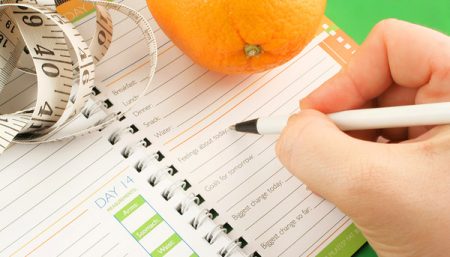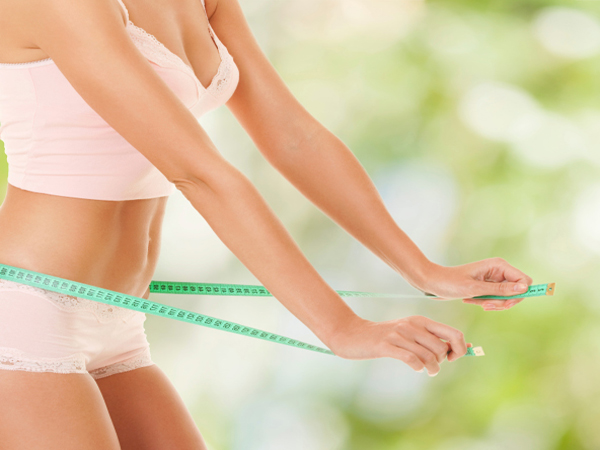
Why do many of us simply tend to eat and eat and eat. The answer to this uncontrolled munching lies in the fact that most of us are eating while distracted — when watching TV, talking with family or friends, or eating in the car. Another external factor influencing how much we eat is serving size: If a larger serving is in front of us, we tend to eat more no matter what.
Convenience and visibility of a food is another factor — if it’s easy to reach out and grab a food, we’ll be more likely to eat it. Even the way a room is lighted can cause us to eat more: Dim, soft lighting encourages us to prolong the eating experience and we eat more. Still other factors include stress, boredom or emotional reasons for eating. We do not rely on the internal cues, such as how hungry we are.
Yoga can go a long way in teaching asanas to control mindless munching by relating our body to hunger, cravings and eating behavior. Yoga will help you better associate with internal cues like “fullness”, instead of external cues like how much food is left on your plate. Listening to external cues leads to overeating.
Poses generally recommended include the Crab Pose, the Pigeon Pose, the Locust Pose, the Staff Pose, the Child’s pose, the Downward Dog pose, plow pose and the Full Wind Pose, among others. Grounding postures like the Goddess Pose, Mountain Pose, and the Standing and Prayer Squats are also used to increase strength and fortitude.
Balasana (Child Pose):
This relaxing pose can decompress your mind, letting you reflect on the emotion that’s driving you to eat.
- Sit on your knees with your feet together and buttocks resting on your heels. Separate your knees about the width of your hips. Place your hands on your thighs, palms down. (This is the vajra-asana or Thunderbolt Pose).
- Inhale deeply, then exhale as you bring your chest between your knees while swinging your arms forward.
- Rest your forehead on the floor, if possible, and then bring your arms around to your sides until the hands on resting on either side of your feet, palms up.
- Breath gently through your nostrils as you hold the posture. Hold for about one to two minutes. Then return to asana upright kneeling position with your back straight and your hands on your thighs.
Repeat the posture at least one more time.
Adho Mukha Svanasana (Downward Dog Pose)
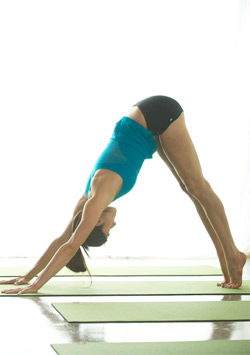 Downward-Facing Dog Pose (Adho Mukha Svanasana) can be healthy for you and may help you lose weight when included in your diet & exercise plan.
- Begin on your hands and knees. Your wrists should be underneath your shoulders, and your knees underneath your hips.
- Inhale as you tuck your toes under your heels. Then exhale to lift your hips, coming into an upside down “V” shape called Downward Facing Dog.
- Spread your fingers wide and create a straight line between your middle fingers and elbows. Work on straightening your legs and lowering your heels toward the ground. Your heels should be slightly wider than your toes, so the outside edges of your feet are parallel with the outside edges of your mat. Relax your head between your arms, and direct your gaze through your legs or up toward your belly button. Work on holding for five breaths.
Uttanasana (Standing forward Bend)
Simple standing forward bends can help calm your busy brain, halt craving and reduce stress.
- Stand in Tadasana, hands on hips. Exhale and bend forward from the hip joints, not from the waist. As you descend draw the front torso out of the groins and open the space between the pubis and top sternum. As in all the forward bends, the emphasis is on lengthening the front torso as you move more fully into the position.
- If possible, with your knees straight, bring your palms or finger tips to the floor slightly in front of or beside your feet, or bring your palms to the backs of your ankles. If this isn’t possible, cross your forearms and hold your elbows. Press the heels firmly into the floor and lift the sitting bones toward the ceiling. Turn the top thighs slightly inward.
- With each inhalation in the pose, lift and lengthen the front torso just slightly; with each exhalation release a little more fully into the forward bend. In this way the torso oscillates almost imperceptibly with the breath. Let your head hang from the root of the neck, which is deep in the upper back, between the shoulder blades.
- Uttanasana can be used as a resting position between the standing poses. Stay in the pose for 30 seconds to 1 minute.
- Don’t roll the spine to come up. Instead bring your hands back onto your hips and reaffirm the length of the front torso. Then press your tailbone down and into the pelvis and come up on an inhalation with a long front torso.
Pawanamuktasana (Wind Liberating Pose)
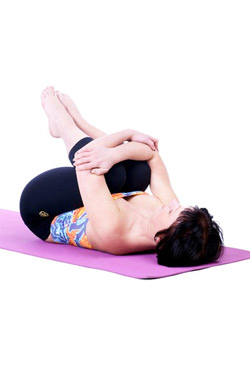 Lie down on your back and stretch both your legs. Now leaving the left leg stretched on the ground bend your right leg at the knee and bring the bent knee near the chest. Now inhale and press your bent leg on your chest with both hands, which should be interlocked for 90 this purpose.
- Keep the breath full in your belly and go on pressing the leg on it. Stay in this position for some time. Now start exhaling, lift your head and try to touch your bent knee with your nose. Inhale and bring your head back in the normal position; also take the leg down and exhale. Concentrate on Maniptir Chakra. Repeat this process with your right leg and then with both the legs.
Remember, eating is a multidimensional behaviour and there are a number of factors within our environment that promote over consumption. Its time you take control.
Related Links
- Top 10 Triggers for Over-eating
- Emotional Eating: Coming to Terms with the Vulnerable Truth
- Pigeon Pose: a Must to Avoid Tight Hips
Disclaimer
The Content is not intended to be a substitute for professional medical advice, diagnosis, or treatment. Always seek the advice of your physician or other qualified health provider with any questions you may have regarding a medical condition.