|
|

Asthma is a chronic
condition of the lungs that has two main components. Two things happen inside
the lungs of women suffering with Asthma�constriction, the tightening of the
muscles surrounding the airways, and inflammation, the swelling and irritation
of the airways. Constriction and inflammation cause narrowing of the airways, by
a combination of muscle spasm, mucosal swelling and bronchial secretion with
symptoms such as wheezing, coughing, chest tightness, or shortness of breath.
Furthermore, there is increasing evidence that, if left untreated, asthma can
cause long-term loss of lung function.
CLINICAL
FEATURES :
Asthma might be either episodic or chronic . In general atopic individuals tend
to develop episodic asthma and non-atopic individuals develop chronic asthma.
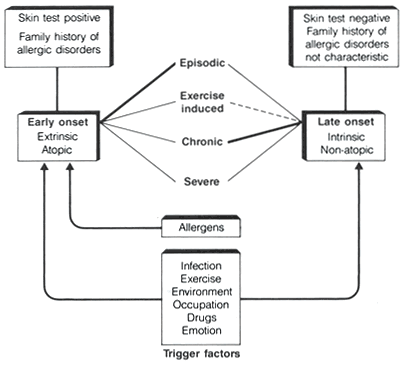
[ Types of Asthma ]
Episodic asthma: In
this type of disease the patient has no respiratory symptoms between episodes of
asthma . Episodes of asthma might be triggered by allergens, exercise and viral
infections such as common cold or may be apparently spontaneous . Attacks may be
mild to to severe and may last for hours ,days or even weeks . For example, some
people find that their asthma is worse in the spring when there is an increase
in flowering plants. Others find their asthma is worse in the late summer or
early fall when ragweed and leaves from trees are more likely to cause problems.
Exercise induced asthma, simply refers to the fact that some asthmatics
have primarily their asthma symptoms during exercise, and sometimes have no
other asthmatic symptoms. It refers to the fact that in these individuals, when
they exercise, most commonly in cold weather, they will begin to wheeze, become
short of breath, and when tested will have all the characteristics of asthma,
but often only during those circumstances. During the rest of their lives, they
may have no other asthmatic symptoms. Exercise, cold air, sudden changes
in air temperature, and even gastroesophageal reflux (heartburn) may be triggers
for people with non-allergic asthma.
Severe acute asthma:
This is a term used in place of "status asthmaticus" which is a
description for life threatening attacks of asthma .The patient usually adopts
an upright position fixing the shoulder girdle to assist the accessory muscles
of respiration . Their is often an incidence of an unproductive cough which
aggravates respiratory distress . The respiratory symptoms are accompanied by
tachycardia, pulsus paradoxus, sweating and in
severe cases central cyanosis.
Chronic asthma: with
symptoms of chest tightness ,wheeze and breathlessness on exertion ,together
with spontaneous cough and wheeze during the night ,may be chronic unless
controlled by appropriate therapy .Episodes of 'severe acute asthma' can occur
,and cough production of mucoid sputum with recurrent episodes of frank
respiratory infection is common in this type of asthma which in adult may
be difficult to distinguish from chronic bronchitis .
CAUSES
OF ASTHMA:
Asthma triggers are irritants in the environment that can provoke asthma
symptoms or attacks. There are many triggers that can aggravate asthma symptoms,
and they often differ from person to person. You can help prevent bothersome
asthma symptoms by identifying and avoiding your known triggers. In fact,
identifying and avoiding triggers should be part of a detailed plan of action to
successfully help manage your asthma.
It may not be possible to completely eliminate asthma triggers. You should still
try to remove as many as possible from your home and work surroundings. This can
help you enjoy a healthier life with fewer asthma symptoms and attacks.
-
Smoking
Do not allow tobacco smoke in the home or around you, especially in the
bedroom or a car. Do avoid smoke-filled areas.
-
Dust
Mites
Dust mites are tiny bugs you cannot see that live in cloth and carpet.
Encase your mattress and pillow in a special dust-proof cover.
Replace old pillows with new ones at least once every 5 years.
Wash the sheets and blankets on the bed each week in hot water. Water must
be hotter than 130� F (this kills dust mites).
During the day, keep dust off your bed by covering the entire bed with a
bedspread. At night, take off the bedspread and put it in another
room.
If you�ve done all these things and still have trouble with your asthma,
talk to your healthcare professional.
-
Pets
Some people are allergic to the flakes of skin (dander) or dried saliva that
come from animals with fur or feathers.
Find a new home for the pet or keep pets out of your home. This can be very
hard to do but might be the best way to control your asthma if you are
allergic to animals.
If you cannot keep pets out of your home, keep the pet out of your bedroom
and keep the bedroom door closed.
Consider placing filters on the air vents in your bedroom.
Remove carpets and furniture covered with cloth from your home. If this is
not possible, keep the pet out of the rooms where these are located.
-
Cockroaches
Many people with asthma are allergic to the dried droppings and remains of
cockroaches.
Keep all food out of your bedroom.
Keep food and garbage in closed containers (never leave food out).
Use baits or traps to eliminate cockroaches.
If a spray is used to kill roaches, stay out of the room until the odor goes
away.
-
Indoor
Mold
Fix leaky faucets, pipes, or other sources of water.
Clean mold off of surfaces with a cleaner that has bleach in it.
Replace or wash moldy shower curtains.
-
Smoke,
Strong odors, and Sprays
If possible, do not use a wood-burning stove, kerosene heater, or
fireplace.
Try to stay away from strong odors and sprays, such as perfume, talcum
powder, hair spray, and paints.
-
Pollen
or Outdoor Mold
During your allergy season, you should:
Try to keep your windows closed.
Stay indoors with the windows closed during the midday and afternoon, if you
can. Pollen and some mold spore counts are highest at that time.
Ask your healthcare professional whether you need to adjust your current
asthma treatment regimen before your allergy season starts.
-
Activity
If you have asthma, you can still be active. See your healthcare
professional if you have asthma symptoms when you are active�like when you
exercise, do sports, play, or work hard.
Ask your healthcare professional about taking medicine for your asthma
before you exercise to prevent symptoms.
Warm up for about 6 to 10 minutes before you exercise by stretching or
walking.
Try not to work or play hard outside when the air pollution or pollen levels
(if you are allergic to pollen) are high.
-
Colds
and Infections
If colds and infections trigger your asthma, talk with your healthcare
professional about developing a treatment plan to follow when you start
feeling sick. Also consider:
Getting a flu shot
Trying to stay healthy by getting plenty of rest, eating a balanced diet,
exercising regularly, drinking plenty of fluids, and avoiding contact with
others who have colds or the flu.
-
Weather
Cover your nose and mouth with a scarf on cold or windy days.
Avoid going outside on days when pollen or mold counts are high if you are
allergic to pollens or molds (check weather reports or the newspaper).
-
Genetics
Polymorphisms of the beta2-adrenoceptor genes appear to have an association
with adult-onset asthma in sedentary, but not in active women, according to
researchers at the Harvard Medical School in Boston and at other centers.Dr.
R Graham Barr and colleagues noted that a "sedentary lifestyle is
associated with adult-onset asthma." Furthermore, Glu27 polymorphism of
the beta2-adrenoceptor may predict body mass index (BMI). Gly16 polymorphism
is also associated with asthma severity. To read more regarding the report
at :
Genetically
Influenced Asthma Onset Greater in Sedentary Women
(Dec
13, 2001)
-
Other
Triggers
Sulfites in foods: For example, do not drink beer or wine, and do not eat
shrimp, dried fruit, or processed potatoes if they cause asthma
symptoms.
Other medicines: Tell your healthcare professional about all the medicines
you may take. Include aspirin, cold medicines, nonsteroidals (e.g.,
ibuprofen, naproxen), and even eye drops
SYMPTOMS
OF ASTHMA
What happens to you when your asthma is not under control? A whistling sound
that you make when you breathe? A tight grip around your chest? Most patients
with asthma have one or more of these classic symptoms:
-
Chest tightness: Feels
like a rope being tightened around your chest. During an attack the chest is
held near the position of full inspiration and the percussion note may be
hyper resonant.
-
Shortness of breath:
Feels like you're trying to breathe through a straw�or worse, like you
can't catch your breath at all. Breathing out is especially tough. The
airflow obstruction which characteristically fluctuates causes mismatch of
alveolar ventilation and perfusion and increases the work of breathing
.Being more marked during expiration it also causes air to be 'trapped' in
the lungs causing shortness of breathing .
-
Coughing: A cough or
hack that may not go away, and often occurs or is worse at night.
Death may occur from alveolar
hypoventilation and severe arterial hypoxaemia culminating in cardiac arrest .
Here are the 2 main things that happen deep within the airways of your lungs
when you have asthma symptoms that may lead to an attack:
-
Constriction: The
muscles around the airways in the lungs squeeze together or tighten. This
tightening is often called "bronchoconstriction," and it can make
it hard for you to breathe the air in or out of your lungs.
-
Inflammation: The
airways of the lung are often swollen and irritated if you have asthma, and
become more swollen and irritated when an attack begins. Your healthcare
professional may refer to this swelling and irritation as
"inflammation." Inflammation can reduce the amount of air that you
can take in or breathe out of your lungs.
The bottom line on asthma is this: it can be a quiet, sneaky condition that's
always with you. Your airways may be constricted and inflamed, whether you have
symptoms or not. That's why it's so important to treat asthma every day�even
when you're feeling fine�because there is increasing evidence that, if left
untreated, asthma can cause a long-term loss of lung function.
MANAGEMENT
& PREVENTION OF ASTHMA
-
Avoidance of Allergens:
There are a few instances in which a single agent can be identified as the
cause of attacks of asthma .These allergens include grass pollens, mites
animal dander , drugs industrial chemicals such as isocyanates , and certain
articles of diet . Prevent the exposure to these agents as far as possible .
-
Hyposensitisation:
This is the only specific measure available for the prevention of damaging
antigen-antibody reaction . It involves the subcutaneous injection of
initially very small ,but gradually increasing doses of extracts of
allergens believed to be responsible for the patient's asthma
.Hyposensitisation may be of some value when only a single allergen ,such as
grass pollen ,house dust mite or animal dander is implicated but it is not
without the risk of producing an acute anaphylactic reaction .
Hyposensitisation with a mixture of allergens is irritable and cannot be
recommended .
-
Drugs which control or
suppress clinical manifestation of asthma:
-
Sodium Cromoglycate:
Administered by inhalation . This has actions which include prevention of
mediator release from the mast cells . It seems to be of particular
value in children with atopic asthma and should be given a trial of at
least 4 weeks duration in all such patients .This drug has no place in the
management of severe asthma .
-
Nedocromil sodium:
This an anti-inflammatory drug with similar properties to those of sodium
cromoglycate and is administered by inhalation from a metered dose inhaler
in a dose of 4mg,2-4 times daily .
-
Ketotifen: Taken
by mouth ,it is claimed to have a similar mode of action ,but is less
effective than sodium cromoglycate or nedocromil sodium and has the serious
disadvantage in some patients of causing drowsiness which may be of
dangerous side effect in patients driving car or operating machinery .The
recommended dose is 1-2 mg twice daily with food .
-
Bronchodilators
and Corticosteroids: Bronchdilators have a direct and
immediate effect on airflow obstruction ,corticosteroids
relieve and prevent airflow obstruction indirectly by their
less rapid anti-inflammatory action .
Beta-adrenoreceptor agonist stimulate adenyl cyclase the enzyme which catalyses
the formation of cyclic adenosine 5'-phosphate (AMP) from adenosine triphosphate
(ATP). The effect caused is the relaxation of bronchial muscles ,but does not
last for long .Corticosteroids also do have a beneficial effect on bronchial
inflammation and decreases bronchial hyper-responsiveness .
In case of selective
beta-agonists such as salbutamol , terbutaline or fenoterol ,the inhalation of
aerosol has clear advantage over oral administration because it reduces airflow
obstruction more rapidly .Also because the effective dose is much lower it is
less liable to produce side effects such as tremor and anxiety .
VENTOLIN is a
fast-acting beta2-agonist that is used as a rescue medicine. It acts within
minutes to help relieve bronchospasm and its symptoms for up to 6 hours.
VENTOLIN is indicated for the prevention and relief of bronchospasm in patients
4 years of age and older with reversible obstructive airway disease and for the
prevention of exercise-induced bronchospasm in patients 4 years of age and
older.
See your healthcare professional to find out if VENTOLIN is right for you at. http://gsk.ibreathe.com/ventolin/
TREATMENT
OF :
-
EPISODIC ASTHMA: Mild
and infrequent episodes of asthma can be controlled by inhalation of
bronchodilator aerosol .When the episodes are more frequent treatment should
be supplemented by regular prophylactic therapy with a corticosteroid
by inhalation .
-
EXERCISE-INDUCED ASTHMA:
This common phenomenon which occurs particularly in children and young
adults can often be prevented by the inhalation of 2 metered dose salbutamol
or terbutaline a few minutes before exercise .In the long-run,
exercise has been shown to be good for asthma, but nevertheless, in the
short-run, the patients can have these severe attacks that are precipitated
by exercise. Regular treatment with sodium cromoglycate or an inhaled
corticosteroid may be necesarry if treatment with a beta-adreno-receptor
agonist is not wholly effective .
-
CHRONIC ASTHMA:
Some form of suppressive treatment is necesarry in all patients with chronic
asthma . Sodium cromoglycate is worth a trial in children ,but a better
response has been observed with inhalation of corticosteroid aerosol . Doses
might vary with the severity of the illness .Corticosteroid aerosols are
free from systemic unwanted effects in conventional doses ,but can cause
oropharyngeal candidiasis and a husky voice in few patients .
New
asthma treatment
Recent findings from two phase III clinical trials show that treatment with
Anti-IgE resulted in fewer asthma attacks and a decrease in the use of steroid
medications in children and adults ages 6-75. In most cases, those in the study
were able to completely stop taking the medications that had been an essential
part of their lives.
How Anti-IgE Works
"This is a completely new approach to therapy, one that may greatly improve
the treatment outlook for people with allergic asthma," says Henry Milgrom,
a pediatric asthma specialist at the National Jewish Medical and Research Center
in Denver, Colorado. "It is unlike anything that has been used
before."
When the allergic asthmatic encounters irritants like animal dander, molds, and
dust mites--called allergens--an immune system antibody known as immunoglobulin
or IgE binds to certain cells, and this causes allergy symptoms. These cells
(mast cells) are found in the lungs, skin, and mucous membranes. Then,
inflammatory agents (like histamine) are released.
When mast cells come in contact with an allergen, allergic symptoms
result--coughing, wheezing, nasal congestion, hives, and inflammation and
swelling of the airways. Anti-IgE works by binding to circulating IgE in the
blood. It prevents IgE from binding to mast cells and later blocks the release
of inflammatory agents.
Another benefit of Anti-IgE treatment is that it does not produce the serious
long-term side effects that other asthma drug treatments cause. "Oral
corticosteroids suppress the swelling and inflammation of the airways that are
responsible for asthma symptoms," Dr. Milgrom says. "These drugs have
side effects such as osteoporosis, high blood pressure, cataracts and, in
children, slowed growth. The ability to eliminate or reduce the need for this
medicine would be a very favorable development in the treatment of allergic
asthma.".
References :
| More news |
-
Asthma Taboo Among Blacks (March 24, 2004)
-
Saving Lungs (March 15,
2004)
-
Is
it Allergies?
(March 15,
2004)
-
Inhaled
Steroids Safe for Pregnant Women With Asthma, The drugs don't lead to low
birth weight babies, a new study says. (March
8,
2004)
-
Little-Known
Asthma Inducer (February 23,
2004)
-
Hormone
Replacement and Respiratory Disease (February 24,
2004)
-
Little-Known Asthma Inducer
(February 23,
2004)
-
Antioxidants Lower Risk of Asthma
(February 3,
2004)
-
Best way to Treat Asthma
(January 23,
2004)
-
High Birth Weight Associated
with Asthma
(January 13,
2004)
-
Different Types of Asthma
(January 12,
2004)
-
Benefits of Asthma Treatment
Outweigh Risks
(December 12,
2003)
-
Corticosteroids Safe for
Bones
(October 29, 2003)
-
Building Strength for Lung
Patients
(October 24, 2003)
-
Ozone�s Effect on Asthma
(October 08, 2003)
-
Asthma -- From Childhood to Adulthood
(October 09, 2003)
-
Nutrition and Asthma
(September 15, 2003)
-
Common Plant Triggers
Asthma
(August 11, 2003)
-
Special Bedding not Effective for Asthma Control
(July
16, 2003)
-
Diet Affects Asthma
(July
3, 2003)
-
Consequences of Undiagnosed Asthma
(July
2, 2003)
-
FDA Approves First Biologic for Allergy-Related Asthma
(June 20, 2003)
-
Ailing Homes
(June 2, 2003)
-
Study
of Asthma-Drug Halted
(January 23, 2003)
|
|