
Weak muscles are often at the root of backpain, especially lower back pain. The muscles of the back, the abdomen, and the buttocks all support the spine – these muscles are called the core muscles.
Muscles are the spine’s main defense against gravity. Strengthening the muscles that support the spine with exercises, can prevent, reduce and in some cases eliminate back pain.
Strong abdominal muscles (especially the deep abs) are as crucial as strong back muscles for supporting the lower back and preventing lower back pain. Strong quadriceps (front of thigh muscles) is important to prevent back injuries when lifting. Proper lifting techniques involve using your legs and if your legs are weak, you may end up using your back.
If you are suffering from an episode of acute back pain, start with the appropriate exercises as soon as you can move without too much pain – probably about a day after the attack began. Progress to the exercises in the middle column when the severe pain has subsided. The exercises in the third column are for stretching and strengthening, to help you to avoid back trouble.
| Condition | During acute attack | After severe pain | Prevention |
| Acute lumbar pain(caused by discsyndrome) |
|
|
|
| Acute wry neck (caused by disc or facet joint) |
|
|
|
| Acute pain in the leg |
|
|
|
| Lumbar instability |
|
|
|
| Facet joint disease |
|
|
|
| Strained muscles |
|
||
| Tense muscles |
|
||
| Trigger points |
|

Therapeutic exercises for lower backs
These may help acute pain in the lower back or sciatica. Always follow your physiotherapist’s or doctor’s advice about exercising your back. But if you have recurrent attacks and are familiar with the exercises, or if you feel that your attack is not sufficiently severe to warrant a consultation, then it may be worth trying any of the following exercises. Begin the exercises about a day after the pain first started, but stop at once if the pain increases or spreads away from your spine.
Pelvic tilt
This helps most types of acute lumbar pain by relieving pressure on the facet joints and gently stretching the muscles and ligaments of the back. It strengthens the abdominal muscles that indirectly support the spine. If practiced regularly, it encourages better posture. Do it on the floor at first, but later try it standing up. If it’s easier, support your legs on cushions in the fowler position.
- Lie on the floor with your arms at your sides, your feet flat on the floor and your legs bent at a comfortable angle.
- Gently press the small of your back against the floor and tilt your pubic bone upwards by tightening your abdominal and pelvic floor muscles. Hold for at least six seconds, then relax slowly. repeat up to ten times.

Passive extension
This helps many kinds of backache brought on by sitting. Don’t try it if it increases your pain. If bending backwards or staying upright is difficult because you are already stuck in a stooped position, lower yourself slowly until you are lying face down and relax for a few minutes before you start. Try the exercise two or three times initially.
- Lie face down with your hands flat on the floor and level with your shoulders as if you were about to do a press-up.
- Push up with your arms, leaving your hips on the floor. Lift your head and shoulders as high as you can. Let your back sag in. Breathe out, then slowly lower your trunk, using your arm muscles only. Repeat up to ten times.
Back-strengthening exercises
Chronic back pain can lead to weak back muscles. The traditional exercises for strengthening back muscles tend to raise pressure in the discs and facet joints of the lower back. They may aggravate the condition if started too intensively or too soon after an acute flare-up. Evidence suggests that dynamic strengthening of the extensors (muscles used to straighten up the back and limbs) and recruitment of the deep stabilizing muscles can help in preventing a relapse.
All 4’s raising one leg
Core stability comes from learning to use the deep abdominal muscle layer (transverse) to support the lumbar spine while moving the limbs. This exercise helps you to use your buttock muscles more independently.
- Get down on your hands and knees, with your legs together and your hands parallel and pointing forwards. Breathe out and suck in your lower abdomen until your spine is flat. Hold for ten seconds while continuing to breathe. Repeat ten times on the exhale.
- From the basic position, with your lower abdomen drawn in and your spine straight and flat, slowly raise one leg towards the horizontal. Hold for ten seconds. Don’t allow the spine to hollow or your pelvis to rotate up or down. Repeat five times on each side.
Alternate limb raise
This exercise is one of the many exercise which train the back, transverse and hip girdle muscles to work together to improve stability and posture.
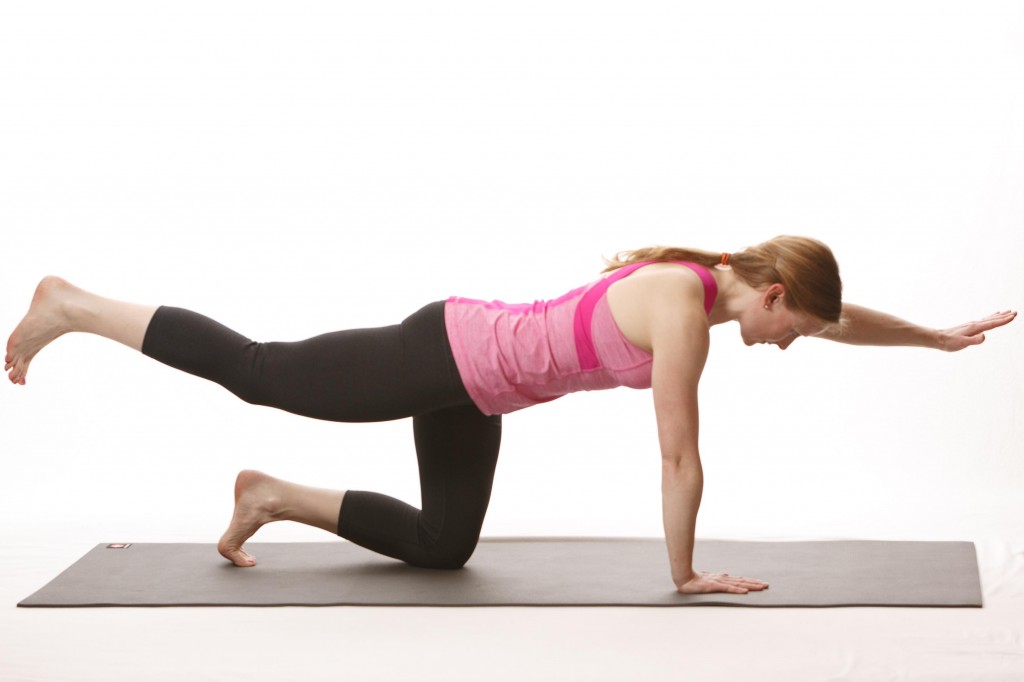
Hold the parallel
From step 2 of the all 4’s position, stretch out the opposite arm and leg parallel to the floor. Hold for ten seconds, then lower. Repeat with the other arm and leg. Repeat five times each side.
Horizontal raise
In this exercise, do not raise your legs orshoulders above the horizontal, since this would increase the stress on your facet joints.
- Lie face down on a pillow across a firm table, with someone holding your ankles to keep your legs in place.
- Raise your whole trunk until your body is horizontal. Do not pass beyond this point. Lower your trunk and relax. Repeat ten times in one session. Increase gradually over three months to 100 repetitions.
Both legs lift
Like the horizontal raise, this exercise is vigorous and makes a good contribution to the long-term prevention of lower back pain.
- Lie forwards over a firm table and hold on to the sides with both hands. Bend your knees so that the weight of your legs is held entirely by your back muscles.
- Extend your knees and raise your legs outwards to a horizontal position and then return. Repeat this ten times during the first session. Subsequently, increase the number of repetitions gradually to between 50 and 100 over a three-month period.
Every workout should consist of back strengthening exercises; however the truth is that most people never think about this problem until they are screaming out in pain from their chronic back pain. Our bodies are built to take care of us as long as we are willing to do what it takes to take care of them.
In addition to the exercises described above, research suggests that other low-impact exercise can be beneficial for maintaining a healthy, pain-free back. Good examples of such activities include: