|
|
Piercing of the Upper Ear: Risks Involved?
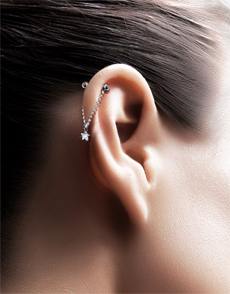 Piercings
can trigger consequences like allergic reactions, infection and
hepatitis, according to a new research review by Northwestern
University's Feinberg School of Medicine. Piercings
can trigger consequences like allergic reactions, infection and
hepatitis, according to a new research review by Northwestern
University's Feinberg School of Medicine.
From a medical standpoint, piercing of upper ear not a good thing.
Unlike the earlobe, the rim of the upper ear is composed mostly of
cartilage, which lacks a good blood supply. This makes it vulnerable
to bacterial infections. Most of these are minor and controllable
with antibiotics. But left untreated, they can lead to systemic
infections, possibly involving the lining and valves of the heart.
And, of course, there's always the risk that the nickel used in
inexpensive pierced earrings can cause an allergic reaction.
Healing may prolong up to a year because it involves not just skin,
but cartilage as well, which has decreased blood flow to the area.
|
Common
Complaints
According to an article in the Encyclopedia Britannica, some of the
risks that are involved with piercings are
-
Uncontrollable bleeding
-
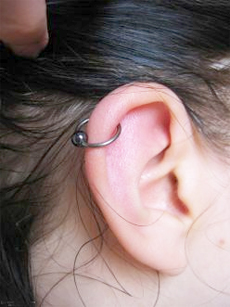 Scarring - If your piercing doesn't heal, it may leave an
ugly scar when you take it out. Scarring - If your piercing doesn't heal, it may leave an
ugly scar when you take it out.
-
Skin allergies to
the jewelry used
-
Boils that secrete pus.
Some more serious risks include
-
Hepatitis
-
Tetanus
-
-
Chronic infection, and
-
Nerve damage
When should people seek help?
If there is no sign of healing for 2-3 days, there is redness around the area,
pain, some kind of discharge.
Essential Notes before Opting for Piercing
-
Go to a reputable place. Ask for after-care instructions, oral and
written instructions that tell you how to care for your piercing but also
what signs to watch for. Among the 16 to 24 year-olds, complications,
including those that were serious enough to warrant hospitalization, were
more common if the piercing had been done by a non-specialist.
-
Talk to the piercer. Check his reference list. You should go to a real
piercer for a cartilage piercing. Don't even use the word "gun". The gun's
explosive force doesn't do the cartilage in your ears any favours, and the
blunt force of the earring is not fun.
-
Sanitation: In order to minimize the risk of infections, make sure the
shop you're getting it in is clean. This includes making sure the person
doing the piercing washes his or her hands with a germicidal soap and puts
on fresh disposable gloves. The person doing the piercing should also be
using a disposable or sterilized instrument.
-
Make sure that the piercing you want is an appropriate type for your
ear.
-
Choose the right jewelry: make sure you're not allergic to the type of
metal on the jewelry you choose to have in your piercing. It�s worth paying
the extra money for jewelry that�s nickel-free [a common allergy], to have
jewelry that�s the appropriate gauge, so you�re minimizing risk of it
tearing out or migrating.
-
During healing, you need to be very aware of your surroundings to reduce
exposure to bacteria. This includes avoiding swimming pools/lakes/bodies of
water, washing bedding and pillows often, and using the other ear to talk on
the phone.
The next time you get a piercing, keep everything in mind to avoid the mess. As
piercings becomes more common, it is important that people are aware of all of
the risks involved in getting piercings Should you get an infection contact a
doctor or your piercer!
Ref:
Dated 29 March 2013
Related Links
|
|
|
|
|





