

Skin cancer is the most common form of cancer worldwide, resulting from the uncontrolled growth of abnormal skin cells. It often develops due to excessive exposure to ultraviolet (UV) radiation from the sun or artificial sources like tanning beds. There are three main types of skin cancer: basal cell carcinoma, squamous cell carcinoma, and the more aggressive melanoma.
To help individuals recognize warning signs early, the American Academy of Dermatology (AAD) and the Skin Cancer Foundation promote the ABCDE rule—a simple but effective way to assess moles or skin lesions that could be cancerous.


Their recommendations are developed by experts, including board-certified dermatologists, and are based on current research and clinical experience.
Regular Self-Examination: A Priority
The AAD encourages regular self-examinations, ideally once a month, to familiarize yourself with your skin’s normal appearance and to detect any new or changing lesions.
Step-by-Step Skin Self-Exam
Examine your face
- Check nose, lips, mouth, and ears—front and back.
- Look closely at your eyelids and behind your ears.
Check your scalp
- Use a blow dryer and mirror, or ask someone to help.
- Part your hair in sections to check the entire scalp.
Look at your hands and arms
- Check palms, backs of hands, between fingers, and under fingernails.
- Look at wrists, forearms, and upper arms, front and back.
Focus on the torso
- Check your back
- Use a hand mirror to inspect your neck, shoulders, upper, and lower back.
Don’t forget the buttocks.
- Examine your lower body
- Sit down to check legs, front and back, and feet.
- Look between toes and under toenails.
- Check the genital area as well.
What to Look For: The ABCDE Rule

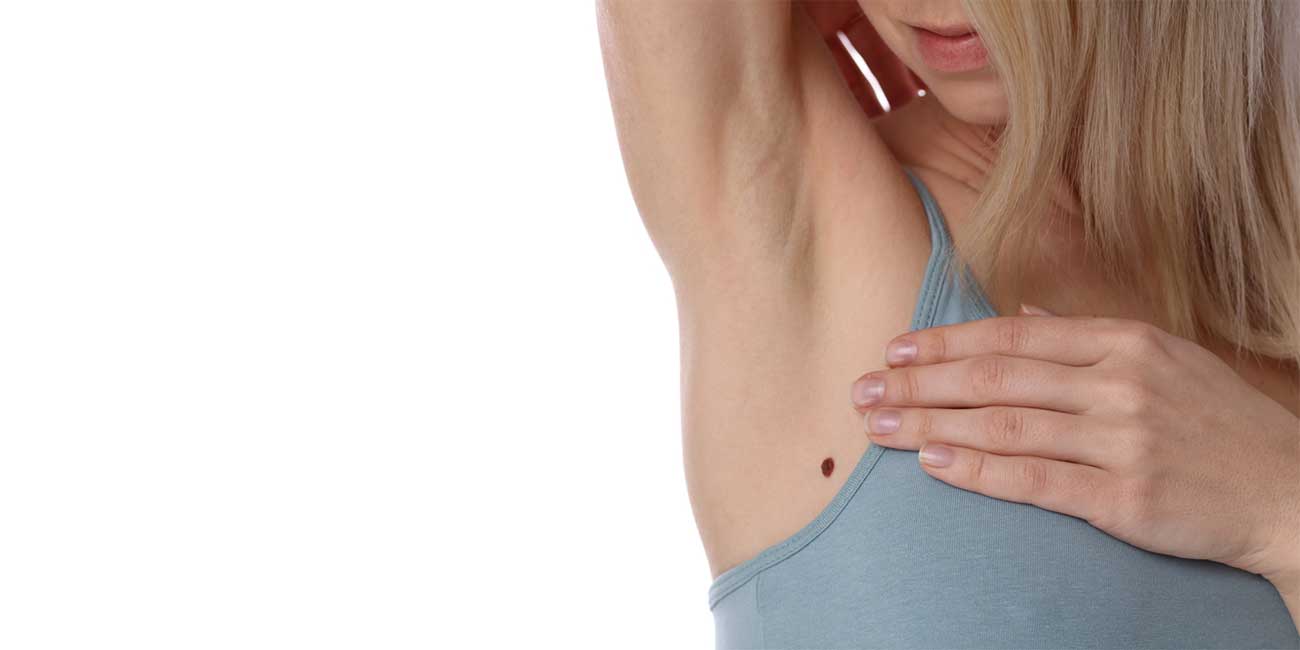
A – Asymmetry: One half of the mole or spot doesn’t match the other half in shape.
B – Border: Edges are irregular, ragged, notched, or blurred.
C – Color: The color is not uniform and may include shades of brown, black, pink, red, white, or blue.
D – Diameter: The spot is larger than 6 millimeters across (about the size of a pencil eraser), although melanomas can sometimes be smaller.
E – Evolving: The mole is changing in size, shape, color, or elevation, or new symptoms such as bleeding, itching, or crusting develop.
In addition to the ABCDE rule, the Foundation also highlights the “ugly duckling” sign, which refers to a mole that looks different from the rest. This strategy is based on the concept that most normal moles on your body resemble one another, while melanomas stand out like ugly ducklings in comparison.
Get in Touch with a Dermatologist
If you see something NEW, CHANGING or UNUSUAL, get checked by a dermatologist right away. It could be skin cancer. This includes:
- A growth that increases in size and appears pearly, transparent, tan, brown, black, or multicolored.
- A mole, birthmark, or brown spot that increases in size, thickness, changes color or texture, or is bigger than a pencil eraser.
- A spot or sore that continues to itch, hurt, crust, scab, or bleed.
- An open sore that does not heal within three weeks.
Regular self-examinations using these guidelines, combined with annual dermatologist visits, can significantly aid in the early detection of skin cancer.