|
Exercise
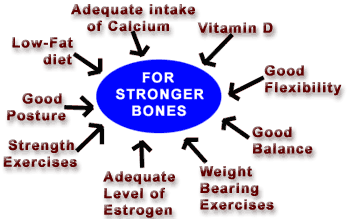
is an important component in the overall strategy for improving the health and
strength of your bones. The optimal exercise regime for preventing osteoporosis
has yet to be established, but these guidelines are based on our current state
of knowledge. We do know that exercise works best when you have adequate levels
of estrogen, calcium intake and vitamin D. The diet should be low in fat with
emphasis on cereals ,fruits and vegetables .
|
We
think of bones as solid, rocklike structures, instead they're living tissue that
is constantly changing. Peak bone mass usually occurs between age 20 and 30 and
then slowly declines. Bone loss accelerates during the first several years
following menopause. A Recent study indicated that a fat-laden diet could
lead not only to obesity and heart disease but to the thinning, fragile bones of
osteoporosis. The
foods we eat, the amount of physical activity we perform and various
environmental and genetic factors contribute to bone health. If you have been
diagnosed with osteoporosis , check with your physician before starting any
exercise program.
Effect
of good/bad Posture
How
we work, play, sit and move can determine the chronic stress placed on our
spine. Viewed from the side, the spine is shaped like an S-curve. It is ten
times stronger when these natural curves are maintained. Good posture and body
mechanics can alleviate/prevent back pain and protect your spine against
fracture.
Posture:
-
When
standing, an imaginary vertical line should connect your ear,
shoulder & hip.
-
Don't
lock your knees. Stand with feet straight ahead or slightly turned
out.
-
Pull
in your stomach muscles so as to prevent a sag.
-
Maintain
a normal (not flat or exaggerated) curve in your low back.
|
 |
Sitting:
-
Do
NOT sit or stay in the same position for prolonged periods of time.
-
Sit
in a firm, straight-back chair with your buttocks all the way back.
-
Use
a lumbar roll to maintain the natural curve in your low back.
-
Tuck
your chin in and pull your head straight back.
-
To
get out of a chair, slide forward without slouching and then stand up.
|
Moving
& Lifting:
-
Keep
an upright back.
-
Use
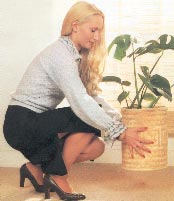
your legs instead of your back ,when you lift even the lightest object. Keep
a wide base of support. Squat down, keeping your chest upright.
-
Avoid
forward bending. If you must lean forward, bend where your legs meet your
trunk, NOT at your waist.
-
When
lifting, hold objects close to you. Keep the activity close to your body.
-
Avoid
twisting movements. Always point your feet in the direction you're moving.
-
It
requires lots of practice before new ways of performing daily tasks become a
habit. But the payoff is long-term back health. Observe how many times you
bend over and how many hours you're sitting during a typical day: ie.
cleaning the bathtub, picking up a child, reaching for your workout bag or
purse, gardening, commuting, watching t.v. or working on the
computer. Start
off with a few changes. Make a consistent effort to be aware of your
movements and protect the normal curves of your spine.
Flexibility
Much
of our day is spent sitting or bending ,thanks to advancement of science. This
can tighten some muscles and put a lot of stress on the spine. As part of an
overall program of stretching, develop good flexibility in your spine,
hamstrings (back thigh), hip flexors (front thigh) and pectoral (chest) muscles.
Avoid forward bending exercises to prevent extra stress on the bones and discs of the spine.
Stretch the muscles to a point of tension, not pain, and hold the stretch for
15-30 seconds at least 3 -5 times daily or as directed by your physical
therapist.
Strength
Training
Strength
training is probably one of the most important things you can do to build or
maintain strong bones. During exercise muscles are challenged, to pull on their bony
attachments stimulating bone formation. If you want to increase bone mass in a
particular bone, the exercise must recruit muscles that attach to that bone. It
has been observed that a certain strength training intensity stimulates bone
growth. You must challenge a muscle to fatigue after about 8-10 repetitions, 2-3
times/week. It's important to gradually increase resistance as your muscles
become stronger, instead of cruising through a workout that has become easy. Use
of free weights appears to stimulate bone growth in the hips (probably due to
weight-bearing). To increase bone density in the spine, utilize either free
weights or exercise machines. Have an exercise professional design a
well-balanced strength program for you involving major muscle groups,
particularly in the hips, wrists and spine (common osteoporosis fracture sites).
Learn proper exercises for the upper/lower back and abdominals to give you
strength for good posture.
Weight
Bearing Exercise
Each
time we step, jump, run or balance on part of our body, the impact causes
compressive force on the bone which in turn encourages
bone building. That's why it's important to participate in regular
weight-bearing exercise which is appropriate for your fitness level and current
bone health. For example: very fast walking, uphill walking, stair-stepping,
jump rope or jumping activities, high-impact aerobics, jogging, certain types of
dancing, soccer, tennis, squash and basketball can be good exercise choices for
bone-building. High impact forces and a variety of movement patterns cause a
stronger bone response. However, your strength, heart health and bone integrity
must be adequate for safe exercise. Your doctor or physical therapist can tell
you what's safe and effective for you.
Strength
training exercises done standing (or when balancing your weight on a leg or
hand) are also an important part of a weight-bearing exercise program.
Balance
Good
levels of strength and flexibility guarantee that you'll keep your balance more
easily. To help prevent falls, activities that require balance are also good to
practice. Many forms of dance can
promote good balance.
A
simple exercise: Practice standing on one foot for 30 seconds. Repeat with the
other leg. When you can do this easily, try it with your eyes closed or while
moving the "air leg" forward-and-back or out-and-in. There are all
kinds of balance games and activities you can do. Remember to progress gradually
and provide for something to grab if you need a balance check.
As
an adolescent or young woman, exercise can boost your bone mass. After the
mid-thirties, success means keeping the bone you have (or slowing the rate of
bone loss). Whatever your age, exercise is good medicine for your body and your
bones.
|