|
|
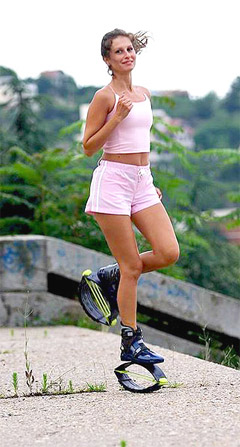
Thirty three health benefits of Jumping Shoes
 Rebounding
is an exercise that reduces your body fat; firms your arms, legs, thighs,
abdomen, and hips; increases your agility; strengthens your muscles overall;
provides an aerobic effect for your heart; rejuvenates your body when it's
tired, and generally puts you in a state of health and fitness. In fact, there
are at least thirty three health advantages of regular rebounding, including the
following: Rebounding
is an exercise that reduces your body fat; firms your arms, legs, thighs,
abdomen, and hips; increases your agility; strengthens your muscles overall;
provides an aerobic effect for your heart; rejuvenates your body when it's
tired, and generally puts you in a state of health and fitness. In fact, there
are at least thirty three health advantages of regular rebounding, including the
following:
-
It
provides an increased G-force (gravitational load), which strengthens the
musculoskeletal systems.
-
It protects the joints from the chronic fatigue delivered by exercising
on hard surfaces.
-
It helps manage body composition and improves muscle-to-fat ratio.
-
It increases capacity for respiration.
-
It circulates more oxygen to the tissues.
-
It establishes a better equilibrium between the oxygen required by the
tissues and the oxygen made available.
-
It aids lymphatic circulation by stimulating the millions of one-way
valves in the lymphatic system.
-
It tends to reduce the height to which the arterial pressures rise
during exertion.
-
It lessens the time during which blood pressure remains abnormal after
severe activity.
-
It assists in the rehabilitation of a heart problem.
-
It increases the functional activity of the red bone marrow in the
production of red blood cells.
-
It improves resting metabolic rate so that more calories are burned for
hours after exercise.
-
It causes muscles to perform work in moving fluids through the body to
lighten the heart's load.
-
It decreases the volume of blood pooling in the veins of the
cardiovascular system preventing chronic edema.
-
It encourages collateral circulation by increasing the capillary count
in the muscles and decreasing the distance between the capillaries and the
target cells.
-
It strengthens the heart and other muscles in the body so that they work
more efficiently.
-
It allows the resting heart to beat less often.
-
It lowers circulating cholesterol and triglyceride levels.
-
It lowers low-density lipoprotein (bad) and increases high-density
lipoprotein (good) within the blood holding off the incidence of coronary
artery disease.
-
 It promotes tissue repair. It promotes tissue repair.
-
It increases the mitochondria count within the muscle cells, essential
for endurance.
-
It adds to the alkaline reserve of the body, which may be of
significance in an emergency requiring prolonged effort.
-
It improves coordination between the propreoceptors in the joints, the
transmission of nerve impulses to and from the brain, transmission of nerve
impulses and responsiveness of the muscle fibers.
-
It improves the brain's responsiveness to the vestibular apparatus
within the inner ear, thus improving balance.
-
It offers relief from neck and back pains, headaches, and other pain
caused by lack of exercise.
-
It enhances digestion and elimination processes.
-
It allows for deeper and easier relaxation and sleep.
-
It results in better mental performance, with keener learning processes.
-
It curtails fatigue and menstrual discomfort for women.
-
It minimizes the number of colds, allergies, digestive disturbances, and
abdominal problems.
-
It tends to slow down atrophy in the aging process.
-
It is an effective modality by which the user gains a sense of control
and an improved self-image.
-
It is enjoyable!
Dated 27 January 2014
|
|
|
|
|





