| Exercises | Exercises | |
|---|---|---|
| Introduction | Walking on Treadmill | |
| Exercise Goals in Pregnancy | Jogging on Treadmill | |
| Walking | Outdoor/Stationary Cycling | |
| Jogging | Stair Stepping | |
| more.... |
Under the WF Cardiovascular
exercise section, you will learn about:
- Factors to consider before starting on a cardiovascular Program
- Exercise goals for women during pregnancy
- Instructions for seven of the most popular and effective cardiovascular exercises are provided.
- Each exercise description includes:
- A demonstration to view on your PC. Proper technique is to be the most important feature during exercise session .
The exercise instructions can also be viewed on your PC and/or printed out and taken to your health club. Detailed instructions, list of benefits, the proper apparel, and recommendations for the warm-up, cool-down, and muscles that should be stretched for each cardiovascular exercise.
|
Exercises |
|
|---|---|
| 1. Rowing | 2. Aerobic Classes |
| 3. Swimming | 4. Other Cardiovascular Exercises |
| 5. Fitness Benefits of Various Exercises |
6.
Exercises
vs. Calories Burned |
| 7. Jumping Rope |
8.
Running |
Introduction

Before starting on any of innumerable ways to burn out the body fat, there is a need to keep certain things in your mind and be cleared out by your doctor to go ahead on the road of achieving a better healthy you.
- You need to be clear about your fitness goals.
- Before you start any program have the necessary medical checks, take note of your resting pulse rate and warm-up.
- If you are not used to exercise be sure to start with the appropriate beginners' program.
- If you feel dizzy, or pain, stop at once.
- Always choose an activity that you enjoy, so that there is less chances of a dropout.
- If you are a beginner, do not start off too fast. You cannot get fit in a week, but you can get a long way towards it in a month.
- Work at your own pace. If you feel stiff the day after exercise, change activities or simply do some warm up exercises, so that your body gets time to recover.
- Exercise at a time of the day, that is most convenient, but preferably not until two or three hours after a meal.
- Never exercise if you feel ill or have cold or fever. Do not start training again until you are free of symptoms and keep your intensity low.
- Be sure you're clear about what you expect from exercise. That way you'll be sure to take to those activities that will nurture forward your goals.
- Lay out your exercise clothes the night before. They'll serve a silent reminders.
- Spend time with other people who exercise.
- As far as possible breathe through your nose not your mouth-research indicates that can reduce the amount of pollutants, including ozone, that reaches your lungs.
Exercise Goals in Pregnancy
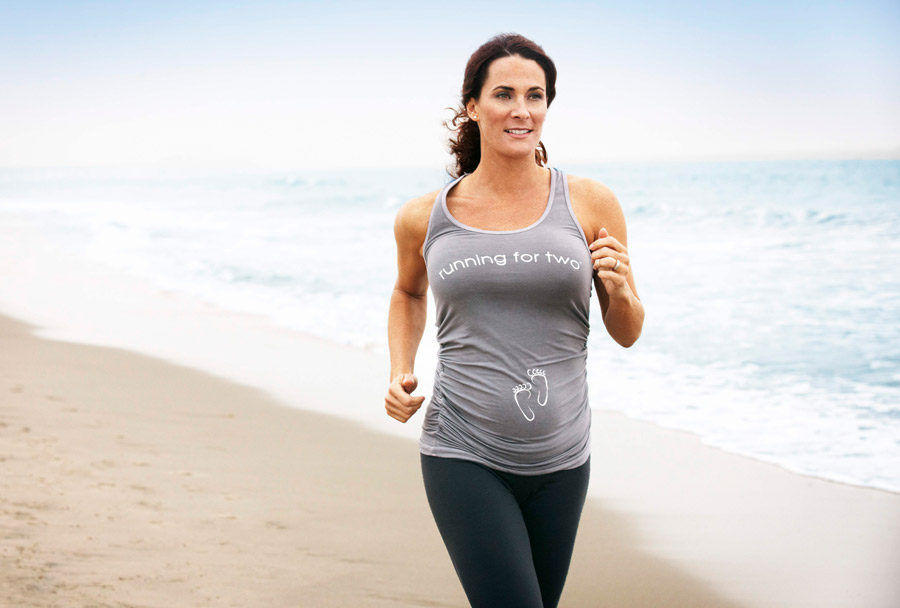
The goal, when exercising in pregnancy should be to do enough to produce a feeling of "well being" in the mother, but not so much so as to detract from normal l growth. Although this sounds simple, the exact amount of activity tolerated by each maternal-fetal couple, will vary tremendously.
Some general recommendations
- Don't plan to dramatically increase or improve your workout when you are pregnant, unless you are doing very little before pregnancy. Plan on cutting back, or at most, maintaining your typical activity if you are on an established exercise regimen.
- Replace lower extremity strenuous exercise with other activities whenever possible. Swimming and water exercises are a great substitute.
- Use you maternal pulse as a guideline of workout intensity. Plan on exercise routines that do not increase your pulse by more than 30% over your pregnant baseline pulse rate for extended periods of time. Pulse monitors are very handy for this.
- If experiencing pre-term contractions or vaginal bleeding stop immediately, and contact your physician. Pre-term contractions are generally concerning when they occur at frequencies of 4 per hour or greater. Less frequent contractions may still be a sign that you are overdoing it.
Looking out for High-Risk factors
There are many pregnancy complications that can dramatically effect
the wisdom of certain activities during your pregnancy. Consult a
physician before proceeding with any exertion if any of the
following are present:
- Vaginal bleeding
- Pre-term contractions
- Multiple gestations
- History of multiple pregnancy losses
- History of incompetent cervix placement
- History of small for gestational age babies
- Hypertension
- Diabetes
- Renal Disease, Pulmonary Disease, Heart Disease, or any major medical problem.
Of course, if you are unsure about the safety of any planned activities, always consult a physician for your own specific recommendations. Remember, every pregnant woman is different, and every pregnancy is different!