|
|
Exergaming: Fusion of Exercise and Gaming
 Fitness
game, Exergaming or exer-gaming (a portmanteau of "exercise" and "gaming") is a
term used for video games that are also a form of exercise. Exergaming relies on
technology that tracks body movement or reaction. The genre has been credited
with upending the stereotype of gaming as a sedentary activity, and promoting an
active lifestyle. However, research indicates that exergames do not actually
promote a more active lifestyle. Exergames are seen as evolving from technology
changes aimed at making video games more fun. Fitness
game, Exergaming or exer-gaming (a portmanteau of "exercise" and "gaming") is a
term used for video games that are also a form of exercise. Exergaming relies on
technology that tracks body movement or reaction. The genre has been credited
with upending the stereotype of gaming as a sedentary activity, and promoting an
active lifestyle. However, research indicates that exergames do not actually
promote a more active lifestyle. Exergames are seen as evolving from technology
changes aimed at making video games more fun.
The genre's roots can be found in games released in the late eighties, including
the Foot Craz, which was the first such device, released for the Atari 2600 in
1987, and the Power Pad (or Family Trainer), released for the Nintendo
Entertainment System (NES) in 1988, although both had limited success. Konami's
Dance Dance Revolution was cited as one of the first major successes of
exergaming; when it was ported from the arcade to PlayStation, it sold over
three million copies. In the 2000s, a number of devices and games have used the
exergame style to much success: the EyeToy camera has sold over ten million
units, while Nintendo's Wii Fit has sold in excess of 21 million copies.
By June 2009, health games were generating revenues of $2 billion, largely due
to Wii Fit's 18.22 million sales at the time. The term exergaming entered the
Collins English Dictionary in 2007. The genre has been mooted as a way to
improve users' health through exercise, but few studies have been undertaken to
measure the health benefits. Smaller trials have yielded mixed results and have
shown that the respective traditional methods of exercise are superior to their
video game equivalents.
Exergaming contains elements that were developed in the virtual reality
community during the 1980s. The pioneer in this area was Autodesk, which
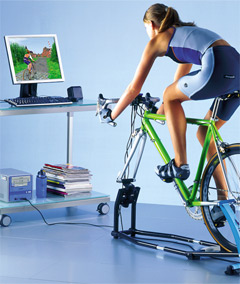
developed two systems, the HighCycle and Virtual Racquetball. The HighCycle was
an exercise bike that a user would pedal through a virtual landscape. If the
user pedaled fast enough, the virtual bike would take off and fly over the
landscape. Virtual Racquetball tracked the position and orientation of an actual
racquet that was used to hit a virtual ball in a virtual environment. This
environment was shared with another user equipped with another tracked racquet,
allowing the two users to play each other over phone lines. In both systems, the
users could wear the VPL eyephones, an early Head-mounted display (HMD), that
would provide more immersion for the user.
The first true attempt at what would later be called Exertainment was the Atari
Puffer project (1982). This was an exercise bike that would hook up to an Atari
400/800 or 5200 system. Forward speed was controlled by pedaling while steering
and additional gameplay was handled by a handlebar-mounted Gamepad. The machine
was nearly ready for production with several games (Tumbleweeds and Jungle River
Cruise) when Atari declared bankruptcy and the Puffer project was abandoned.
Nintendo also dabbled in this space with the Power Pad in the late 1980s.
The first exergaming system released to the market was the 1986 Computrainer.
Designed as a training aid and motivational tool, the Computrainer allowed users
to ride through a virtual landscape generated on a Nintendo NES, while
monitoring data such as power output and pedaling cadence. The product had a
price that was far too high to be considered as an entertainment product, but
was affordable by dedicated athletes. The product continues to this day, where
it now runs using Microsoft Windows compatible software with extensive graphic
and physiological capabilities.
Also released for the NES in 1986 was the Family Trainer, which focused on
entertainment rather than exercise. About the same time as the Computrainer,
Concept II introduced a computer attachment for their rowing machine. This has
become their eRow product and is used for both individual motivation as well as
competition in "indoor rowing leagues"
During the 1990s, there was a surge of interest in the application of "virtual
reality" technologies to high-end gym equipment. Life Fitness and Nintendo
partnered to produce the Exertainment System; Precor had an LCD-based bike
product, and Universal had several CRT-based systems. The Netpulse system
provided users with the ability to browse the web while exercising. Fitlinxx
introduced a system that used sensors attached to weight machines in order to
provide automated feedback to users.
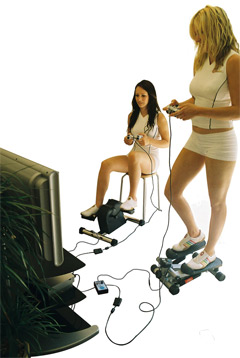 The
most sophisticated of these entries was the Tectrix VR Bike. Developed
originally by CyberGear Inc., The VR Bike allowed users to pedal through a
number of virtual environments as well as engage in single and multiplayer
games. It was joined later by the VR Climber. The VR Bike software is now
distributed alongside Trixter bikes. Three issues combined to ensure the failure
of these systems in the marketplace. First, they were significantly more
expensive than the equivalent models that did not have all the additional
electronics. Second, they were harder to maintain, and were often left broken.
Lastly the additional expertise required to operate the software was often
intimidating to the users, who shied away from the machines out of fear that
they would look foolish while trying to master the machine. The
most sophisticated of these entries was the Tectrix VR Bike. Developed
originally by CyberGear Inc., The VR Bike allowed users to pedal through a
number of virtual environments as well as engage in single and multiplayer
games. It was joined later by the VR Climber. The VR Bike software is now
distributed alongside Trixter bikes. Three issues combined to ensure the failure
of these systems in the marketplace. First, they were significantly more
expensive than the equivalent models that did not have all the additional
electronics. Second, they were harder to maintain, and were often left broken.
Lastly the additional expertise required to operate the software was often
intimidating to the users, who shied away from the machines out of fear that
they would look foolish while trying to master the machine.
Until 1998, nothing significant happened in the field of videogame exercise.
Hardware was still too expensive for the average home consumer, and the health
clubs were gun-shy about adopting any new technology. As high-performance game
console capabilities improved and prices fell, manufacturers once more started
to explore the fitness market.
In 1998, Konami's Dance Dance Revolution was released. It was highly
effective�exercise-wise�and very cost effective and so brought exergaming into
the mainstream.
In 2000, UK startup Exertris introduced an interactive gaming bike to the
commercial fitness market. Exergaming came to the mass media attention at the
Consumer Electronics Show when Bill Gates showcased the Exertris Interactive
Gaming Bike in 2003, and the following year the same show hosted a pavilion
dedicated to video game technology that also worked as sports and exercise
equipment.
The 2005 release of the EyeToy: Kinetic, brought the first�multi-function�exergame
hardware into the home market. Making the players physical movements into the
game's controller. 2006 Saw the launch of Gamercize, combining traditional
fitness equipment with games consoles. The minimalist approach allows game play
to continue only when exercising, turning all game titles into potential
exergames.
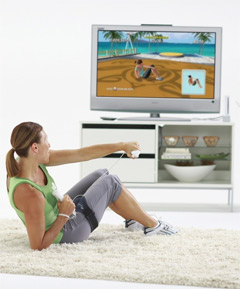
Nintendo's Wii in 2006 brought acceleration detection with the Wii Remote. In
late 2007, Nintendo released the exergame Wii Fit, which utilized a new
peripheral, the Wii Balance Board. Various approaches to exergames have been
documented and compared by VideoJug in an information film.
The PCGamerBike appeared at CES in 2007 where it received an Honoree Award. It
differs from other exergaming devices in that its pedal motion can be mapped to
any key on the keyboard. It also has an optical encoder which detects forward
and reverse pedal motion. The Fisher-Price Smart Cycle was another entry in the
field.
Other examples of exergaming products include: Cobalt Flux Blufit, Cyber coach,
NeoRacer, Gymkids exercise equipment with interactive technology, some Wii
titles such as EA Sports Active, Cybex TRAZER, Powergrid Fitness Kilowatt,
Lightspace Play Floor, PlayMotion, Yourself!Fitness, Expresso Fitness S2, i.play,
Cyber ExerCycle, VEQTOR Sport Trainer and Sportwall.
The effectiveness of maintaining interest in exercise using traditional fitness
machines has been examined with Gamercize and found to be six times more
sustainable than exercise alone. While the Wii has been seen as being more
physically demanding than sedentary game consoles, a study published in the
British Medical Journal found that while playing the Wii uses significantly more
energy than playing sedentary computer games, the energy used when playing
active Wii games is not of high enough intensity to contribute towards the
recommended daily amount of exercise in children.
Benefits of exercise on mental ability and productivity are in the early stages
of research, but indications from using Gamercize with a computer have been
reported as providing a 17% productivity improvement. Combining cardiovascular
exercise and balance practice has been shown to increase academic success among
students in grades K-12. According to the 2009 Active Healthy Kids Canada Report
Card on PhysicalActivity for Children and Youth, children who are physically
active perform better in school than those who are not. Interestingly, academic
performance improves even when academic learning time is reduced to allow time
for physical activity.
Based on a systematic review on active video games for youth, none of the games
elicited an average energy expenditure above 6 MET threshold for vigrous energy
expenditure.
Electronic Arts commissioned a 2010 study by the University of Wisconsin which
found that EA Sports Active passed fitness guidelines for an "effective workout"
put forth by the American College of Sports Medicine.
 One
primary goal of exergaming is to get children "off the couch" and more active.
Accordingly, children in laboratory studies briefly increased their levels of
physical fitness as a result of exergaming. However, a study children in actual
homes over an extended period did not show lasting changes to their exercise
habits. The study revealed �no evidence that children receiving the active video
games were more active in general, or at any time, than children receiving the
inactive video games.� Exercise physiologist Anthony Barnett suggests the
results of the study are predictable. One
primary goal of exergaming is to get children "off the couch" and more active.
Accordingly, children in laboratory studies briefly increased their levels of
physical fitness as a result of exergaming. However, a study children in actual
homes over an extended period did not show lasting changes to their exercise
habits. The study revealed �no evidence that children receiving the active video
games were more active in general, or at any time, than children receiving the
inactive video games.� Exercise physiologist Anthony Barnett suggests the
results of the study are predictable.
He says that children compensate for the increased activity of exergaming by
reducing their exercise in other parts of their lives, resulting in no net gain.
When designing interventions that incorporate exergaming, guidelines on
frequency and duration of usage should be given to participants.
In order to better understand exergaming�s relationship with physical activity,
laboratory studies have compared exergames to both traditional seated video
games and other physical activities, for example, treadmill walking. Consistent
evidence demonstrates exergaming requires more energy and has the potential to
raise heart rate in comparison to traditional seated video games and rest.
Overall, most exergames are equivalent to light-to-moderate activity for both
adults and children.
Energy expenditure during exergames differs only slightly from other traditional
light-to-moderate intensity physical activities. Most exergames elicit energy
expenditures between light and moderate intensities, although in some studies a
�sizeable percentage� of players have performed at vigorous activity levels.
Exergames which only require upper body movement typically result in energy
expenditures equivalent to light physical activity, while lower and whole body
movement games provide activity of at least a moderate intensity.
Exergames increase heart rate compared to resting. Those which require
whole/lower body movement produce a greater increase in heart rate than those
which use only upper body movements. Different games requiring similar movements
for game play do not necessarily have the same impact on heart rate. For
example, games played on dance mats have increased heart rates to levels similar
to those of moderate and even vigorous intensities; whereas games played using a
balance board have produced heart rates less than that of a brisk walking pace,
although both require lower body movement. It has been argued that heart rate is
not a good proxy for energy expenditure for exergames as several studies have
shown heart rate to increase for sedentary video games.
Few exergaming studies have examined actual changes in body composition over
time. Instead, estimates have been made based on laboratory game play. For
example, it has been suggested that if exergaming were to take place at a
similar intensity outside the laboratory, children would have the potential to
lose 2.5 kg-6 kg over the course of a year with only 15�30 minutes of game play
per day. One randomised controlled trial (RCT) demonstrated exergames, when used
as a substitute for traditional video games or other time spent inactive, result
in smaller increases in BMI over six months compared with continued traditional
game play in 10- to 14-year-olds. The exergame group also had a larger decrease
in body fat compared with the control group.
Children and young people report enjoying Wii Fit activities more than inactive
games and treadmill exercise.The evidence in adults is less abundant than in
children. Studies tend to have only a small number of participants, which makes
it difficult to generalise the findings to the whole population.
Exergaming provides a form of light-to-moderate physical activity for adults.
Wii Boxing has been shown to produce similar energy expenditure to a
self-selected brisk walking pace, while Wii Aerobics results in lower energy
expenditure. In general, exergames have less of an effect on energy expenditure
than playing the actual sport. Energy expenditure does not increase by adding
active elements to traditional games. For example, adding specialist motion
sensing controllers to play shooting games was no more effective in increasing
energy expenditure than using traditional hand held controllers.
Exergamers experience a greater increase in heart rate after 30 minutes of Wii
Fit�s Free Run than treadmill walking (at 3.5 mph), while Wii Boxing produces a
heart rate similar to that of a self-selected brisk walking pace. In contrast,
self-selected brisk treadmill walking results in a higher heart rate than what
is obtained by participating in Wii Aerobics, Tennis or Baseball.
Research shows changes to psychological wellbeing from taking part in exergaming
are mixed. In older women, positive changes to self-perception and social and
psychological wellbeing have been noted after six weeks of game play.
Alternatively, measurements of wellbeing decreased after a single session of Wii
Fit Free Run compared with treadmill walking in young adults. These young adults
did however perceive playing Wii Fit to be more intense than treadmill walking.
Both younger and older adults rate exergaming as more enjoyable than inactive
gaming and treadmill walking.
In healthy older adults there is some evidence that dance exergames can improve
mental health (e.g. Dance! Don't Fall), improve measures of physical
performance, e.g., the narrow walk time test and self-reported balance
confidence. Additionally, anecdotal evidence suggests the Nintendo Wii can be
used as part of a falls rehabilitation programme. Studies have demonstrated
increases in dynamic balance, a reduction in Timed Up and Go scores, which
measures mobility, and improvements in static balance after Wii usage. However
most of these studies tend to be case studies. More robust evidence is needed to
warrant the inclusion of exergaming in falls prevention programmes.
Upper extremity dysfunction results from a variety of different diseases and
disorders. The degree of dysfunction ranges from the subject�s self-reported
pain, weakness, and impairment of the shoulder, elbow, wrist, and hand, to
larger symptoms such as debilitating post- stroke. Multiple studies have chosen
to incorporate the Wii into both movement therapy and exercise regimens for
patients displaying these symptoms, in order to test whether the use of Wii�s
motion controller will benefit these patients. A study done by Hsu et al.
examined the effect of Wii bowling on shoulder motion range. Elderly long-term
care patients with upper extremity debilities supplemented their standard
exercise regimen by playing Wii Sports bowling with the affected arm for 20
minutes at least twice a week, for one month. This resulted in an overall
improvement of patients� active range of shoulder motion, as well as better
scores in the modified PACES (Physical Activity Enjoyment Scale) and the NHPPT
(Nursing Home Physical Performance Test). Research has also shown a positive
effect from Wii Sports movement therapy for stroke patients. Stroke patients
with upper limb dysfunction underwent movement therapy consisting of monitored,
intense Wii Sports gaming for two weeks. These patients displayed improved
functional use of their dominantly affected arm and hand, along with an increase
in joint range of motion. Furthermore, significant clinical improvement on test
metrics such as the WMFT (Wolf Motor Function Test) and MAL-QOM (Motor Activity
Log Quality of Movement) suggests that the skills gained from Wii-based movement
therapy are transferable to daily-living activities.
Individuals with disabilities often have fewer opportunities to be physically
active and therefore higher levels of obesity. Existing exercise games are often
not accessible to individuals who are blind. Accessible Exergames have been
research with the goal to provide this vulnerable population with new
opportunities to exercise. The ViFit research project has explored a number of
novel audio/tactile interfaces to make a number of Wii like games accessible to
blind players.
 When
making an exergaming system, the manufacturer of a consumer product must make
the decision as to whether the system will be usable with off-the-shelf games or
if custom software must be written for it. Because it takes longer for a user to
move their entire body in response to stimulation from the game, it is often the
case that dedicated software must be written for the game to playable. An
example of this is Konami's Dance Dance Revolution. Though designed to be played
by users moving about on a specially designed dancepad, that game can
alternatively be played by pushing buttons with one's fingers using a standard
hand-held gamepad. When played with the dancepad at higher levels the game can
be quite challenging (and physically exhausting), but if the game is played
using the buttons on the hand controller, none of the sequences are physically
limited. When
making an exergaming system, the manufacturer of a consumer product must make
the decision as to whether the system will be usable with off-the-shelf games or
if custom software must be written for it. Because it takes longer for a user to
move their entire body in response to stimulation from the game, it is often the
case that dedicated software must be written for the game to playable. An
example of this is Konami's Dance Dance Revolution. Though designed to be played
by users moving about on a specially designed dancepad, that game can
alternatively be played by pushing buttons with one's fingers using a standard
hand-held gamepad. When played with the dancepad at higher levels the game can
be quite challenging (and physically exhausting), but if the game is played
using the buttons on the hand controller, none of the sequences are physically
limited.
Newer systems such as Xbox 360, PlayStation 3 and Wii use alternative input
devices such as the Kinect and PlayStation Move. The Move uses image analysis to
extract the motion of the user against a background and uses these motions to
control the character in the game. A specifically designed exercise game
Kinetic, superimposes animated objects to be punched, kicked, or otherwise
interacted with over a video image of the user. The Wii and PlayStation 3 both
incorporate motion sensors such as accelerometers and gyroscopes into the
hand-held controllers that are used to direct behaviors within the game.
Research projects such as Exertion Interfaces that investigate the design
aspects of these games explore how the technological augmentation that comes
with the digital gameplay component can be nurtured for additional benefits,
such as utilizing the social power of exercising together even though players
are connected only over a network or scaling the amount of players, enabling
novel exercise experiences not available without the technological augmentation.
Exergame resellers have developed fitness centers and specialist room designs
with programmes that focus entirely on creating environments for young people
using exergaming for fitness. Exergaming can be found as part of larger fitness
facilities or dedicated gyms.
Exergaming: Main Players
Kinect for Xbox 360: With multi- and single-player games that include
boxing, volleyball, kung fu, track and field, soccer, and more, the Kinect is
hands-free, using a sensor in the game console to track movement, then translate
it into game play.
PlaystationMove: Employing a camera and a motion controller remote, this
gaming console offers exercise game titles for single and multi-player play,
including beach volleyball, disc golf, archery, dance, table tennis, kickboxing,
and more.
Nintendo Wii Fit: Featuring multi- and single-player games, including
skateboarding, hula, kung fu, skiing, dance games, and more, the Wii Fit uses a
balance board and remote, both of which translate real life movement into game
play.
Smart Phones: Exergames for smart phones like the Android and iPhone are
still in their infancy, but Ernie Medina Jr., DrPH, a preventive care specialist
in California and self-described "exergame evangelist" sees a definite trend.
"Instead of being stuck inside with a TV and a console, these games get you
playing outdoors."
Video
Dated 01 February 2014
|
|
|
|
|





