- Introduction
- Strength Training For Older Women
- Benefits Of Strength Training
- Strength Training For Adolescent Women
- Strength Training for Pregnant Women
- Strength Training for Postpartum Woman
- Weight Lifting Terms
- Making Time
- Staying Motivated
- Set Goals
- Make It Fun
- Measuring Progress
- Factors Affecting Strength
- Strength Training Discontinuation
- Safety Precautions
- Pain Soreness
- Differences Among Types of Strength Equipment
- Principles and Guidelines
- What to Expect from Weight Training
- Make Strength Training a way of Life
- Buyer's Equipment Guide
- Take Action
- Click Here to Read Related Articles
The strength training content is your on-line "how to" manual. Everything you need to know about strength training and exactly how to achieve the results you desire, is taught in this manual.
The strength training content
is 37 page long and can be viewed on your computer or printed out. All
the examples in this content are linked to demonstrations that will
enhance your understanding.
Below is a list of all the very
important topics we'll discuss throughout the strength training content.
Members receive full access to the strength training content (and all of
the WF website). In addition, sample topics are provided FREE for
non-members. Please refer to the chart below.
In the strength
training component, you will find information on:
- The benefits of strength training
- Strength training for older women
- Strength training for Adolescent women
- Strength training for Pregnant women
- Strength Training for Postpartum women
- Weight - lifting Terms
- Ways to stay motivated
- Your body type and what results you can expect
- The importance of concentrating during your workout
- The best ways to measure progress
- How to best combine cardiovascular exercise, flexibility training, and good nutrition into your strength training program
- The factors that affect strength
- What to expect if you discontinue your strength-training program
- The disadvantages and dangers of steroids
- Safety precautions and basic gym safety
- Pain, soreness and injury
- Differences among types of strength-training equipment
-
Principles and
guidelines for :
- Warming up, cooling down, and stretching
- The importance of blood supply to your muscles and common mistakes that hinder the process
- How to select the best exercises for a safe and effective program
- The proper lifting speed for maximum effectiveness
- The importance of proper form/technique and how to achieve it
- How to be sure you're exercising through the full range of motion
- The best exercise sequence for maximum effectiveness
- How to calculate the number of sets and repetitions and the amount of weight you should use to reach your goals
- The importance of progressive resistance
- How to avoid over-training
- How to develop a program that is right for you
- How to overcome plateaus through intermediate training techniques that alleviate boredom and produce new results
- Advanced (intense) training techniques that overcome plateaus, prevent boredom, and produce new results.
Introduction

Women pursue fitness for a myriad of reasons. According to WF, true
physical fitness encompasses a three-tiered equation, including strength
development,
cardiovascular training
and
flexibility. An integral part of the fitness equation is strength training.
Women are becoming increasingly aware of the fact that lifting weights provides
them with a sleek, toned look instead of the muscle-bound physic of a body
builder. Women, by nature, do not develop large muscles. This is because we do
not produce enough male hormone, testosterone, to develop that type of
musculature.
Weight bearing exercise builds sturdier bones. This is of particular
importance to women who may be prone to
osteoporosis due to decreasing estrogen levels during menopause or a genetic
predisposition.
Similarly maintaining a healthy diet and exercise program during
pregnancy can help a woman also maintain her self-esteem. Regaining muscle
tone and losing weight after childbirth is also easier for those women who
stayed active throughout their pregnancy. Unless a woman is experiencing
complications with the progression of her pregnancy it is perfectly safe for her
to continue an exercise program, with some adjustments like avoiding sports
where she can easily fall. Pregnant women should not work out as hard as they
might have before pregnancy.
Historically, gyms were the domains of men and the old bench and dumbbells in the garage only took up space where the car should be parked. But with increasing awareness, women have come to realize that strength training is an essential component of life long fitness-mind and body.
Benefits of Strength Trainingng
Strength training is exercise that uses resistance for example, weights, to
strengthen and condition the muscle-skeletal system, improving muscle tone and
endurance. WF uses 'strength-training' as a general term synonymous with
other common terms: "weightlifting" and "resistance training"
as a general term synonymous with other common terms:
"weightlifting" and "resistance training". Physiologically the benefits of
consistent strength training include an increase in muscle size and tone,
increased muscle strength, and increases in tendon, bone, and ligament strength.
Strength training has also been shown to improve psychological health as well,
by increasing self-esteem, confidence and self-worth.
These improvements have a great influence on our physical performance, metabolic efficiency, physical appearance and risk of injury. We will go into each of these in detail, outlining some very exciting benefits of a good strength-training program that most people overlook or don't realize.
Improved Physical Performance and Appearance

One important result of strength training is increased physical
performance. Muscles quite literally utilize energy to produce movement,
functioning as the engine or powerhouse of the body. Strength training increases
the muscle size, strength, and endurance, resulting in improved physical
performance in accomplishing a specific task. Stronger muscles enable us to lift
or move something that is heavy, which is considered muscle strength, and to
lift or move something that is light more times, which is called muscle
endurance. Increases in both muscle strength and muscle endurance contribute to
improvements in our work, our favorite sports and hobbies, and our general
day-to-day activities.
Many studies have shown that strength-training beginners gain about three
to five pounds of muscle and 25-45 percent more strength and endurance after
10-12 weeks of consistent weightlifting. This is wonderful news for anyone
considering a strength-training program. Implement the
principles and guidelines
presented in this component and train consistently with the program designed
specifically for you and you will achieve outstanding results.
Another benefit of a good strength-training program is its effect on our
overall appearance and body composition, which can directly influence
self-esteem, self-worth, and level of confidence.
Both our physical appearance and our physical performance can be improved
by muscle gain or hampered by muscle loss. Research indicates that unless we
strength train regularly, we lose more than one-half pound of muscle every year
of our lives after age 25. Unless we implement a safe and effective
strength-training program, our muscles gradually decrease in size and strength
in the process called "atrophy".
Strength training is therefore important for preventing the muscle loss
that normally accompanies the aging process. A common misconception is that as
we get older, it is normal to stop being active and to start using ambulatory
aides like canes and wheelchairs. Many people think we have no choice; they
think this is normal.
But this couldn't be far from the truth. There is absolutely no reason why all of us can't be physically, mentally, socially, and sexually active, living a healthy vibrant life until the very day we die. The reason many elderly people rely on ambulatory aides and become slower and fatter is simply that over the years their muscles are decreasing. So their physical performance and metabolism also decrease, becoming less efficient.
Metabolic Efficiency

That
one-half pound of muscle loss every year after age 25 produces a one-half
percent reduction in
Basal Metabolic Rate (BMR)
every year. A reduction in BMR means that our bodies are less able to use
the food we consume as energy thus more gets stored as body fat.
Everyone has an individual metabolic rate. "Basal metabolic rate"
refers to the energy used by our body at rest to maintain normal
body functions.
Our muscles have high-energy requirements. Even when we are sleeping, our
muscles use more than 25 percent of our energy (calories). When you implement
the principles that we teach, and if you are consistent in your
strength-training program, you will achieve an increase in lean muscle mass
throughout body and increase your BMR. In other words, you can actually
condition your metabolism to work better and more efficiently even when you are
at rest. An increase in muscle tissue causes an increase in metabolic rate, and
a decrease in muscle tissue causes a decrease in metabolic rate.
Once again: adults who are not on a safe, effective
strength-training program will experience an annual half-pound loss of muscle
and half-percent reduction in metabolic rate unless they begin some form of
strength training. The gradual decrease in muscle and BMR is related to the
increase in body fat that most people gain as they get older if they do not
strength train. With a decrease in muscle, less energy is used for daily
metabolic function, so calories previously necessary to perform the activities
of daily living now end up stored as fat.
You can see that anyone interested in decreasing body fat percentage and their risk of disease as well as in increasing physical performance and appearance, should be strength training to help condition their metabolism (BMR).
One of the biggest mistakes women make when starting a weight-management program is not including a strength-training program with their cardiovascular exercise and low-fat eating regimen. This is unfortunate because when we cut calories without exercise, we can lose muscle as well as fat. Many do not choose to do strength training because: 1) they mistakenly think they are going to make their body big and bulky, and 2) they do not realize how beneficial and important strength training is in a weight-management program. Whether it is strength, endurance, muscle size or muscle tone (or a combination) you desire, WF will show you exactly how to get those results.
Decreased Risk of Injury
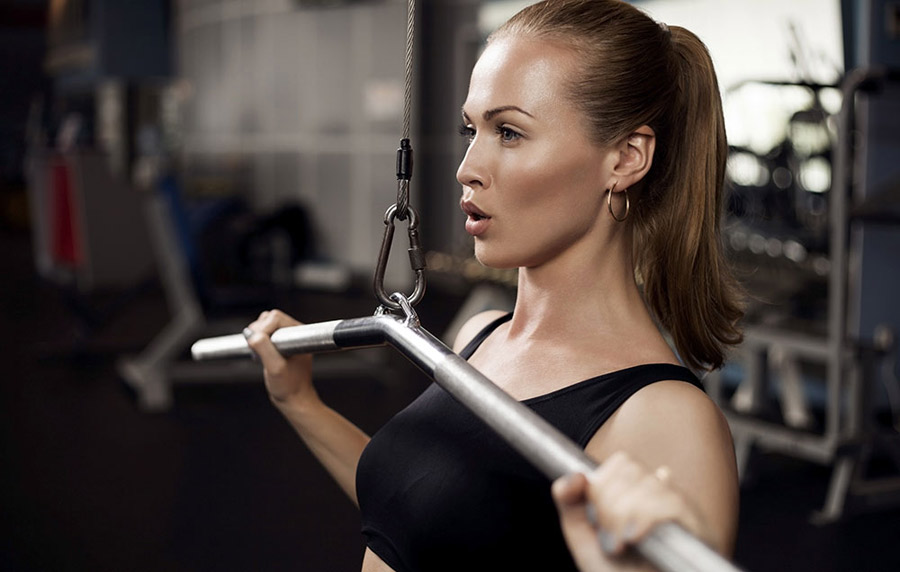
Our muscles also function as shock absorbers and serve as important balancing
agents throughout our body. Well-conditioned muscles help to lessen the
repetitive landing forces in weight-bearing activities such as
jogging or playing basketball.
Well-balanced muscles reduce the risk of injuries that result when a muscle
is weaker than its opposing muscle group. For example, jogging places more
stress on the hamstrings and calves than it does on the quadriceps, creating a
muscle imbalance that often leads to knee injuries. So it is very important that
runners be on a good strength-training program that includes training the
quadriceps as well as the hamstrings and calves.
To reduce the risk of imbalanced muscle development, you should make sure
that when you are training a specific muscle group, the opposing muscle groups
are being trained as well (though not necessarily on the same day). For example,
if you are doing strength training exercises for your chest you should include
back exercises in your program as well. Of course, you will have no problem with
muscle imbalance when using the WF Strength Training programs; we cover every
group in the body, promoting well-balanced muscle development.
Please realize that a sound strength-training program that includes all
major muscle groups is the most effective way to decrease risk of injury. For
safe, effective strength-training programs work well not only for injury
rehabilitation, but for injury prevention as well.
As a WF member you are now ready to begin the WF Strength Training content. We begin with basic terminology, safety precautions, and the necessary mind-set you need in order to be successful. We will then discuss the principles and guidelines of an effective strength training program, and then proceed to the intermediate and advanced techniques that will alleviate boredom, prevent plateaus, and produce new results, again and again.