|
|
Article of the Week
May, 26 2015Calorie cycling is a systematic method of raising and lowering daily calorie intake. The main way this diet works is the zig-zagging of the starchy carbs, where we avoid starchy carbs (like bread, pizza, pasta, potatoes, rice) during the low days and only eat them during the high days, this enables your metabolism to run smoothly all the time (even during the low days).
More>
-
Drawing on more than 100 years of combined industry experience, Whole Foods Market’s product experts (WFM), a dynamic leader in the quality food business have pinpointed 10 top food trends to watch in 2016.
-
A High protein diet consist of at least 20% protein and very high protein diets contain at least 30% protein. With this plan, you are basically consuming between 30 to 60 % of daily calories in the form of protein, and the rest from carbs, fruits, veggies, and fats. In a typical diet only about 10 to 15 percent of calories come from protein.
-
Smoothies make great breakfast and post-workout snack. Evergreen Protein Shake Serious nutrition and energy from this shake; it combines spinach, good saturated fats, a trio of delicious fruits, sweet honey, and a huge hit of protein.
-
Some people are
naturally thin and would like to be larger. Exercise is important
for good health and the right type of exercise can help you gain
muscle, which will give you more body mass. Weight-lifting exercises
that are designed to build muscle should be included with your
weight-gaining diet and perhaps aerobic exercise should be cut back
a bit.
-
Some people are
naturally thin and would like to be larger. Exercise is important
for good health and the right type of exercise can help you gain
muscle, which will give you more body mass. Weight-lifting exercises
that are designed to build muscle should be included with your
weight-gaining diet and perhaps aerobic exercise should be cut back
a bit.
-
High protein shakes are instantly becoming identified among the athletes as well as
individuals who hope to eat up healthy as well lose weight. They are
easy to prepare, tasty and healthy. All these powders do is provide
your muscles with protein to rebuild and they are in no way superior
to a well balanced meal!
-
The bright red and deep purple
berries have been used by Native Americans for centuries. But now, the
chokeberry can be found in the form of dietary supplements in local pharmacies
and health food stores.
-
Whey is the
ultimate protein in terms of bioavailability (around 100) and content of
essential amino acids, which the body needs on a daily basis to promote a
healthy body and assist in maintaining muscle tone.
-
Even though there has been a huge resurgence in the interest in low
carbohydrate/high protein diets, the low carb vs. high carb issue is
still the subject of much controversy. Is the low carb/high protein
diet the best way for bodybuilders to get ripped or just another
fad?
-
Once physical and sexual maturity have been reached during
adolescence, a woman’s size, strength, and general health have to be
maintained. This can be difficult given the wide variety of
physical, psychological, social, and environmental pressures
encountered throughout life.
-
The fact that carbohydrate cause weight gain is misleading. Weight
gain is caused by consuming too many kilojoules (or calories)
whether they are from carbohydrate, protein or fat.
-
Meal replacements came into prominence several years ago, when a company
called Met-Rx introduced a unique formula that was unlike anything else on the
market. This revolutionary product was billed as a means to build muscle and
reduce bodyfat.
-
Protein is essential for building and maintaining muscles, as
well as repairing the muscle damage that occurs during training.
-
One problem for the increase in body fat % with advancing age is
that 'basal fat oxidation' - the rate at which fat is broken
down inside the body tends to drop as we get older.
-
Grazing can also keep your metabolism, or calorie-burning
mechanism, running high. Your body uses calories when you
eat and digest food.
-
Fiber generally refereed to as 'roughage' is essential for
the healthy functioning of your body. Even though research
continues to prove fiber’s power, statistics show that many
people still aren’t taking this nutrient seriously enough.
According to the American Dietetic Association (ADA), most
adults consume less than 15 grams (g) of fiber daily, and yet
the recommended intake for optimum health is 20 to 35 g. Here
are 10 facts to help you fuel your health with fiber.
-
Protein intake in both lacto-ovo-vegetarians and vegans can
be made adequate by careful planning and smart cooking.
A
large proportion of calories should come from carbohydrates is so
that the body has enough energy to deal with the rigors of training
and recovery. Bodybuilders require complex carbohydrates as they
release energy more slowly than simple sugars. This is important as
simple sugars cause an insulin response which places the body in a
state where it is likely to store additional calories as fat rather
than muscle, furthermore frequent consumption of simple sugars can
lead to Type II diabetes. However bodybuilders do ingest some simple
sugars post-workout to replenish glycogen stores within the muscle.
Poor quality carbohydrates are those that contain sugar or are
highly processed. These would include most breakfast cereals,
breads, snack foods, candies, and even fruits and juices.
Eating these foods immediately prior to bedtime will likely
result in increased fat deposit and will prevent your body
from maintaining a successful fat-burning mode.
It is
recommended that bodybuilders receive 1 to 2 grams of protein per
pound of bodyweight to help the body recover and build. These
protein sources should be of a high biological value such as steak,
chicken, fish, soy, milk or whey, and egg whites. Chicken, whey, and
egg whites are often preferred due to their relatively low fat
content. Some Bodybuilders prefer to get their daily protein
requirement from foods first and then from supplementary protein
powders.
Also,
adequate intake of vitamins and minerals is necessary; Bodybuilders
almost universally take a multi vitamin each day. Essential fatty
acids, especially omega-3s, are consumed as well.
 Supplements can help muscle gain, although some are unproven and
many are ineffective. Creatine however, is one which has been proven
to help bodybuilders. Although creatine only helps if used in
conjunction with a solid nutritional base and weight training
program, this is true for all supplements. Supplements can help muscle gain, although some are unproven and
many are ineffective. Creatine however, is one which has been proven
to help bodybuilders. Although creatine only helps if used in
conjunction with a solid nutritional base and weight training
program, this is true for all supplements.
Some
bodybuilders may use drugs to gain an advantage over results due to
natural hypertrophy, especially in professional competitions.
Although many of these substances are illegal in many countries, in
professional bodybuilding the use of anabolic steroids (a class of
natural and synthetic steroid hormones that promote cell growth and
division, resulting in growth of muscle tissue and sometimes bone
size and strength) and precursor substances such as prohormones (a
chemical compound that is a precursor to an actual hormone) are
essential to competing in world-class competitions. Steroids
increase levels of free testosterone and result in muscle
hypertrophy (increase of the size of an organ). Significant negative
side-effects accompany steroid abuse, such as liver damage as well
as negative feedback leading to a decline in the body's own
testosterone production and possible infertility.
-
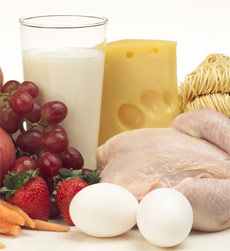 If
you want to build muscle, you need to consume quality calories.
How much calories? You need to consume more total calories in your
weight lifting diet than your body uses each day. It is very
important to understand that the human body is constantly working,
using and storing energy day and night. If
you want to build muscle, you need to consume quality calories.
How much calories? You need to consume more total calories in your
weight lifting diet than your body uses each day. It is very
important to understand that the human body is constantly working,
using and storing energy day and night.
-
It
is also very important to understand that in order to keep the
machine rolling, you need to know what and how much to feed it.
This is the single most important element in the muscle building
process.
-
You
need to feed your body a correct balance of calories, protein,
carbohydrates and fat. Complete muscle building nutrition is the
key. If you can find this key, I'll guarantee you that your muscle
building efforts will sky rocket.
-
Complete muscle building nutrition leads to optimal nutrition.
Over supplementation of certain nutrients will lead to imbalances
in overall nutrition and is damaging to your weight lifting diet
and health.
-
If
you want to build muscle you need to prepare a well balanced
weight lifting diet that is rich in quality calories. Most people
who start out weight lifting usually overlook the importance of a
well balanced weight lifting diet when they are trying to build
muscle.
-
The
sooner you understand that you need an optimal weight lifting
diet, the sooner you'll achieve your goals and objectives.
-
It
is very important that you understand the importance of nutrition
when building muscle. Without a good weight lifting diet, your
muscle gains will be non existent and at best, poor.
-
Sugars, for the most part, have no place in your diet. Sugars in
dairy products are all right, as well as some simple sugars post
workout (I myself enjoy some no sugar added ice cream after dinner
occasionally, where the only sugar in it comes from the milk).
 Serious bodybuilders should be eating 4-6 times per day, period.
Three meals per day simply will not cut it for mass gains. The
biggest part of this is because it's difficult to consume sufficient
calories for mass gains in only three meals. As well, multiple
smaller meals keeps a steadier flow of nutrients into the body.
Studies have also shown positive benefits of multiple, smaller meals
on cholesterol and bodyfat levels (and I'm sure other indices of
health). If nothing else, multiple meals typically makes it easier
to consume the kind of high-calorie diets needed to sustain mass
gains. Serious bodybuilders should be eating 4-6 times per day, period.
Three meals per day simply will not cut it for mass gains. The
biggest part of this is because it's difficult to consume sufficient
calories for mass gains in only three meals. As well, multiple
smaller meals keeps a steadier flow of nutrients into the body.
Studies have also shown positive benefits of multiple, smaller meals
on cholesterol and bodyfat levels (and I'm sure other indices of
health). If nothing else, multiple meals typically makes it easier
to consume the kind of high-calorie diets needed to sustain mass
gains.
In
practice, lifters should be putting something in their mouths
food-wise ever 3 hours or so. That's about how long you'll maintain
blood glucose, insulin after a meal. Most proteins take 2-3 hours to
fully digest (if not longer) so I see little need to eat protein
more often than that.
Beyond that, arguably the most important meals are breakfast (to
halt overnight catabolism) and post-workout. Post workout nutrition
is a place I see lifters making major mistakes. I've watched guys at
my gym finish their workouts and hang out talking (or flirting) for
another 30-60'. There is a window of opportunity where nutrients are
more effectively absorbed after a workout. By the hour mark, you've
already lost some of the benefit. In my opinion, you should take
something with you (or buy it there) to drink right after your
workout. As I'll discuss in a subsequent article, there may be some
benefit to consuming nutrients before or halfway through the workout
as well. Although guidelines are sparse, typical recommendations for
post-workout are 1-1.5 g/kg of carbs and about 1/3rd as much
protein.
A
final place to consider meal frequency is right before bedtime and
in the middle of the night. Between your last meal and breakfast can
be a long time to go without nutrients and anabolism might be better
maintained if nutrients are consumed. There is also some data that
the gut needs time to 'rest' itself and that round-the-clock eating
may hamper that. Another consideration is that sleep should not be
compromised to get more nutrients into the body. Since I usually
wake up in the middle of the night anyhow (to go to the bathroom),
I'll usually have some milk or something while I'm up. If you don't
usually wake up in the middle of the night, a shake before bed
(containing protein, carbs, fat and fiber) will help to keep a
continuous flow of nutrients into your bloodstream.
Helpline
Track Your Progress
|
|