Multiple Sclerosis (MS) is an inflammatory, degenerative, autoimmune disease of the central nervous system that affects approximately 2.5 million people worldwide. Idea behind involving yoga in healing MS, is to balance the nervous system without inflaming and aggravating the condition.
MS symptoms vary greatly and may include weakness, fatigue, exhaustion, tremors, rigidity, muscle wasting, difficulty walking, tingling, numbness, and sensitivity to both heat and cold. Underlying all the symptoms is an over-taxednervous system. Study conducted on yoga and its healing effect on patients suffering with Multiple Sclerosis, showed that although yoga did not influence cognitive function or mood, but it did lessen fatigue and increase energy level. This is an important finding because fatigue is one of the most difficult and hidden symptoms of MS. One more advantage with Yoga is that, it can be done at home with minimal investment.
| Yoga emphasizes stretching and breathing, which can release tension and improve circulation and body awareness. Yoga practice can facilitate harmony between the muscular and nervous systems of the body, possibly resulting in more fluid movement and relief from muscle tension. |
Balance for MS patients , can be addressed with asanas like Tadasana (Mountain Pose), Virabhadrasana I (Warrior Pose I) and Virabhadrasana II (Warrior Pose II), and Trikonasana (Triangle Pose). While you practice try to master the breath and practice restorative postures. The simple breathing technique of lengthening the exhalation a little longer than the inhalation helps quiet the nervous system.
Tadasana (Mountain Pose)
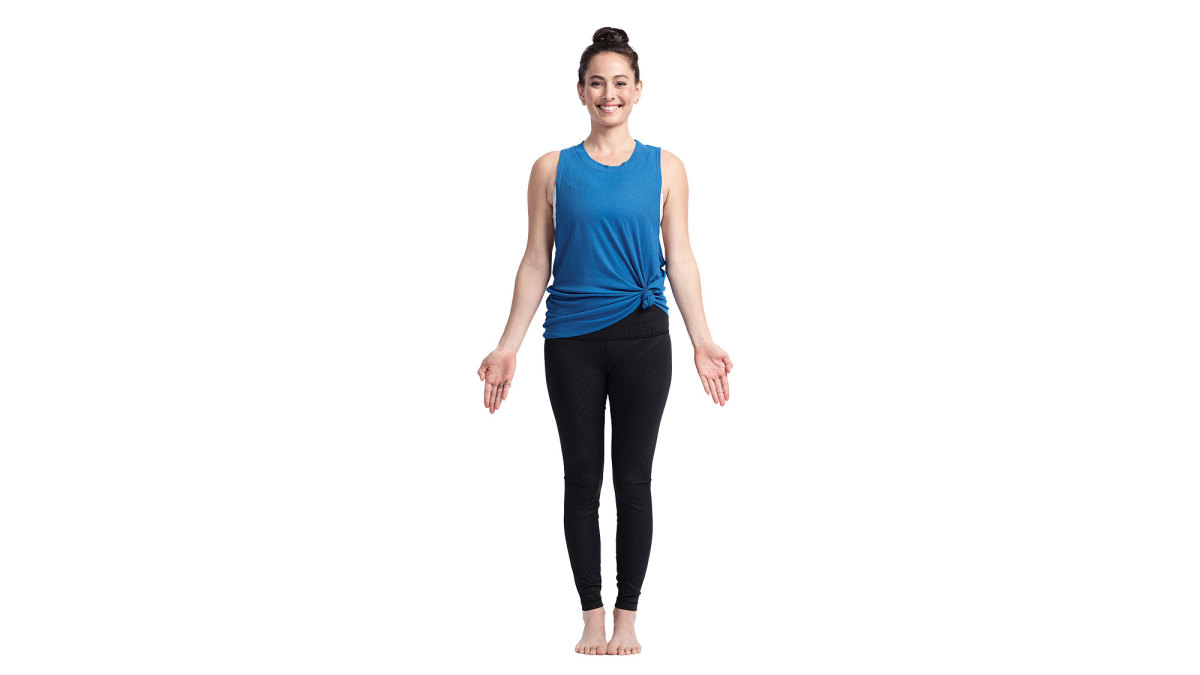
- Stand in your bare feet on a smooth and even surface. Keep your feet together, with your heels touching the wall. Beginners may find it easier to keep their feet 5 cm (2in) apart.
- Stretch your arms along your sides, with the palms facing your thighs, and your fingers pointing to the floor. Stretch your neck upward, keeping the muscles soft and passive.
- Distribute your weight evenly on the inner and outer edges of your feet, and on your toes and heels. Tighten your kneecaps and open the back of each knee. Turn in the front of your thighs. Tighten your buttocks. Pull in your lower abdomen, and lift your chest.
- Keep your head erect and look straight ahead. Breathe evenly and with awareness. Experience your body and mind as an integrated whole and feel the surge of energy. Stay in the pose for 30 – 60 seconds.
Virabhadrasana I (Warrior Pose I)
- Support your right buttock and most of your right thigh along the very edge of a chair or support. Your right foot should be directly under your knee. Kneel with your left knee on the floor or supported by a block if needed. If necessary, tall people can pad the seat with a blanket or mat to get more height. Visualize an imaginary line running vertically down the centre of your body.
- Your left buttock is off the chair, with your inner thigh pressed into the edge of the seat. If necessary for balance, rest your hand on the back of a second chair. If possible, raise one arm, then the other. Repeat on the other side.
Trikonasana (Triangle Pose)
- Stand with your feet three to 3 – 3.5′ apart against a wall. Turn your left foot in 30 degrees and your right foot out 90 degrees.
- Be sure that your right heel is in line with the arch of your left foot. Bring your hands into a T position and take a deep inhalation.
- Exhale and move your pelvis toward the left as you extend your torso to the side and over your right leg.
- Place your right hand down on your shin and stretch your left arm vertically overhead, palm forward. Turn your head to gaze softly at your left thumb. Hold for three breaths. Put your left hand on a block or a chair seat if you can’t comfortably reach the floor. Raise your left arm up, balancing against the wall.
- Release by coming back to standing and practice on the opposite side.
Adhomukha Svanasana (Downward Facing Dog) :
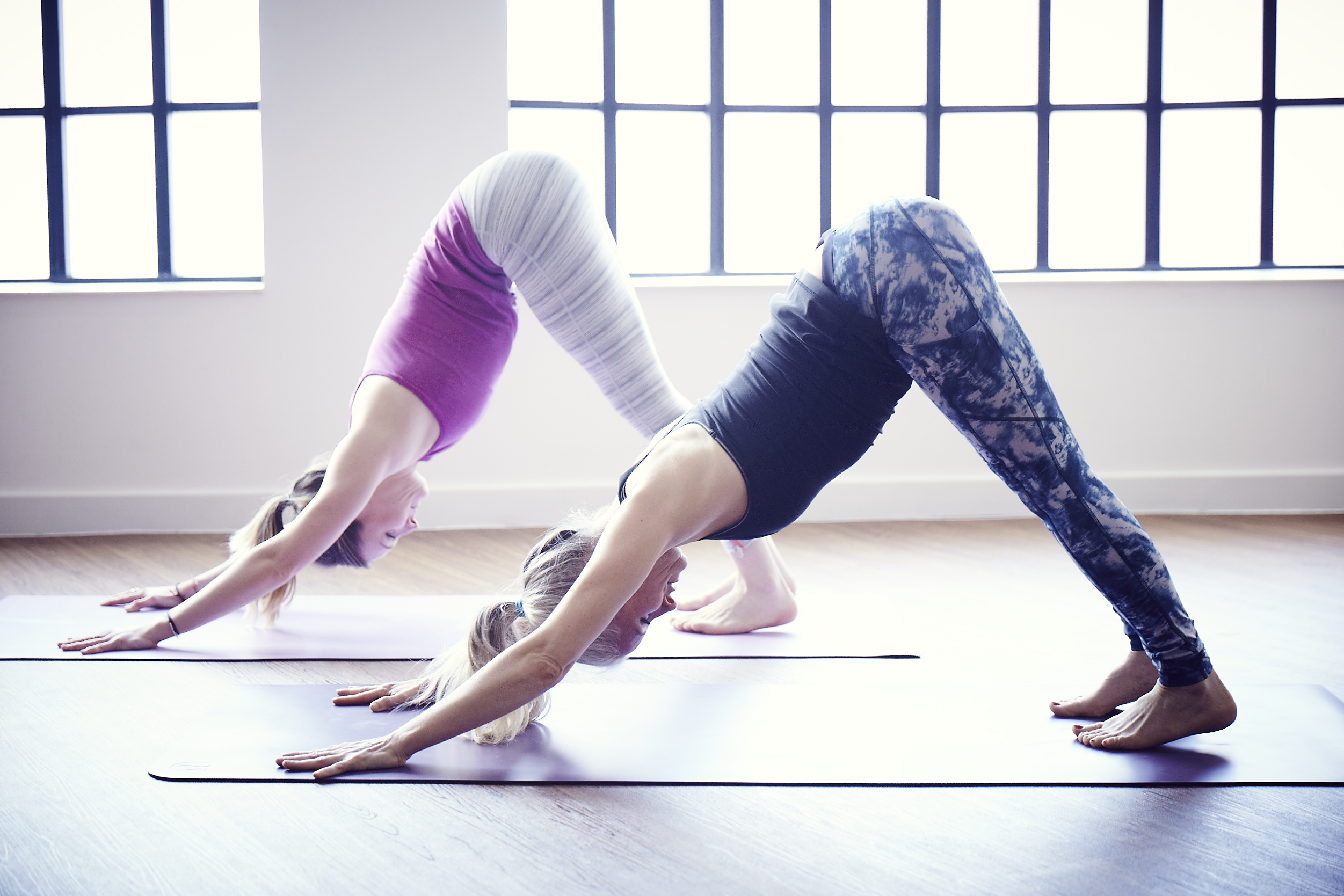
- This is a good posture to begin with for those who are mobile but have balance problems and for those who are weak in the arms or legs. Stand with your back to the wall with a chair in front of you, turned so the seat faces away from the wall.
- Fold a sticky mat into quarters, place it on top of the chair back, and cover it with one or two blankets. With your heels against the wall, bend at the hips and put your hands on the chair seat.
- Place the bottom of your pelvis, below the navel, onto the padded chair back. Deepening the bend at the hips, rest your chest on the chair seat, your hands on the floor.
- Your feet may go up the wall or be elevated on blocks, depending on your height and flexibility.
Savasana (Corpse Pose):
- Spread the mat on the floor. Place a bolster on the mat, with its long sides parallel to the long sides of the mat. Sit in Dandasana (Staff pose) with the short end of the bolster against your buttocks, and place the folded blanket on the far end. If you have osteoarthritis of the knees or if your legs are feeling tired, place a bolster under your knees.
- Lower your back, vertebra by vertebra, onto the bolster until your head rests comfortably on the folded blanket. Position your buttocks evenly on the centre of the mat. Spread out your arms to the sides, palms facing up, and rest them on the floor.
- Straighten your legs and stretch them evenly away from each other, without disturbing the extension of your waist. Exhale, focusing on your breathing, then lift and stretch your diaphragm, keeping it free of tension. Keep your arms at a comfortable distance from your body. If they are placed too near or too far away, your shoulders will lift off the bolster.
- Stretch your shoulders away from your neck. The centre of your back should be on the centre of the bolster, keep your abdomen soft and relaxed. Expand your chest and relax your throat. Until you feel a soothing sensation in the neck. Ensure that your head does not tilt back. Relax your facial muscles and your jaw. Do not clench your teeth.
- Keep your breathing smooth and free of tension, but do not breathe deeply. Let your eyeballs relax into their sockets, and allow external surroundings to recede. Feel the energy flow from your brain to your body body as the physical, physiological, mental, intellectual, and spiritual lanes come together. Stay in the pose for 5 – 10 minutes.
Practice the poses at your own pace, never forcing or straining. Remember that the goal is to enjoy the practice, not to achieve a particular posture. Hold each pose for 10 to 20 long, deep breaths, then re
lease and move with awareness to the next posture.
Suggested Links:
Disclaimer
The Content is not intended to be a substitute for professional medical advice, diagnosis, or treatment. Always seek the advice of your physician or other qualified health provider with any questions you may have regarding a medical condition.