When you sit in a standard chair, some important postural control muscles are inactivated, while others are asked to work overtime. The Hamstrings are shortened by long hours of sitting. Also, during sitting, the Gluteus maximus (GM) is relaxed and unable to tension the lumbosacral fascia. The Erector Spinae (ES) muscle group therefore is made perform the entire lumbar extension workload. Assuming you are not using a full and appropriately shaped chair back, your Iliopsoas muscles must pull your torso forward to stop you falling backward, and they have to do that at the short end of their range of contractile length. All these triggers are responsible for Iliopsoas muscle shortening and development of trigger points.

The psoas muscle, is a combination of the iliopsoas, psoas major and psoas minor muscles. It originates on the lumbar spine, travels over the front of the pelvis and inserts on the femur. It is the only muscle which directly connects the core with the legs. Most muscles go core to pelvis or pelvis to legs.
Some basic psoas facts:
- The psoas causes low back pain, sacroiliac pain, sciatica, disc problems, scoliosis, hip degeneration and knee pain
- Unresolved trauma can keep the psoas short and reactive
- The psoas (pronounced “so – az”) primarily flexes the hip and the spinal column
- The psoas functions as a hip and thigh flexor, which makes it the major walking muscle
- The psoas can torque your spine to the right or left, pull it forward and twist the pelvis into various distortions
- When the psoas is stuck in contraction stretches can tighten the muscle even more
- The psoas is a major part of your body’s defensive physiology which responds to danger with flight, fight or freeze.
(Source: squido.com)
Exercises to Work Psoas Muscle
The Psoas crunch: Kneel on all fours, extend your left arm and right leg out and then crunch them in bringing your right elbow towards your left knee. Round your back, exhale and pull your belly button hard up to your spine as you crunch in, hold for two seconds and repeat. To add variety support your arms on an exercise-ball instead of the floor or turn over and do this exercise lying on your back.
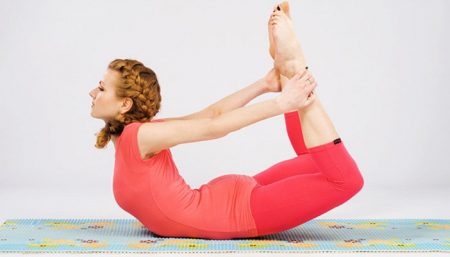
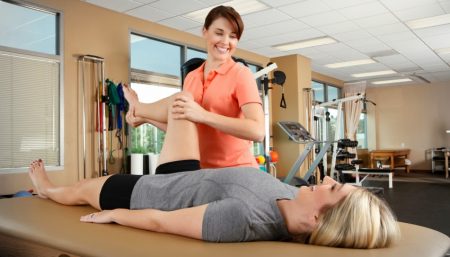
The Psoas Stretch: Put your front foot on a low bench, turn your back foot out and press your hips forward and toward the floor. Hold for 20 seconds. You should feel this stretch on the front side of your hip/inner thigh of your rear leg.
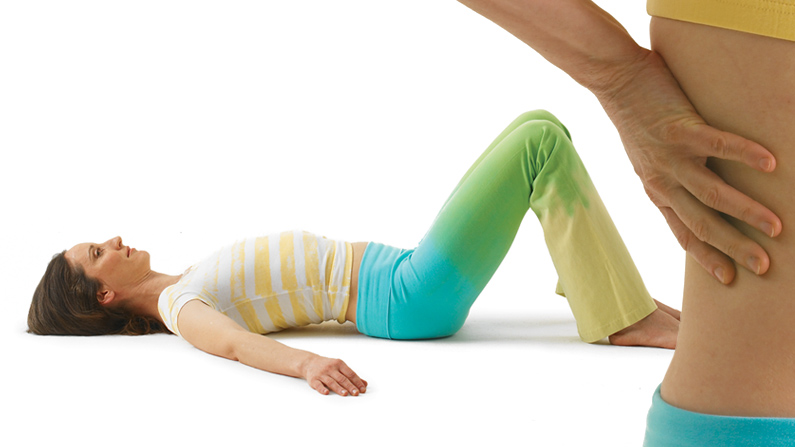
Heel Slide: Beginning with both feet on floor, draw your belly button in toward your spine and exhale while sliding your left foot away from you. Maintain the weight of your leg on the floor (do not lift your leg off the floor). Stop if you feel back pain or feel your lower back arching up from the floor. You can monitor this by putting your fingers on either side of your lower spine to sense whether it is arching. Once you’ve reached the point where you feel pain or your lower back arches, stop and inhale. Exhale while sliding your foot back to a bent-knee position. Repeat on right side. Continue alternating sides until you experience back pain or fatigue or you cannot maintain a flat spine. To progress this exercise, gradually begin with both feet further from your body until both legs can be fully extended while your lower spine is either flat, controlled, or pain free.
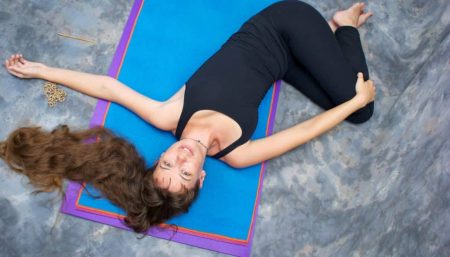
Spine Twist: Lying on the floor, place right foot on the left knee. Using your left hand, gently pull your right knee towards the floor, twisting your spine and keeping left arm straight out, hips and shoulders on the floor. Switch sides.
Click here for more on symptoms and management.
Keep in mind that the way we stand, walk and sit can distort the psoas. If we walk or stand with our chin in an overly forward position the muscle will tighten. Sitting through much of the day at the office, car or elsewhere causes the muscle to shorten to keep us bio-mechanically balanced in our chairs. Over time we develop a “normal” way of holding the psoas that is dysfunctional. Until the psoas is released the muscle may stay contracted and go into further shortening and spasm very easily.
Disclaimer
The Content is not intended to be a substitute for professional medical advice, diagnosis, or treatment. Always seek the advice of your physician or other qualified health provider with any questions you may have regarding a medical condition.