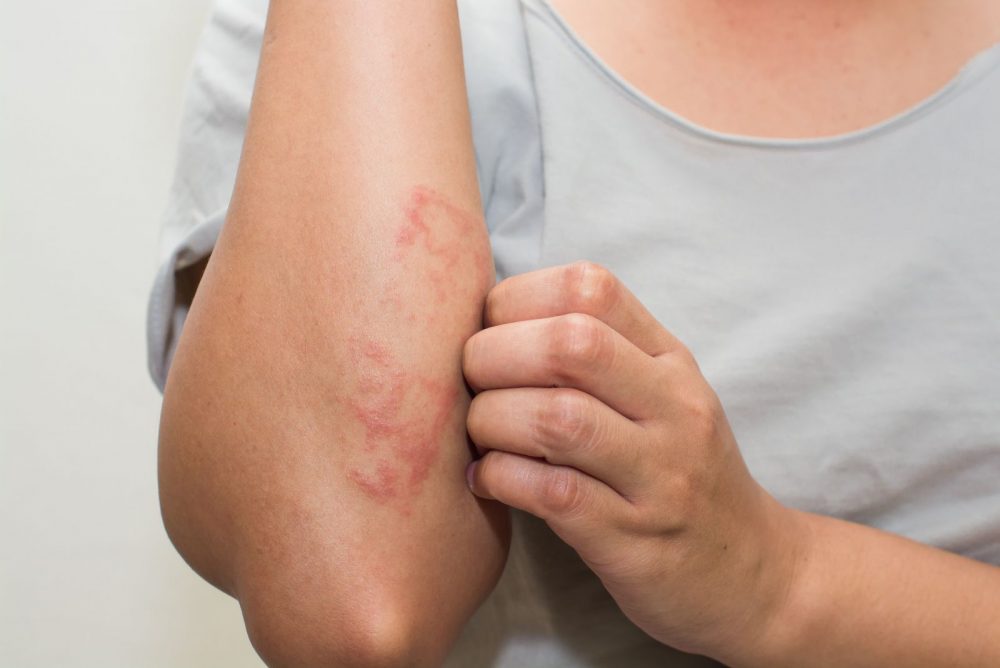
What is Psoriasis:
Once thought to be a skin disorder, psoriasis is now understood to be a condition originating in the immune system that can appear in many different forms and can affect any part of the body, including the nails and scalp. The patches may be silver or red. It is characterized by skin cells that multiply up to 10 times faster than normal. As underlying cells reach the skin’s surface and die, their sheer volume causes raised, red patches covered with white scale.
The skin flaking that occurs in psoriasis is known as scaling. At first, a few small, flaky patches – known as plaques – may appear. Often, the plaques gradually enlarge and increase in number.
Though not contagious, psoriasis tends to run in families. Fair-skinned people from 10- to 40-years-old are particularly susceptible, especially those who have a blood relative suffering from the disorder. Psoriasis is extremely rare among people with dark skin.
Psoriasis is not an infection and it is not contagious – you cannot “catch” it from anyone.
Types of Psoriasis:
Plaque psoriasis
Skin lesions are red at the base and covered by silvery scales.
Guttate Psoriasis
Small, drop-shaped lesions appear on the trunk, limbs, and scalp. Guttate psoriasis is most often triggered by upper respiratory infections.
Pustular Psoriasis
Blisters of noninfectious pus appear on the skin. Attacks of pustular psoriasis may be triggered by medications, infections, stress, or exposure to certain chemicals.
Inverse Psoriasis
Smooth, red patches occur in the folds of the skin near the genitals, under the breasts, or in the armpits. The symptoms may be worsened by friction and sweating.
Erythrodermic Psoriasis
Widespread reddening and scaling of the skin may be a reaction to severe sunburn or to taking corticosteroids (cortisone) or other medications. It can also be caused by a prolonged period of increased activity of psoriasis that is poorly controlled.
Psoriatic Arthritis
Joint inflammation that produces symptoms of arthritis in patients who have or will develop psoriasis.

Normal skin has two layers: an outer layer called the epidermis and an inner layer called the dermis. Skin cells are created in the dermis and move up through the epidermis to the skin surface. Skin cells are continually dying and being replaced. Normally, skin cells mature and shed in about a month.
In psoriasis, the skin cells reproduce many times faster than normal and live only three to four days. The dead cells build up on the skin, forming thick, flaky patches called plaques. The redness in skin plaques is caused by increased blood supply to the rapidly multiplying skin cells.
Normally, the body’s immune system defends it from infection by bacteria, viruses, and other invaders. Sometimes, however, the immune system makes a mistake and attacks the cells, tissues, and organs of a person’s own body. When this happens, the resulting disease is called an autoimmune disease. Many autoimmune diseases run in families.
Scientists have found abnormally large numbers of T cells in the red, flaky skin patches of people with psoriasis. T cells are the infantry of the immune system. When the body senses a need to defend itself against infection, it first makes and then releases millions of t cells to fight off the invaders. Some T cells are normally found in skin. The presence of abnormally large numbers of T cells in skin affected by psoriasis suggests that the immune system is attacking the skin by mistake.
The first outbreak of psoriasis is often triggered by:
- Emotional or mental stress or
- Physical skin injury, but
- Heredity is a major factor as well.
- Conditions that may cause flareups include infections, stress, and changes in climate that dry the skin.
- Certain medicines, including lithium and beta blockers, which are prescribed for high blood pressure, may trigger an outbreak or worsen the disease.
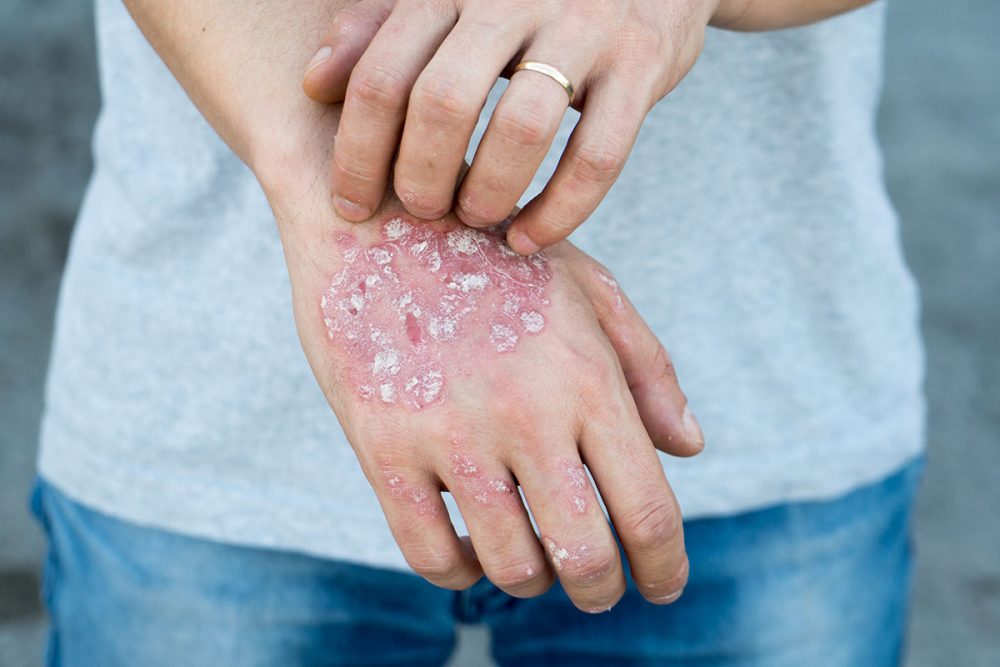
- Patches of itchy, scaly skin develop, with the accumulation of dead skin cells. These deep-pink, raised patches of skin have white scales.
- These patches develop on the scalp, knees, elbows, and upper body. However, when they can develop on fingernails and toenails, they become thick, pitted, and discolored; they may separate from underlying skin.
Red, scaly, cracked skin on the palms of the hands with tiny pustules can signal palmar psoriasis; on the soles of the feet the same condition is plantar psoriasis;when joints are involved, the condition is psoriatic arthritis.
Symptoms of psoriatic arthritis include:
- Stiffness, pain, and tenderness of the joints
- Reduced range of motion
- Nail changes such as pitting, which is found in up to 80% of people with psoriatic arthritis
When the condition progresses to the development of silvery scales, the physician can usually diagnose psoriasis with a medical examination of the nails and skin. Confirmation of diagnosis may be done with a skin biopsy.
Doctors generally treat psoriasis in steps based on the severity of the disease, size of the areas involved, type of psoriasis, and the patient’s response to initial treatments.
Treatment may include:
- Ointments and creams (To moisturize the skin.) – When applied regularly over a long period, moisturizers have a soothing effect.
- Sunlight or ultraviolet light exposure (should be done under a physician’s supervision) – When absorbed into the skin, UV light suppresses the process leading to disease, causing activated T cells in the skin to die. This process reduces inflammation and slows the turnover of skin cells that causes scaling.
- Steroids – These drugs reduce inflammation and the turnover of skin cells, and they suppress the immune system. Available in different strengths, topical corticosteroids (cortisone) are usually applied to the skin twice a day. Short-term treatment is often effective in improving, but not completely eliminating, psoriasis. Long-term use or overuse of highly potent (strong) corticosteroids can cause thinning of the skin, internal side effects, and resistance to the treatment’s benefits.
- Vitamin D cream – Calcipotriene is a synthetic form of vitamin D3 and applying calcipotriene ointment (for example, Dovonex) twice a day controls the speed of turnover of skin cells.
- Creams containing salicylic acid or coal tar – Coal tar is less effective than corticosteroids and many other treatments and, therefore, is sometimes combined with ultraviolet B (UVB) phototherapy for a better result. The most potent form of coal tar may irritate the skin, is messy, has a strong odor, and may stain the skin or clothing. Thus, it is not popular with many patients. Salicylic acid acts as apeeling agent, which is available in many forms such as ointments, creams, gels, and shampoos, can be applied to reduce scaling of the skin or scalp.
- Anthralin – a drug that treats the thicker, hard-to-treat patches of psoriasis. It reduces the increase in skin cells and inflammation. Doctors sometimes prescribe a 15- to 30-minute application of anthralin ointment, cream, or paste once each day to treat chronic psoriasis lesions. Afterward, anthralin must be washed off the skin to prevent irritation. This treatment often fails to adequately improve the skin, and it stains skin, bathtub, sink, and clothing brown or purple. In addition, the risk of skin irritation makes anthralin unsuitable for acute or actively inflamed eruptions.
- Methotrexate – an anti-cancer drug that interrupts the growth of skin cells. It can be taken by pill or injection. Methotrexate should not be used by pregnant women, or by women who are planning to get pregnant, because it may cause birth defects.
- Oral or topical retinoids – such as acitretin (Soriatane), is a compound with vitamin A-like properties that may be prescribed for severe cases of psoriasis that do not respond to other therapies. Because this treatment also may cause birth defects, women must protect themselves from pregnancy beginning 1 month before through 3 years after treatment with acitretin. Most patients experience a recurrence of psoriasis after these products are discontinued.
- Immunosuppressive medications (such as Cyclosporine) – It may provide quick relief of symptoms, but the improvement stops when treatment is discontinued. The best candidates for this therapy are those with severe psoriasis who have not responded to, or cannot tolerate, other systemic therapies.
- Antibiotics– These medications are not indicated in routine treatment of psoriasis. However, antibiotics may be employed when an infection, such as that caused by the bacteria Streptococcus, triggers an outbreak of psoriasis, as in certain cases of guttate psoriasis.
FDA approves new biologic drug for psoriasis (April 30, 2004)
The U.S. Food and Drug Administration (FDA) has approved the biologic drug etanercept (brand name Enbrel) to treat chronic, moderate to severe plaque psoriasis in adults. The drug, marketed by Amgen and Wyeth Pharmaceuticals, is already approved to treat psoriatic arthritis
Disclaimer
The Content is not intended to be a substitute for professional medical advice, diagnosis, or treatment. Always seek the advice of your physician or other qualified health provider with any questions you may have regarding a medical condition.