After delivery the first question naturally is how is my baby? The second question asked by workout – alcoholics often is “When can I begin exercising now that I’ve given birth?”

There are no clear cut answers to this question. You can ask your doctor about when he or she feels you are ready to begin exercising, and restarting your regime also will depend somewhat on how you feel. (This is another time when it is a good idea to listen to your body.) Unless your had a particularly complicated delivery, walking probably can begin fairly soon after giving birth. Taking as little as 15 to 30 minutes while maid watches the newborn so you can get some fresh air, plus a little time to yourself will probably be one of the best things you can do shortly after having a baby. When your infant is a little older taking him or her with your on your walks will be good for both of you. As long as the weather cooperate put the baby in a snuggle or a stroller and get out of the house.
- Begin by working out for about 30 minutes a session three days a week.
- Try for an intensity level of about 50 percent of your pre-pregnancy workouts.
- Gradually build in duration, intensity and frequency.
Go about making the following exercises a part of you daily postpartum recovery.
Alternately contracting and releasing the muscles of the pelvic outlet and birth canal.
Purpose: Strengthening supports the contents of the abdomen, preventing your uterus or bladder from falling through these muscles, especially after you have had children.
Description: Sit upright on a chair with a hard, flat surface; make sure your weight is on your “sits bones,” the two rocker-like bones on either side of your vagina, and you are not slumped down on your tailbone; squeeze the muscles between your sits bones and lift them up inside; hold for 10 seconds (keep breathing), then relax them slowly, noticing how they fall toward the chair surface. Start with five, and then work up to sets of 10 done two or three times each day.
C-Curves
Exhaling and contracting the deep abdominal muscles and curving the lumbar spine (back of the waist) into the C shape.
Purpose: Provides abdominal support, relieves low back discomfort after pregnancy and labor.
Description: Sit upright on your chair or floor, relax your abdomen and inhale; then exhale, tightening your deep abdominal muscle and rolling back slightly onto your tailbone so that your lumbar spine can make the C shape; relax your chest and shoulders; inhale and return to upright. Also do 10 of these two or three times a day.
Wall Push-Ups
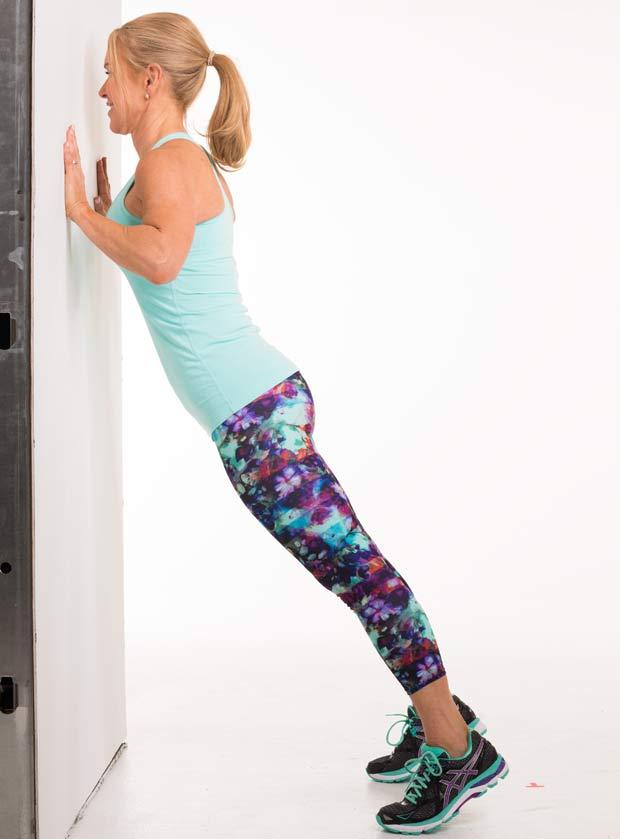
Perform wall push-ups when you have a minute or two by placing your hands at chest level with your feet several inches behind your body. Lean forward toward the wall, and then slowly push back.
Leg Lifts
one your legs and bottom with leg lifts when you’re on the phone or any time you’re standing for a few moments. In a standing position, lift one leg with knee bent up toward your body, and return your foot to the floor. To tone hip and thigh, raise your leg from your side up 12 to 14 inches, and return to the starting position. To tone the buttocks, lift one leg toward your back with the knee slightly bent, and slowly return your foot to the floor.
To wind up, Stretch your entire back and shoulders by standing with your back against a wall, hands at your sides and heels, hips, and shoulders pressed against the wall. Slowly raise your arms over your head, keeping your hands and elbows touching the wall.
Bridge
This exercise will strengthen abdominal and back muscles while providing mobility to your spine. Lie on your back with knees bent, feet firmly on bed hip width apart. Raise buttocks slowly off the ground and lift your hips about 2-3 inches off the floor to form a straight line. Place your hands on your buttocks to feel the muscles tighten. You should feel the weight primarily in the legs and buttocks, not your lower back. If you feel in the lower back, then lower your hips slightly.
Repeat 3-5 times.
Leg Sliding
Lie on your back with your knees bent. Do the pelvic tilt (do not arch). Inhale, then slowly slide one heel up the floor or bed, exhale and slowly lower the leg. Keep your back flat at all times and only work within the range that you can maintain a flat back. Repeat 5 times with each leg.
Postpartum workouts should always include a warm up period and a stretching and cool down phase. Remember to drink lots of water to stay hydrated. Most important have fun and don’t fatigue yourself so much that you cannot enjoy your new days.
Perhaps your were not into fitness before your pre-pregnancy but you have become interested in starting a program now that you’ve looked at yourself in the minor. It’s good to start your new life as a mother with healthy new habits. As with any startup program a trip to the physician is essential before you begins. Find out what your fitness baselines is and set realistic goals that you will have the time and energy to meet. Refer to – for guidelines about setting up your fitness plan.
Exercise can help you meet and enjoy the challenges of motherhood. Combine it with a healthy diet and you will be on your way to regain pre-pregnancy figure.

| Diet Tips |
|
Related Links
- Moms: Play Your Way to Fitness
- Getting Back in shape: Rebuilding the Foundation
- Attending to Your Baby’s Needs
- Strength training for Postpartum Women.
- Recovering after Caesarean birth
Disclaimer
The Content is not intended to be a substitute for professional medical advice, diagnosis, or treatment. Always seek the advice of your physician or other qualified health provider with any questions you may have regarding a medical condition.