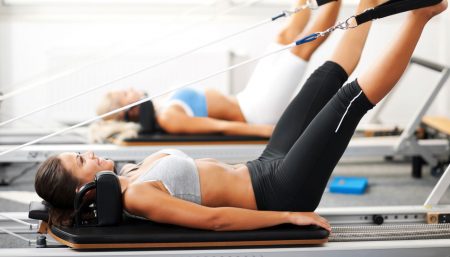
Your core is composed of three muscle regions on your body:
1) abdominal,
2) pelvic, and
3) lower back.
Basically, your core is any muscle located between your pelvis and the base of your ribcage. These muscles work together to support your spine. When you strengthen your core, you gain greater balance and stability. “Stability” refers to the capacity of the body to maintain and/or return to a state of equilibrium. Core stability training is a concrete way to improve balance, athletic performance, and potentially prevent a variety of injuries in people of all ages and fitness levels.
Also, during pregnancy, the weight of the growing uterus causes the spine to overload every day. The stretching pelvis adds risk of injury to the spine, further weakening core muscles. Building Core Stability is absolutely essential before, during and after pregnancy to prevent back injury and alleviate discomfort.
The following exercises will help you build a stronger core.
Bridge
This exercise works many of your core muscles in combination.
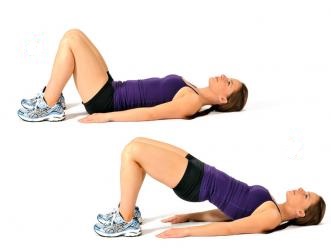
- Lie on your back with your knees bent. Keep your back in a neutral position — not overly arched and not pressed into the floor. Avoid tilting your hips up.
- Cough to activate your transversus abdominis. Holding the contraction in your abdominal muscles, raise your hips off the floor .
- Align your hips with your knees and shoulders. Hold this position and take three deep breaths — or for about five to eight seconds.
- Return to the start position and repeat. For a challenge, try alternately extending one knee while maintaining the bridge position.
The Push Away
- Begin by lying on your back with your knees bent and feet flat on the floor.
- Keeping your knees bent, lift both legs up. Place a hand on each knee and push forward. At the same time, have your knees resist this force.
- Hold for at least a count of six (and no fast counting, either). Return to the starting position. Repeat. As your core muscles become stronger, work up to six or more repetitions.
Flamingo
- Stand in good posture.
- Take arms out to the sides at shoulder level and step forward onto the right leg.
- Bend the left knee and balance.
- Keep abdomen engaged to support the torso and reduce arching of the lumbar spine. Hold for 8 breath cycles.
- Return to standing position and repeat on the other side.
- Repeat on both sides and try to reach arms above the head with palms together to make it more challenging.
Lying Spinal Twists
- Lie on the back with knees bent and arms out to the sides at shoulder level.
- Take a breath and during exhalation, bring knees in toward the chest.
- Inhale and take knees over to the side without letting them touch the floor.
- Exhale and bring the knees back to center.
- Inhale and bring knees to the opposite side.
- Exhale and back to center.
- Continue moving knees side to side with the breath for 12 cycles.
- Rest and repeat for another 12 cycles.
- Keep upper body relaxed during entire exercise. Shoulders should stay on the floor at all times. If you feel any discomfort in the low back, make the movement smaller. For variation, interlace fingers and place hands behind the head. While bringing knees side to side, keep elbows on the floor at all times.
Quadruped
- Begin on your hands and knees. Engage the core muscles.
- Lift the right arm straight in front. At the same time move your left leg straight back (not up).
- Hold for one to two seconds and return each limb to its starting position. Repeat on other side.
- Your hips should not rock to one side. Keep the core engaged the entire time.
Marching
- Lay face up. Knees bent. Feet flat on the ground. Hands on the ground extended by your side.
- Lift your hips/butt off the ground.
- Lift one leg off the ground and extend the knee.
- Then bend the knee and return to starting position.
- Repeat with the other leg. Be sure to keep your hips neutral; do not let them rock to either side.
- A variation is to bend your elbows and point fingers up, or straighten arms and point entire arm up.
Back extension using the Swiss Ball
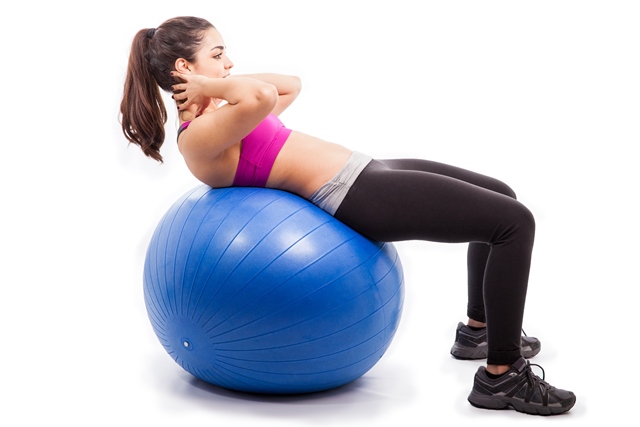
- Lie face down on a Swiss ball, making sure that the ball is securely under your hips and lower torso.
- Your toes (or knees, for beginners) should be on the floor, and your hands should be behind your head (though be sure you do not pull your head forward – you could strain your neck).
- Slowly roll down the ball, lifting your chest off the ball and bringing your shoulders up until your body is in a straight line.
- Make sure your body is in alignment (that is, be sure your head, neck, shoulders and back form a straight line), your abs are pulled in, and that you are breathing continuously.
- Repeat ten to twelve times.
Remember:
- Perform your usual warm-up routine.
- With each exercise, maintaining good posture is extremely important. You need to pull your navel in toward your spine while tilting your pubic bone toward your navel, (also known as “scooping”). Shoulders should be down and your chest lifted while keeping your back straight.
- During each exercise, a good rule of thumb is to exhale on exertion for each repetition.
- Focus on keeping this muscle contracted while doing each of these exercises, and the rest of your core muscles get a workout, too.
Related Links
- Minimizing Sore Muscles
- Adding “Balance” back to life
- Pilates: an Exercise in Balance
- Top 10 Truth About Flat Abs
- Top 10 to build and Define your Abdominals
Disclaimer
The Content is not intended to be a substitute for professional medical advice, diagnosis, or treatment. Always seek the advice of your physician or other qualified health provider with any questions you may have regarding a medical condition.