If you frequently suffer from bloating, cramping, and gas after meals, try practicing these poses.
Yoga poses increase blood flow to your digestive tract and stimulate the intestinal action known as peristalsis so digestion is more efficient. Yoga also calms you, which in turn relaxes your digestive system and leads to more effective elimination. Forward bends increase the space in the abdomen and facilitate the release of entrapped gases. These poses heat the front of the body and cool the back body. For vatas, it is important to stay warm.
The third chakra located in the solar plexus represents solar energy, or inner fire. Fire converts matter to energy in the form of light and heat. Physiologically, this refers to metabolism; psychologically, the transformational nature of fire relates to our expression of vitality, personal power, and will |
Practicing these poses daily on an empty stomach will help. Take a few deep breaths before every meal.
Caution: Avoid these poses if you have had a hiatal hernia or abdominal surgery, have abdominal-inflammation, a hyperthyroid condition, diarrhea, sciatica, or back problems, or are pregnant or menstruating.
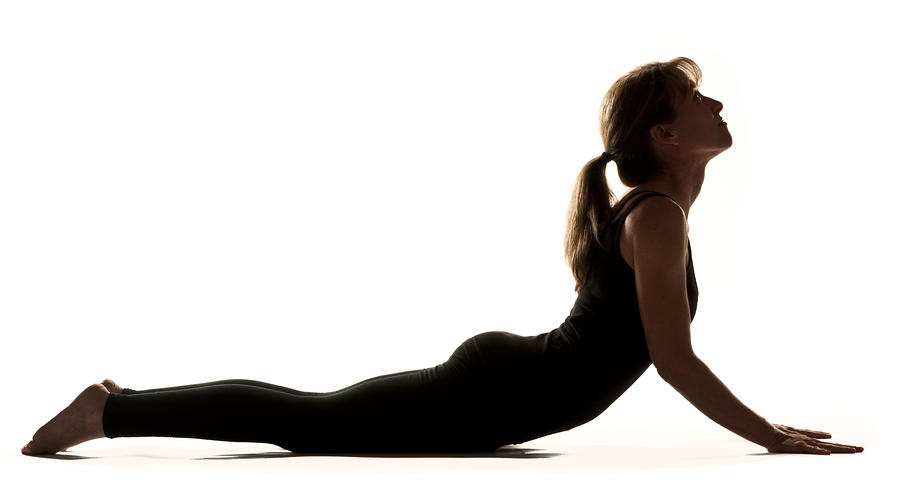
Cobra
- Lie on your stomach with your forehead on the floor. Draw your legs together. . Place your hands under your shoulders with your fingers spread apart. Move your elbows close to your body. Relax your shoulders and keep them lowered away from your ears throughout the pose. Squeeze your buttocks, and press your hipbones and pubic bone into the floor.
- Using the muscles in your back, lift your upper body, beginning with your forehead. Next, lift your nose, your neck, and your shoulders, and finally, your upper chest.
- Press down into your palms to lift your middle torso off the floor, as pictured. Imagine that you are a strong and flexible cobra. Breathe deeply as you hold here for 3 to 10 breaths.
- To release, keep your buttocks squeezed as you slowly roll back down to the floor, starting with your middle torso and ending with your nose and forehead. Turn your head to one side and rest quietly. Let go of any tension.
Bent Elbow Spinal Twist
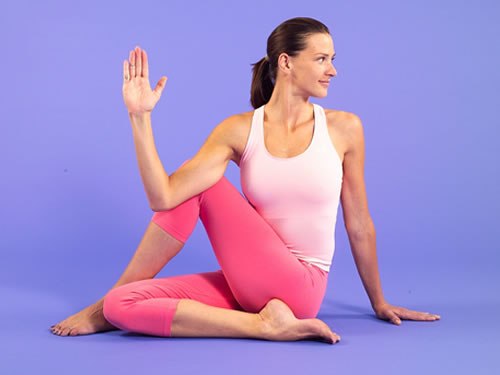
- Sit on the floor with your legs extended in front of you. Throughout this posture, be sure that your sitting bones are firmly on the floor and that you maintain a tall spine. Do not round your back; sitting on the edge of a cushion can prevent this.
- Bend your right knee and plant your right foot on the floor near the inside of your left knee or thigh. Lift your left arm out in front of you, bend your elbow, and place your elbow on the outside of your bent right knee with your palm facing away from you. Put your right hand on the floor behind you.
- Twist your torso to the right to look behind you, as pictured, and hold for 3 to 10 breaths. Each time you inhale, lengthen your spine to grow taller. Each time you exhale, twist to the right a little more. Imagine that your belly is doing the twisting.
- To release, slowly turn back to center and extend your legs out in front of you. Repeat on the opposite side.
Hero
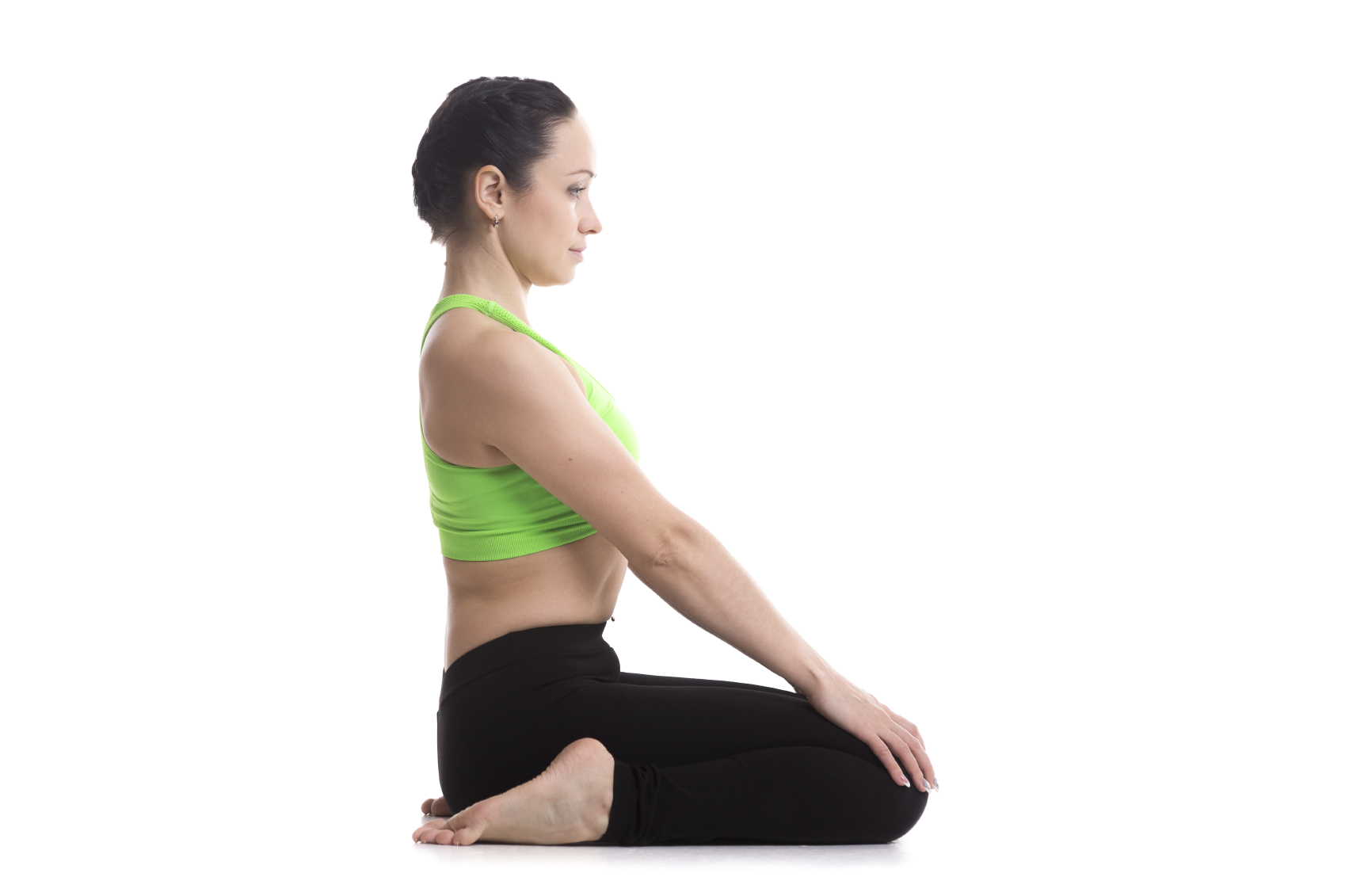
- Sit on your buttocks with your knees bent and your feet flat on the floor.
- Slide your left foot under your right leg and bring your left foot next to your right hip. The outside of your left leg should be flat on the floor. Lift your right bent leg and cross it over your left knee, bringing your right foot as close to your left hip as you can. (Most of us have tight hips, so move your right leg over only as far as feels comfortable.) To better position yourself, place your hands on the floor in front of you and lean forward, balancing on your knees. Then lower your buttocks to the floor.
- Place your hands on the soles of your feet and lengthen your spine. Leading with your chest and folding from your hips, bend forward with a flat back. Stop every inch or so and breathe. You may not be able to come very far forward at first.
- When you reach the point where you feel a stretch but not a strain, gently round your spine and rest your chin on your chest. Hold here for 3 to 10 breaths.
- To release, press down into your buttocks and raise your torso with a straight strong back. Slowly unravel your legs using your hands to guide them back to the position in step 1.
- Repeat steps 2 to 5, sliding your right leg under your left.
Baddha Konasana (Reclining Bound Angle Pose), Supported Supta Sukhasana, and an upright variation of Parsvottanasana (Side Stretch Pose) facing a wall. help lift the diaphragm and chest, increasing abdominal blood supply and reducing digestive acidity.
When suffering from acidity, avoid poses that compress the abdominal area, especially forward bends such as Uttanasana and Paschimottanasana (Seated Forward Bend). Pressure creates heat, and pittas need to cool their inner fire, not stoke it. Asanas such as Virabhadrasana I (Warrior I),Trikonasana (Triangle), and Parivrtta Trikonasana (Revolved Triangle) lift the diaphragm area and extend the esophagus and the top portion of the stomach. This reduces the reflux of gastric contents, cools the solar plexus, and arrests acidity. Standing poses also increase the blood supply to the abdominal organs and help tone them.
Inversions should not be done during the acute phase of acidity, because they can cause headaches and vomiting. However, when the digestive system feels just a little off, it is fine to practice Shoulderstand, for it’s cooling. (Avoid Headstand at such times, however; it’s too warming.) A regular practice of all the inversions during the dormant stage of acidity serves to tone the abdominal organs and promote overall health.
Disclaimer
The Content is not intended to be a substitute for professional medical advice, diagnosis, or treatment. Always seek the advice of your physician or other qualified health provider with any questions you may have regarding a medical condition.