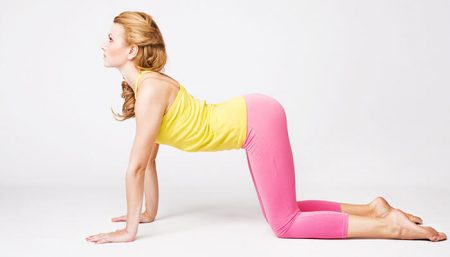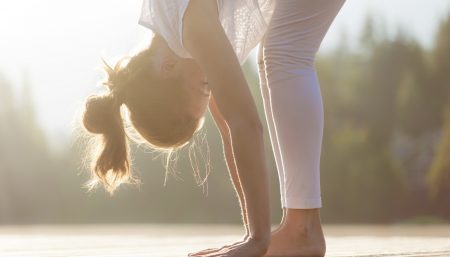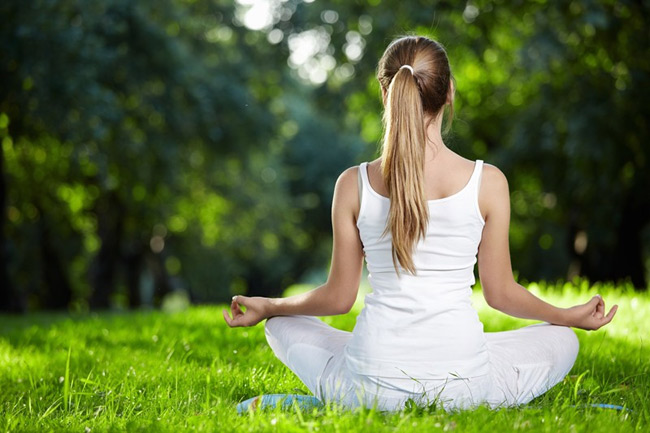
According to a new literature review in the January issue (2016) of the Journal of the American Academy of Orthopaedic Surgeons, it’s becoming more common for children and adolescents to seek medical care for back pain. Even with expensive, advanced tests like MRI scans, doctors may not be able to find the exact cause for the pain. Regular Yoga practice can help prevent backache.
The word “Yoga” means “union”. Yoga is a form of exercise based on the belief that the body and breath are intimately connected with the mind. The common causes of lower backache are either stiffness in the ligaments or muscles of the lower back, or weak abdominal muscles. Poor posture and lack of exercise usually lead to tight and swollen back muscles, resulting in pain in this area.
1. TADASANA SAMASTHITHI
- Stand in your bare feet on a smooth and even surface. Keep your feet together, with your heels touching the wall. Beginners may find it easier to keep their feet 5cm (2in) apart.
- Stretch your arms along your sides with the palms facing your thighs and your fingers pointing to the floor. Stretch your neck upward, keeping the muscles soft and passive.
- Distribute your weight evenly on the inner and outer edges of your feet, and on your toes and heels. Tighten your kneecaps and open the back of each knee. Turn in the front of your thighs. Tighten your buttocks. Pull in your lower abdomen, and lift your chest.
- Keep your head erect and look straight ahead. Breathe evenly and with awareness. Experience your body and mind as an integrated whole and feel the surge of energy. Stay in the pose for 30-60 seconds.
2. TADASANA URDHVA HASTASANA
- Stand in your bare feet in Tadasana on an even. uncovered surface. Exhale, and stretching from your waist, lift your arms in front of you, to shoulder- level. Keep your palms open and facing each other.
- Raise your arms above your head, perpendicular to the floor. Stretch your arms and fingers. Push your shoulder blades into your body.
- Stretch your arms further up from your shoulders, keeping them parallel to each other. Extend your wrists, palms, and fingers toward the ceiling. Feel the stretch along both sides of your body.
- Pull in your lower abdomen. Turn your wrists so that the palms face front. Hold the pose for 20-30 seconds. Breathe evenly.
3. TADASANA URDHVA BADDHA HASTASANA
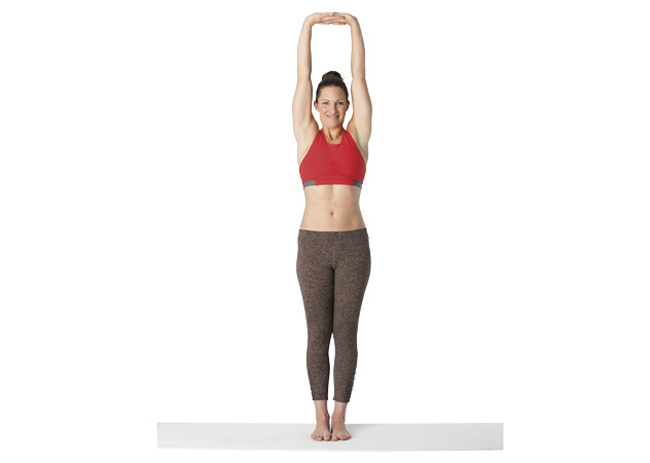
- Stand in your bare feet in Tadasana against a wall. On an even, uncovered surface. Bring your arms toward your chest, with your palms facing the chest. Interlock your fingers firmly, from the base of the knuckles, with the little finger of your left hand lower than the little finger of the right hand.
- Turn your interlocked palms inside out. Exhale, and stretch your arms out in front of you at shoulder-level. Then inhale, and raise your arms above your head until they are perpendicular to the floor. Extend your arms fully and lock your elbows. Feel the stretch in your palms. Hold the pose for 30-60 seconds.
4. UTTHITA TRIKONASANA
- Spread a mat against a wall. Place a wooden block on its ling side on the right edge of the mat. Stand in Tadasana on the centre of the mat. Inhale, then spread your feet about 1m (3.5ft) apart. Your heels and buttocks should touch the wall. Raise your arms out to your sides until they are in line with your shoulders.
- Now, turn the right foot out to the right until it is parallel to the wall. Turn your left foot in slightly to the right. Your left heel and buttocks should touch the wall. Keep your left leg straight. Stretch your arms away from your body, keeping them parallel to the floor, with your palms facing down.
- Bend to the right and extend your right arm toward the floor. Place your right palm on the block. Pull the tailbone into your body, keeping your left buttock and shoulders firmly pressed to the wall. Raise the left arm up toward the ceiling. Turn your head and look at your left thumb. Rest you weight on both heels, and not on your right palm. Breathe evenly, not deeply. Hold the pose for 20-30 seconds. Repeat the pose on the other side.
5. UTTHITA PARSVAKONASANA
- Stand in Tadasana against a wall, with your heels and your buttocks touching it. Place the block on the floor behind your right foot. Inhale, and spread your feet 1m (3.5ft) apart. Turn your right foot out to the right, until it is parallel to the wall.
- Turn your left foot in slightly to the right. Press the outer edge of your left foot firmly on the floor, and bend the right knee, pushing your thigh down until your calf is at right angles to the floor. Stretch your left arm away from your left shoulder.
- Bend to the right, and place your right palm on the block. Stretch the left arm up, with the palm facing forward. Now rotate the arm and bring it toward your left ear. Your left thumb should touch the wall. Turn your head and look at your left arm. Maintain a continuous stretch from the left ankle to the left wrist. Press your outer left foot into the floor. Move your shoulder blades into your body. and extend your spine toward your head. Hold the pose for 30 seconds. Repeat the pose on the other side.
6. ARDHA CHANDRASANA
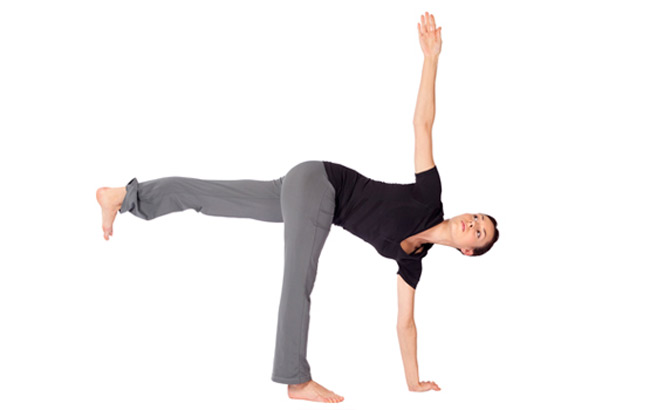
- Stand in Tadasana. Place a block on its short side against the wall. Inhale, spread your feel 1m (3.5ft) apart. Raise your arms to shoulder-level.
- Turn your right foot out to the right, parallet to the wall, and turn your left foot in, slightly to the right. Bend your right knee, and place the right palm on the block. Raise your left arm.
- Straighten your right leg. Raise your left leg, until it is parallel to the floor. Keep your left arm stretched up, in line with the right arm. The back of your left hand should touch the wall.
- Look up at your left thumb. Keep your weight on the right foot, thigh, and hip, not on your right palm. Hold the pose for 20 seconds. Repeat the pose on the other side.
7. PRASARITA PADOTTANASANA
- Stand in Tadasana. Place your hands on your hips, with your thumbs on your back and your fingers on the front of the hips. Inhale, and spread your feet 1.2m (4ft) apart. Your feet should be parallel to each other, the toes pointing forward. Press the outer edges of your feet to the floor. Keep your back erect.
- Exhale, and lift both kneecaps. Bend forward, extending your spine and bring your torso down toward the floor. Look up as you bend to ensure that your back is concave. Take both hands off your hips, and lower them to the floor. Place your palms flat on the floor with your fingers spread out.
- Widen your elbows, keeping your palms flat on the floor. Place the crown of your head on the floor, between your palms. Push your sternum forward and draw the abdomen in. Move the thighbones and groin back to reduce the pressure on your head. Stay in the pose for 1 minute.
8. BUTTERFLY
This sitting pose remedies poor posture by stretching and strengthening the muscles of the legs and the back. Start the pose by sitting up straight and looking ahead.
- Bend your knees and draw the soles of your feet together.
- Holding your feet with both hands, ease them in further towards your body. Gently bounce your knees to the floor.
- As an advanced variation, bend your arms and use your elbows to push your knees gently towards the floor. Keep your back straight
9. COBRA
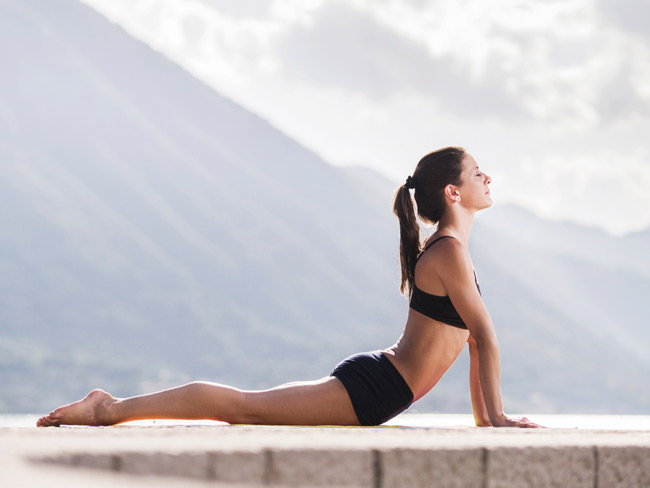
The Cobra is a face-down position in which you lift the upper body, curling up and back like the snake. By holding the posture, the deep and superficial muscles of both the back and abdominal region are toned and strengthened. It increases backward bending flexibility in your spinal column and relieves tension particularly in the lower back region.
- Begin in the Frontal Corpse. Bend your elbows and place your hands flat on the floor beneath your shoulders. Tilt your head forwards until your forehead touches the floor. Tuck your elbows into your sides.
- Inhaling steadily, roll your head back slowly, raising your forehead and bringing first your nose, and then your chin, into contact with the floor. Keep pressing down with your hands.
- Continue the steady inhalation as you slowly push down with your arms to raise your head and chest up, arching backwards away from the floor. Try to press your hips and legs down into the floor, allowing only your upper body to be lifted up.
- Arch back as far as is comfortable by raising your chest and abdomen. Keep your hips on the ground. Roll your neck back and look up. Breathe as you hold the pose for 10 seconds. Take a deep breath, and exhale as you roll slowly out of the posture, uncurling your back first and keeping your head back until last. Repeat three times.
10. CAMEL
The Camel enables you to exercise all of your back muscles and extend your spinal column, by bending your back fully. It is very useful for increasing spinal and hip flexibility.
- Begin the posture by sitting on your heels. Keep your knees close together and your calves parallel with each other.
- Place your arms behind your body with both palms flat on the floor. Lean back so that your weight rests on your hands.
- Drop your head backwards. Raise your hips and arch them forwards; walk your hands inwards to clasp your heels. Keep your back arched throughout.
- The above Yoga asanas or poses can be practiced by young and old alike. While there is no one who should be excluded, check with your doctor before you begin practicing these exercises, especially if you suffer form a medical condition or have any doubts.
Related Links
Disclaimer
The Content is not intended to be a substitute for professional medical advice, diagnosis, or treatment. Always seek the advice of your physician or other qualified health provider with any questions you may have regarding a medical condition.