Psoriasis is a chronic inflammatory skin disease seen as redness, scaling of various sizes. Although psoriasis can strike at any age, it is seen mostly in people in the age group of 15-35 years. Psoriatic arthritis, however, has its highest incidence in the age group of 30-50 years.
With modern medical science unable to find a permanent cure, millions are forced to suffer from psoriasis during the most active and productive parts of their lives. On the other hand, experiments conducted under the system of yoga and ayurveda recently have shown promising results in the amelioration of the otherwise chronic condition marked with lifelong episodes of aggravations and remissions. Groups of patients suffering from varying degrees and types of psoriasis were found to respond positively to the yogic regime of breathing exercises called pranayama, supplemented with ayurvedic formulations.
It is important to mention here that among all the diseases that respond to the systems of yoga and ayurveda, skin problems take the most time to show effective results.
Depending upon the severity of psoriasis, it may take anywhere between six months to a couple of years for a significant improvement in the condition to be seen. However, patients have reported feeling noticeable relief in their condition within a period ranging from a few days to a couple of weeks after the onset of the treatment routine.
For psoriasis, yoga exercises should be done in the morning sun. Seven types of pranayama, the breathing and mental exercises, can be practiced towards successful treatment of psoriasis.
Pranayama Exercises
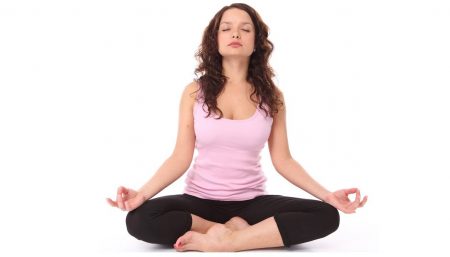
Sit cross-legged on a thin woollen or silken mattress in the open and do the following exercises in the order as below:
Bhastrika
With your hands resting on your knees and arms stretched straight, close your eyes and inhale deeply through both the nostrils. If a nostril is blocked for some reason, close it with your thumb or the two middle fingers and inhale with the other nostril. Follow this up with exhalation. Exhale deeply till you empty out all the stale air inside your lungs. Do this exercise for two to three minutes.
Kapalbhati (KB)
This is a double-nostril breathing exercise. This consists of a series of quick exhalations accompanied by an inward drawing motion of the stomach. You must sit in the same position as you did for bhastrika, to do this exercise. You must concentrate only on the exhalations; the inhalations take place involuntarily. Thus an exhalation and a an inward stomach movement per second set the pace for KB. Do this continuously for five minutes without stopping. However, if you are a beginner, you may take anywhere between a few days to a few weeks to achieve this speed. You can start off slowly; maybe do it continuously for two to three minutes, stop, and then start again. You must work towards doing KB for 15 minutes at a time, with a rest period every five minutes.
Bahya
Sitting cross-legged, with your eyes closed, inhale deeply to allow air to fill up your lungs fully. Hold the air now for a few moments. Then exhale forcefully, thus emptying the air from all the air sacs of your lungs completely. Hold your breath now again. Do this for two to three minutes.
Anulom Vilom (AV)
This is a single-nostril breathing exercise. Sitting in the cross-legged posture, press your right nostril with your thumb. Inhale deeply, without any exertion, through the left nostril. Begin inhalation through the left nostril only, followed by inhalation through the right nostril. Allow exhalations smoothly, but deeply, without exertion. Each inhalation and exhalation should not take more than two to two and a half seconds. You should do AV also for five minutes at a stretch. Thus, 100-120 inhalations and exhalations together over a period of five minutes are ideal. However, if you are a beginner, take your time to get to the five-minute-at-a-stretch norm. Start off slower, and as your body gets used to it, increase the speed. As in the case of KB, you must ultimately be able to do AV too for 15 minutes, with stoppages every five minutes, during a single yoga session.
Agnisaar
Inhale deeply but slowly, pushing your stomach muscles outward, as if filling up your stomach with air. Exhale deeply right thereafter, pulling your stomach muscles inward, as if trying to pull your stomach in as close to your back as possible. Hold your breath here and move your stomach in and out vigorously as many times as possible, before releasing it and allowing air to fill up your lungs. Do this exercise three times, five times or 11 times, as prescribed.
Bhramari
Close your eyes and plug your ears tightly with the thumbs of both the hands. Put the forefingers of your hands on your forehead, over your eyebrows, and the middle fingers of the two hands right on your closed eyes. Inhale deeply and say “OM”, WITHOUT opening your mouth, so that you make a humming sound that travels from your mouth to your ears. You may feel a little pain in the ears when you hum “OM”. The humming of ‘OM’ during Bhramari pranayama generates energy. You can feel the energy at your ears and also its flow down your whole body during this exercise. A soothing chill follows and stays at your ears and your forehead for quite sometime.
Udgeet
Close your eyes. Now, take your hands off your face and place them on your knees. Take a deep breath in and then exhale, saying ”OM”. There is a specific way of uttering the word ‘OM’ here – stress on the syllable “O” as long as the breath lasts, utter the syllable “M” right at the end. Do this three, five or 11 times as prescribed.
Thereafter, rub your hands together vigorously to generate heat and place them on your eyes. Open your eyes to an altogether different world that you will experience. At this moment you are thoroughly charged and yet you are at your calmest. Stay in this position for two to three minutes.
Keep sitting like this for sometime before you conclude the yoga session. While doing the breathing exercises direct the energy generated towards the affected parts of the skin by thinking about its well being. This is very important, as the results of the experiments conducted so far have confirmed.
You can even do KB with AV alternately, each exercise for a period of five minutes.
Disclaimer
The Content is not intended to be a substitute for professional medical advice, diagnosis, or treatment. Always seek the advice of your physician or other qualified health provider with any questions you may have regarding a medical condition.