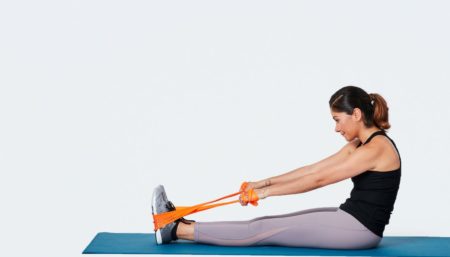
Muscles contract and relax to allow the body to perform crucial activity. Electrical signals tell the muscle when to contract, but when the muscle needs to relax, the signal is deliberately ignored. Until now scientists have been unable to understand how the body ignores this signal.
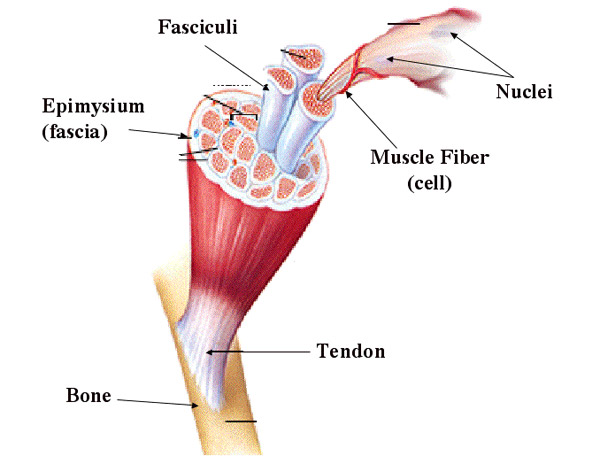
Muscle is an organ specializing in the transformation of chemical energy into movement. Movement is essential to life, and takes many forms, from cytoplasmic streaming and the growth of neurones at the cellular level, to the long distance flight of the albatross or the explosive performance of a sprinter. Although only a few families of protein are responsible for movement in the biological world, muscle has developed to optimize this function, and is packed with movement-related proteins. There are many types of muscles, but they fall into three categories: skeletal muscle (or striated muscle), responsible for locomotion, flight etc; cardiac muscle, which has a vital role and is able to function for a century or more, without ever taking a break, and smooth muscle (or involuntary muscle) which lines the walls of the arteries to control blood pressure, or controls the digestion of food by causing movement of the intestine.
Having established that each muscle is comprised of numerous fibres, each of these in turn consists of many myofibrils, which form the functional units of muscle and effect the contraction and relaxation process. The functional part of the myofibrils consists of numerous contractile units, called sarcomere connected in series. Each sarcomere is composed of different muscle proteins, in particular the two main contractile proteins (myofilaments) called actin and myosin. Myosin filaments are thick contractile proteins and remain relatively stationery during contraction. Actin filaments are thin contractile proteins that are drawn towards each other from both ends of the sarcomere during muscle contraction. The actin and myosin filaments lie parallel to each other and become interlocked during contraction. The two contractile proteins are connected during contraction by myosin cross-bridges. (These are globular proteins that originate from the larger myosin filaments and are chemically bound to the actin filaments during contraction.)
When contracting, the actin myofilaments from both ends of the sarcomere slide over the myosin filaments towards the middle of the sarcomere, thereby shortening the contractile unit by pulling the Z-disks towards each other. This is similar to the forward movement of a millipede. The cross-bridges attach and detach in different sequences (the way a millipede’s legs move along the ground) to pull the actin filaments over the myosin filaments. Not all myosin cross-bridges are attached at the same time.

The difference between the millipede and cross-bridges is that the cross-bridge cycling is significantly faster. As each sarcomere shortens, the entire muscle fibre contracts. Depending on how many myofibrils are activated, their respective forces are also summated and transferred by the tendons and tendinous structures to the bones.
Different forms of muscle contraction
Most people associate muscle contraction with muscle shortening and a decreasing angle between two bones. However, it also means that the muscle attempts to shorten against, or actively resists while lengthening against, a load.
There are four different types of muscle contraction, namely – concentric – eccentric – isometric – plyometric.
CONCENTRIC CONTRACTION
The most common muscle contractions in resistance training are concentric and eccentric. Concentric contraction means that the muscle is activating sufficient myosin-actin cross-bridges to develop enough muscle tension to overcome the load or weights applied upon it. The muscle therefore shortens and closes the joint angle between two bones by pulling the insertion of the muscle towards its origin. In other words, the muscle generates sufficient force to overcome and lift the weight. This is also known as a positive contraction. The lifting phase of resistance training is a concentric contraction. For most concentric contractions, the duration of the contraction should be roughly one to two seconds from beginning to end. This is not, however, true for all techniques.
ECCENTRIC CONTRACTION
Once the weight has been lifted, it has to be lowered to its starting position. This must be done in a controlled manner – for safety reasons as well as for training benefits. While the muscle lengthens and prevents the weights from falling down, the muscle is contracting eccentrically and resists lengthening. The lowering phase of resistance training is an eccentric contraction. Eccentric contractions should last roughly two to four seconds from beginning to end, though not for all techniques.
ISOMETRIC CONTRACTION
Isometric contraction is often defined as ‘muscle contraction without muscle shortening and without visible movement’ although the muscle does shorten to some extent as it contracts against the opposing tendons of the origin and insertion. In this way it applies tension to them and the tendinous structures, and statically supports a submaximal load (less than the maximum load you can lift), or tries to overcome a supramaximal load (more than you can lift). The resistance used, and compliance of the tendons, determine the extent to which the tendons can stretch and the muscles shorten. A better definition would be ‘a static muscle contraction where no movement of the, limb or body part involved is visible’. In other words, an isometric contraction is a static contraction, where the muscle’s tedious insertion and origin do not approach each other, even though the muscle sarcomeres shorten slightly to support or attempt to move the load. Holding a lighter weight stationary, and trying to lift an immovable object are examples of isometric contractions.

PLYOMETRIC MUSCLE ACTION
Plyometric muscle action is the stretch-shortening cycle of a muscle. Plyometric action features the combination of eccentric and concentric contractions when a load is lifted. Most natural and sporting movements make use of the stretch-shortening cycle. In any sporting movement, if you intend to move in one direction, you unconsciously move in the opposite direction first and pre-stretch the muscle before pushing off in the intended direction. A side step in rugby or football is a good example. The term stretch-shortening cycle perfectly describes it: first you stretch the muscle and then you shorten it. You use a quick eccentric stretch of the involved muscle to enhance the concentric contraction to follow. In resistance training, this is a fast and explosiveness and power.
Summary
- Concentric contraction occurs when the muscles generate sufficient force to overcome inertia and lift the weight.
- Eccentric contraction occurs when the weights are lowered (the muscles resist lengthening).
- In an isometric contraction no movement is visible, while the muscles try to overcome an immovable load or hold a submaximal load in a static position. Here the top stoppers resist movement.
Disclaimer
The Content is not intended to be a substitute for professional medical advice, diagnosis, or treatment. Always seek the advice of your physician or other qualified health provider with any questions you may have regarding a medical condition.