
The process of labor and childbirth can be divided into three stages.
The first stage of labor consists of an early phase that begins with the onset of contractions and the gradual effacement (thinning out) and dilation (opening) of the cervix, followed by an active phase in which the cervix begins to dilate more rapidly and contractions are longer, stronger, and closer together (This is when it’s usually time to call your doctor or midwife.) The active phase ends with a “transition period” as the cervix fully dilates to 10 centimeters. The second stage begins once you are fully dilated and ends with the birth of your baby; this period is often referred to as the pushing stage. The third stage begins right after the birth of your baby and involves the separation and delivery of the placenta.
First Stage
First stage of labor is usually the longest part of labor. This is where you are having contractions and your cervix is dilating. This stage is broken down into three phases:
- Early or Latent Phase
The early phase of labor may be spent wondering “Is this really labor?” The contractions are usually very light and may be 20 minutes or more apart in the beginning, gradually becoming closer, possibly up to five minutes apart. The key to this stage is to go about your normal schedule or if it’s the middle of the night go back to bed! Most women will be very comfortable during this stage and with a few exceptions those having a hospital birth will not be in the hospital at this point.Some women will have much more frequent contractions during this phase, though the contractions will still tend to be mild and last less than a minute. You may also notice increasing mucous discharge from the vagina, which may be tinged with blood — the so-called “bloody show.” This is perfectly normal; however, if you see more than a tinge of blood, be sure to call your midwife or doctor.Sometimes the contractions in the latent phase can be quite painful, though they may be dilating your cervix much more slowly than you’d like! If you’re typical, though, your contractions in this early phase won’t require the same attention that they will later in labor. Some women even doze off between contractions. Also, be sure to drink plenty of fluids so that you stay well hydrated. And don’t forget to urinate frequently (even if you don’t feel the urge), since an empty bladder leaves more room for the baby to descend.
Signs of Early Labor:
- Backache
- Menstrual like cramps
- Indigestion
- Diarrhea
- Warm Sensation of Abdomen
- Bloody Show
How long it lasts: This phase can take from 12 to 14 hours or longer, although it’s often considerably shorter for second and subsequent babies
-
Active Phase
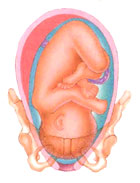 The active phase of labor is where many women are getting serious and withdrawing to do the hard work of labor. Contractions generally are four or five minutes apart and may last up to 60 seconds long. Remember this still gives you a big break in between. Use this break to relax, go to the bathroom, and drink something. For woman who desire medications in labor they will usually go to the hospital in this stage of labor, while those desiring little or no medications will go towards the end of this stage or the beginning of transition, again, with a few exceptions. Mobility and relaxation are the key to getting through active labor.
In the Active Phase, your contractions will become more frequent, longer, and stronger, and your cervix will begin dilating faster. As a general rule, once you’ve had regular, painful contractions (each lasting about 60 seconds) every five minutes for an hour, it’s time to call your midwife or doctor.
Breathing exercises, relaxation techniques, and a good labor coach can be a huge help during this stage. By now, you may have arrived at the hospital or birth center. If you have no medical or obstetric complications, you should be able to move around the room. You may find that it feels good to walk but will probably want to stop and lean against someone (or something) during each contraction.

Indications of Active Labor:
- Increased back pain
- Leg pains
- More bloody show
- Anxiety
If you’re having great difficulty coping or have little interest in natural childbirth, this is when you might opt for some pain medication. With systemic pain relief, usually delivered by IV or injection, you’ll still feel the contractions but to a lesser extent. Since the medication might make you feel drowsy or dizzy, you won’t be allowed to walk around after receiving it. Generally, regional anesthesia (such as an epidural and/or spinal) will provide you with much more complete pain relief, although you might continue to feel some pressure if your baby is low in your pelvis.
Practicing slow deep breathing can give you confidence about your ability to stay calm and cope during labor
How long it lasts: This phase can last up to six or more hours, although it can be a lot shorter, especially if you’ve previously had a vaginal delivery.
-
Transition Phase
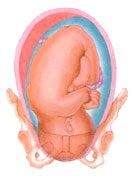 Transition is the time that your body is completing dilation and preparing to push your baby out. This is one of the shortest parts of labor, but definitely one of the hardest. Your contractions may be two or three minutes apart, lasting up to a minute and a half. Some women will shake and may vomit during this stage. This is normal. Remember that this stage usually doesn’t last more than an hour or two. Transition is also recognizable by various physical signs, which may or may not be present at your labor. Some women get hot and cold flashes, cold sweats, nausea or vomiting, shivering or shaking, hiccups, burping and a general inability to feel comfortable in any position. This is the most common time for the bag of waters to break naturally. When you begin to show these signs, it does not matter if you are dilated to 1 or 10 centimeters, it means you are very close to pushing your baby outBecause of the intensity of transition, mom’s moods may be volatile. She may be irritable, hostile, confused, disoriented; she may feel trapped and want to go home; may fear she is dying; often very dependent; discouraged or exhausted. It is common for her to say: “I can’t, I can’t.” Its your turn to remind her how well she is doing, and help her find a comfortable position, use cold rags for her face, and give her sips of water or ice in between contractions. This is hard work. When this phase is done you will be completely dilated! Some women will have a small break of no contractions after becoming fully dilated, and yet not feeling the need to push yet.

Signs of Transitional Labor:
- Feel strong pressure in your back and against the perineum from the baby’s head
- Bloody vaginal show will increase
You may feel:
- Leg cramps
- Nausea
- Exhaustion
- An overwhelming urge to push
- Duration: Range: 10 minutes to 2.5 hours. Average is about 1 hour in first time moms.
Second Stage
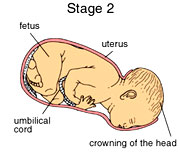 Once your cervix is fully dilated, the work of the second stage begins: the descent and ultimate birth of your baby. This stage normally lasts between ten minutes to two hours. You will be pushing with “all your worth” with your contractions and rest between your contractions trying to regain some of your composure and energy.
During this Stage:
- You will feel a strong urge to bear down.
- Crowning occurs when the baby’s head can be seen at the vaginal opening.
- You may feel pressure and stinging in the birth canal.
Pushing usually feels better for most women. They have spent the first stage of labor relaxing and letting their body do all the work, now they can actually do something to help. This stage can last three or more hours, but for many women will not. During labor, the baby descends into the pelvis. The measurement of this is “station.” When the baby is “floating” high above the pelvic inlet, that is station -4 or -5, because he is 4 or 5 cm above the mom’s ischial spines
The baby is defined as 0 station, or engaged, when his ‘presenting part’ (usually his head) is even with the ischial spines. Many women are at 0 station when labor begins. At +2 or +3, his head is at the vaginal opening, and the perineum is bulging.
The baby’s head continues to advance with each push until it “crowns” — this is the term used to describe the time when the widest part of your baby’s head is finally visible. The excitement in the room is palpable as your baby’s face begins to appear: the forehead, nose, mouth, and, finally, the chin. It’s a moment of unparalleled beauty. Crowning, is considered +4 or +5 station.
After the head delivers, you’ll be coached to pant while your midwife or doctor suctions the baby’s mouth and nose, and feels around the neck for the umbilical cord. His head then turns to the side as his shoulders rotate inside the pelvis to get into position for their exit. With the next contraction, you’ll be coached to push as his shoulders deliver, one at a time, followed by the body. This stage ends with the birth of your baby!
It’s a special moment, and you may feel a wide range of intense emotions: euphoria, awe, pride, disbelief, excitement (to name but a few), and, of course, relief. Exhausted as you may be, you’re also likely to feel a huge burst of energy, and any thoughts of sleep will vanish for the time being.
How long it lasts: The length of this stage is dependent upon the positioning of the mother (upright = faster), the positioning of the baby, whether medications have been used, etc. This stage can last anywhere from minutes to hours. The average duration of the second stage is close to an hour for a first-timer (or longer if you have an epidural) and 20 minutes if you’ve previously had a vaginal delivery.

Third stage
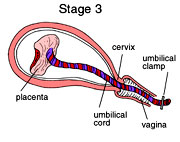 The third stage of labor begins immediately after the birth of your baby and ends with the delivery of the placenta. Shortly after your baby is born, the uterus begins to contract again. The first few contractions usually separate the placenta from the uterine wall.
When your midwife or doctor sees signs of separation, she may ask you to gently push to help expel the placenta. After you deliver the placenta, your uterus should contract and get very firm. You’ll be able to feel the top of it in your abdomen, around the level of your navel. Your midwife or doctor, and later your nurse, will periodically check to see that it remains firm. A well-contracted uterus is necessary to prevent continued bleeding from the place where the placenta was attached.
The contractions in the third stage are relatively mild. By now your focus has shifted to your baby, and you may well be oblivious to what else is going on around you. if you have any tears that need to be stitched. If you have lacerations or had an episiotomy, you may be given an injection of a local anesthetic before being sutured. If you had an epidural during labor, the anesthesiologist or nurse anesthetist will come by and remove the catheter from your back.
How long it lasts: Mild contractions generally resume within about three to five minutes after the arrival of your baby. The third stage of labor can take only a few minutes or last up to 30 minutes or so. On average, you can expect it to take about five to ten minutes.
Fourth or Postpartum Stage

No real contractions to speak of, but postpartum (The period of time after a baby’s birth) is generally accepted as the fourth stage of labor. Your body is going through many changes now that the baby has been born. Not to mention the large changes your family is going through adding a new person to your family. Be sure to ask for help. Your body will slowly change and become more like your pre-pregnancy self, but not exactly.
Enjoy your labor, believe it or not it’s the hardest work you’ll do, but it yields the most rewards
Disclaimer
The Content is not intended to be a substitute for professional medical advice, diagnosis, or treatment. Always seek the advice of your physician or other qualified health provider with any questions you may have regarding a medical condition.