|
|
Top 10 for Boning Up your Skeleton
A majority of
women face the threats of
osteoporosis, a disease that weakens the bones and
leaves them vulnerable to breaking. It's responsible for an estimated 1.5
million fractures every year - mostly of the hip, wrist, and spine. While
osteoporosis affects both sexes, it seems to target women with particular
ferocity. But there is a bright spot among all these bleak statistics. You see,
osteoporosis doesn't happen overnight. It takes a lifetime to develop. o if you act now, you can help protect your skeleton from this insidious
disease. The best prescription for your bone health? Engage in weight-bearing
exercise (such as
walking,
running, or
aerobics), give up
smoking (if you do),
and - perhaps most important - eat lots of bone - friendly foods. In fact,
one estimate suggests that the right diet alone could prevent as many as half of
all osteoporosis - related fractures.
Befriend the Bone-Builders
By no means are we suggesting that you feast on high-fat fare for your bones'
sake. Experts say that there are plenty of healthy ways that you can meet
your daily
calcium quota through diet. The following nutrition strategies can keep your bone bank in the black - and
save your skeleton for a lifetime.
Rediscover dairy :
|
|
|
Have you paid a visit to your
supermarket's dairy case lately? If not, you should. You'll find an
almost mind-boggling array of nonfat and
low-fat dairy products, including milk,
cheese, and yogurt. And just because the fat is gone doesn't mean the
calcium is . For example, an eight-ounce glass of skim milk
contains 300 milligrams of calcium. Drink 3 1/2
glasses a day, and you'll get all of the mineral you need.
Variation
Graze on greens
:
|
They don't supply as much calcium as dairy
products do, but dark green, leafy vegetables can definitely move you a few
rungs up the ladder to your recommended daily intake. Among the calcium
standouts in this produce group are kale, with 47 milligrams per
1/2 cup, and broccoli, with 36 milligrams per 1/2
cup.
|
|
Grow fond of fish
:
|
Certain fish have edible bones that are loaded
with calcium. For
example, three
ounces of canned pink salmon has 181 milligrams of the mineral, while one ounce
of canned Atlantic sardines has 92 milligrams. Canned fish does have a lot
of
sodium,
though, so look for brands labeled "low-salt" and, in the case of sardines,
rinse them well before eating.
Seek out surprise sources
:
|

Many manufacturers now add calcium to
certain packaged foods. Calcium-fortified orange juice, for
instance, supplies just as much of the mineral as skim milk: 300
milligrams in an eight-ounce glace.
|
Nosh at night
:
|
As mentioned
earlier, your body is constantly dumping old bone tissue. But at
least one study has shown that the process actually speeds up while you
sleep, peaking at about 3:00 in the morning. Having a calcium-rich
night cap-maybe a glass of skim milk or some nonfat yogurt - may keep your
blood level of the mineral more stable during the overnight hours.
|
Don't forget D :
|
Calcium can't do its job without vitamin D to
escort it across intestinal walls and into your cells. Your body can
manufacture its own D with a little help from Old Sol. But if you live in
northern climate or don't spend 5 to 15 minutes in direct sunlight without
sunscreen every day, you'll want to make sure that you're getting enough of the
nutrient from food sources instead. Both milk and break-fast cereals are
fortified with
vitamin D. Aim for the Daily Value (DV) of 400 IU.
|
Watch
your tempeh :
|
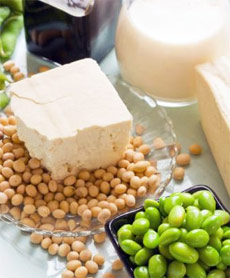
Tempeh, tofu, and other soy foods contain
estrogen-like compounds called isoflavones. Scientists at the University
of Illinois found that women who consumed 90 milligrams of isoflavones a day
experienced a 2 percent increase in their bone densities. You can reach 90 milligrams - the amount used in the study - by eating one
cup of roastedsoy nuts (60 milligrams) and drinking one cup of soy milk (30
milligrams).
By the way, not all soy foods contain isoflavones. You won't find them
in soy sauce or soybean oil, for example.
Spot the a-salt
:
|
A high-sodium diet delivers a double whammy to
your skeleton. Salt not only interferes with calcium absorption but also
increases the amount of the mineral that's excreted from your body.
You don't necessarily have to give salt entirely, but a little moderation in order. Ideally,
experts say, you should get no more than the DV of 2,400 milligrams of salt a
day - the equivalent of about one teaspoon.
Quaff coffee with caution
:
|
S ome
studies suggest that drinking a lot of coffee - or any caffeine - laden
beverage, for that matter - may raise your risk of a hip fracture.
Based on what they know so far, experts believe that you can have up to
two cups of java a day without any ill effects. And rather than drinking
your coffee black, try adding a little milk. Milk prevents caffeine from stealing calcium from your bones.
|
Give cola the cold shoulder
:
|
It's not only the caffeine in cola
that can be hard on your bones. Preliminary research
suggests that phosphorus - a mineral found in cola as well as in many processed foods
contributes to higher rates of bone fracture. Some scientists believe that
phosphorus actually steps up calcium excretion. The combination of too much
phosphorus and too little calcium leads to osteoporosis.
Clearly, more research is necessary to flesh out the phosphorus-osteoporosis
link. For now, experts recommend limiting your cola consumption to one
12-ounce serving per day.
Put a lid on alcohol:
Research has shown that people who drink
more than two glasses of wine or four ounces of hard liquor a day have less bone
mass than teetotalers of the same age and sex. Why? Well, alcohol
not only has a direct toxic effect on bone cells, it also seems to take the
place of calcium-rich foods in the diet. The bottom line is that it f you must imbibe, do so in moderation-no more
than two or three drinks a week. (A drink is defined as 5 ounces of wine,
12 ounces of beer, or a mixed drink made with 1 1/2 ounces
of liquor.)
|
|
Related Links
|
|
|
|
|