Depression is one of the most common mental health problems in the world. Tens of millions of people across the planet are diagnosed with some form of depression every year. While many cases of depression are tied to personal issues that affect the emotions, some have biological roots.
The first thing a depressed person stops doing is moving. Regular exercise becomes intolerable. But Yoga exercise, starting with as few as three poses a day in just a few minutes’ time, coupled with correct breath patterns, can become so pleasant to you that soon you will want to do more and more. Often depression sneaks in slowly, as breathing patterns change from too much sitting at a desk, stress, age, or illness. The deep, invigorating breath techniques of Yoga bring large amounts of fresh oxygen to the brain and other parts of the body. Like a spring wind, it blows through the system bringing new light and strength to the unused parts of the body and mind where depression hides.
Another thing to be noted is that depression is one of the most treatable of the mental illnesses, particularly if you get early intervention. There are a variety of medications and talk therapy techniques in existence that have great potential to ease your symptoms. A qualified mental health professional can guide you toward the right treatment program for you. Here we focus on Yoga asana to tackle depression.
The Lion Pose (Simhasana)
Contraindications: Knee pain or injury
This is a wonderful pose for gaining courage and lightening your emotional load; the facial expressions involved are guaranteed to boost your mood.
- Kneel on the floor; keep your knees about shoulder-width apart.
- Sit back on your heels; your calves should be flat on the floor.
- Spread the knees apart a little further; only move them as far as is comfortable.
- Straighten and lengthen the back and shoulders; sit up tall.
- Without rounding the shoulders, place your hands loosely on your knees.
- Inhale and lean forward slightly without compromising your straight spine.
- While leaning forward, stretch your mouth and jaw open as wide as possible. Extend your tongue and cross your eyes by looking at the tip of your nose; also tense and straighten your fingers out from their resting place on the knees.
- Hold this position for one breath and then relax; lean back and let your fingers drop back to your knees. Close the mouth and eyes.
- Repeat this posture at least three times with a short break in between each repetition.
Benefits: The Lion is a great pose for loosening up the muscles of a clenched or tight jaw. All the muscles of the face are used; each repetition causes tension to melt away.
The Fish Pose (Matsyasana)
Releases tension and is also good for deep breathing and relaxation.
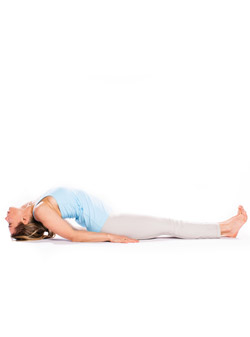 Lie flat on your back, either on a mat or on a carpeted floor. Keep your knees straight and keep your feet together with toes pointed to the ceiling.
- Slide your hands under your thighs and buttocks. This motion should cause your chest to bow upward slightly.
- Bend the elbows and push them into the floor; use the bend of the elbows and arms to raise the chest higher, keeping the chest arched upward.
- When the chest is arched as high as possible, drop your head and rest the very top of your head on the floor. Your chin should point to the ceiling.
- While in this posture, breathe deeply and really enjoy the chest expansion. Hold this position for as long as is comfortable.
Benefits: This is a great chest-opener; many people who have depression coupled with anxiety often have feelings of tightness or pressure in the chest—this pose can help ease the pressure. The Fish is also very beneficial for a tense neck, shoulders and lower back.
The Child’s Pose (Balasana)
A good, relaxing counter-pose if performed after the Fish pose.
- Kneel on the floor, and then sit directly onto your heels.
- Shift your knees until they are a little more than hip-width apart.
- Bend forward at the hip; bring your chest to rest between your thighs.
- Keep your buttocks in contact with your heels and rest your forehead on the floor. If this is uncomfortable, rest your forehead on a cushion or folded blanket-make sure it is high enough for you to be comfortable.
- Stretch your arms out in front of you on either side of your head. Lengthen the muscles as far as you can, really give a good stretch! Then slide your arms back to your sides, palms up and relax.
- Remain in this pose for as long as possible. Breathe deeply and relax into the posture.
Benefits: Child’s pose is a comforting, peaceful asana. Staying in this position is not only relaxing, but also promotes a feeling of safety and security. The stretch involved to the lower back and arms also feels wonderful!
Warrior (Virabhadrasana)
This yogasana is a great confidence booster; anytime you feel unsure of yourself or uneasy, try this posture.
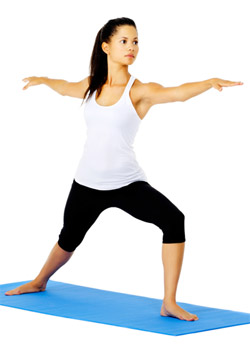 Stand tall with good posture and plant your feet about shoulder-width apart.
- With your right foot, take a large step forward into a lunge; keep the left foot firmly planted. Do not turn or rotate the hips.
- Your right knee should be bent and you should keep the knee located directly above the ankle. You should feel a good stretch in the calf muscle of the left leg. If not, slide the left foot back an inch or so.
- After achieving a good strong lunge, raise the arms above your head. Really stretch them to the ceiling; feel that stretch all the way to your fingertips. Relax a bit, keeping the arms up, and turn the palms facing each other.
- To deepen the stretch, carefully arch the back and look at the ceiling.
- Repeat this posture at least once using the left leg for the lunge.
Benefits: This is a very easy asana, but also a very powerful one. Warrior can help you feel more grounded. You can gain equilibrium both mentally and physically, with this pose.
Corpse Pose (Savasana)
There’s just no better way to end a yoga session than with the ultimate relaxation pose.
- Lie on your back on the floor (or on a mat). Spread the arms out to a 45 degree angle from your sides. Let your legs drop open. There should be no tension in trying to hold this position, don’t try to keep the toes pointed. Keep your head resting comfortably.
- Close your eyes and breathe deeply. Each breath should expand both the chest and belly. Allow your entire body to feel heavy and soft; literally try to relax into the floor.
- Mentally look for places where your body is tense. Should you find tension, focus on that part of the body, tense it and then release. Wiggle your fingers and toes to remove any pressure or stress.
- Try to clear your mind. Continue to breathe deeply and enjoy yourself.
- Do not fall asleep; that isn’t the goal here. Enjoy a conscious state of deep relaxation.
Benefits: The benefits of this pose are truly endless. Nothing beats a good bit of relaxation. Use this pose anytime you feel upset or blue. If it’s hard to get out of bed in the morning to face the day, use this posture to give you a little better perspective. If you suffer from insomnia, this is a perfect way to end the day.
Sun Gazing can also be a powerful technique of Yoga for depression and overall health.
There are many ways to relieve depression and you should always ask your physician about which ways are best for you. Among the many options you might have is through Yoga. Meditating and Yoga exercises stimulate your circulation and nervous systems along with other bodily functions. It also improves your concentrate and energizes your mind and body.
Disclaimer
The Content is not intended to be a substitute for professional medical advice, diagnosis, or treatment. Always seek the advice of your physician or other qualified health provider with any questions you may have regarding a medical condition.