A study published in the latest issue of Psychology of Women Quarterly reports that mind-body exercise, such as yoga, is associated with greater body satisfaction and fewer symptoms of eating disorders than traditional aerobic exercise like jogging or using cardio machines. Yoga practitioners reported less self-objectification, greater satisfaction with physical appearance, and fewer disordered eating attitudes compared to non-yoga practitioners. Through yoga, this study suggests that women may have intuitively discovered a way to buffer themselves against messages that tell them that only a thin and ‘beautiful’ body will lead to happiness and success.
Yoga offers an unparalleled opportunity to heal negative body image. The various poses challenge people to use balance, strength, stamina, stillness, mindfulness, and flexibility. The yogic system identifies eating disorders as a problem related to the first chakra. Different poses are used to balance it: crab, full wind, pigeon, locust, staff, and many more. Strengths and courage can be increased by using grounding postures such as mountain, goddess, standing squat, and prayer squat. The postures re-establish the strong mind-body connections and help overcome many physical obstacles. Most back bending poses help reduce depression and forward bends usually calm the spirit and minimize the effects of anorexia.
An active, specifically targeted meditation practice will prove to be highly effective in managing eating disorders. General meditation practice will be beneficial, but using an active and targeted meditation would be more effective. Practice any or all of the following based upon what calls you to be invoked within yourself: Inner Peace Meditation, Third Eye Meditation, Root Chakra Meditation or Prana Healing Meditation. If it becomes uncomfortable to practice with the eyes closed, have them slightly open with a soft downward gaze.
Yoga, highly therapeutic and relatively non-threatening, is the ideal therapy: a gentle reawakening of the mind and a soft embrace of the body, all helping to get patients back into the land of healthy living.
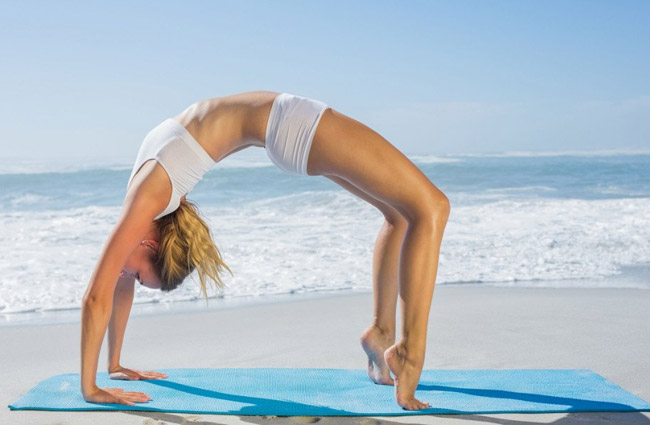
Crab posture (Catuspadapitham)
Crab posture opens the front side of the body and builds arm, leg and core body strength.
Instructions
- From staff posture/Dandasana, bend the knees bringing the feet flat on the floor hip width apart. Keep the arms behind your hips with the fingers pointed away from your body.
- Lean back into the arms and slowly inhale and lift the hips up towards the ceiling.
- Press into the feet, squeezing the thighs and buttocks and engaging mula bandha.
- Press down into the hands with the arms straight to lift the chest up towards the ceiling, slightly arching the back.
- If it feels safe, slowly let the head drop all the way back.
- Breathe and hold for 2-6 breaths, making sure you breathe into the belly and into the chest.
- To release: slowly exhale the hips back down to the floor.
- Inhale one leg up towards the ceiling, pressing out through the heel.
Pigeon (Kapotasana)
Pigeon opens the hips and chest, facilitates deeper breathing, and opens the heart (5th) chakra.
Instructions
- From the table position, slide the right knee forward, between the hands. Let the right foot slide over to the left. Slide the left leg back, lowering the hips towards the floor.
- Press down into the palms or fingertips, inhale and reach the crown of the head up, lengthening the spine. Exhale and sink the hips down into the floor. Roll the shoulders down and back and press and lean forward through the chest.
- Breathe and hold for 3-6 breaths.
- Move as deep into the posture as you can while still maintaining full deep breathing. Breathe and hold for 3-6 breaths.
- To release: support your weight with the hands as you slide the right knee back into the table.
- Repeat other side.
Modification
- Lead with the chest as you exhale forward, coming on to the forearms, bringing the forehead to the floor or supported on top of your palms or fists. For a deeper stretch, slide the hands all the way forward.
- Bring the hands to the front bent knee, lifting yourself up a little higher.
- Interlace the fingers behind your back, squeezing the shoulder blades together.
- Inhale the arms over your head, in a H position, palms together with thumbs crossed, or interlace the fingers and point the index finger.
Locust Pose (Salabhasana)
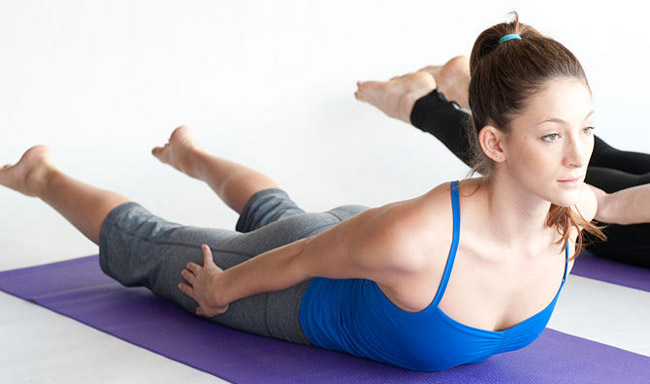
This is an exceptional posture in that it requires a sudden movement. It is like the cobra posture but raising the feet instead of the head. It can therefore be used, occasionally only, instead of the cobra.
Instructions
- Lie on your front. Rest your chin on the ground, then move it forward as much as you can, so that your throat lies almost flat. Put your arms by your sides, then push your hands under your body, and make them into fists or clasp them together. Bring your elbows as close together as possible.
- Inhale as you lift one leg. Hold this position for at least 10 seconds, then exhale while lowering your leg and repeat the pose with your other leg. Practice it 3 times on each side. Chin position: The further forward you push your chin, the more your spine can stretch and the more you will gain from this asana.
- Lie with your chin out, as in the Half Locust, then take 3 deep breaths. On the third, lift both legs off the ground. They may not come up far at first, but with practice you may be able to lift them much higher. Hold for as long as you can, then lower your feet. Repeat twice and then relax.
- Up and Up: With practice, you will be able to raise your legs higher. Eventually, you may even be able to lift your body vertically.
Related Links
Disclaimer
The Content is not intended to be a substitute for professional medical advice, diagnosis, or treatment. Always seek the advice of your physician or other qualified health provider with any questions you may have regarding a medical condition.