Stress is an important influencing factor for IBS patients. All who suffer from it agree that when stress increases, so do the IBS symptoms. That, in turn, saps the energy from the patient. Practicing yoga will initially help lessen the existing symptoms, and, if practiced regularly, will result in less frequent and intense occurrence IBS. A bonus is that there will be no undesired side-effects, as can be possible when medication is required.
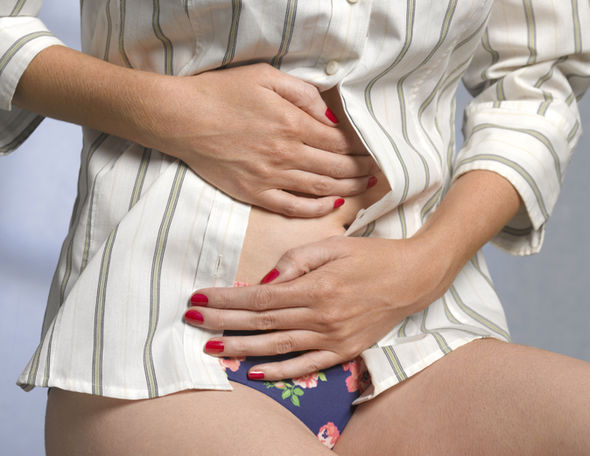
Yoga teaches us to breathe as babies do, into our abdomen. As a result, the breathing process slows and deepens. With these slow, deep breaths comes a calmness and serenity that is unavailable otherwise. When we are under stress, the diaphragm freezes and we develop shallow breathing. This often happens outside of our conscious awareness. Over time, this shallow breathing comes to feel natural and normal to us. |
IBS sufferers often battle bowel habits that are painful and unpredictable. During a flare-up, concentrate on postures that provide a soothing effect. Forward bends and simple abdominal twists like Jathara Paravritti (a revolved twist) and Apanasana (a knee-to-chest pose), may help soothe a hyperactive bowel or stimulate a sluggish one.
Jathara Paravritti
This twist is fantastic for all the internal organs and for releasing tightness in the back. It is also a great preparation for relaxation.
Instructions:
- Start in the lying rest position. Lift your buttock a few centimetres and move them to the left about 2 hands breadths and place them down again.
- Now lift the knees and feet and roll them both to the right till they both rest on the floor to the right side of your body. Try to have a right angle at both the hip and knee joints.
- Lift your head and turn to look over your left shoulder. Stay here for 4-6 breaths, letting the in-breath start at the belly and come up to the chest and on the out-breath, progressively let go of every muscle.
- Roll back and re-adjust everything to the centre and then go the opposite way. Buttocks up and to the right – then down, knees and feet up and to the left and then down, head up and to the right.
- After completing both sides rest in the lying rest position.
Apanasana
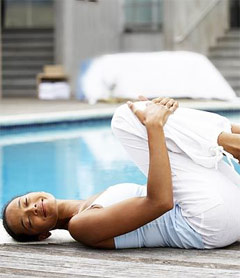 This classic posture helps digestion and elimination and limbers the lower back.
Instructions:
- Starting in the lying rest position, take the feet off the floor and bring the thighs to a vertical position.
- Place the hands on the knees and without taking your head off the floor, exhale, while bringing the knees towards the torso.
- Try to let the abdominal muscles do most of the work, letting the hands help a little toward the end of the movement.
- On the inhalation, allow the knees to move away to the starting position, while bringing the arms overhead to the floor behind you.
- Repeat slowly 6 times, being sure to breath out as the knees come towards the body and breath in when they move away.
Spinal twist exercise
can help to relieve your IBS symptoms and possibly ward off flare-ups by increasing blood flow to the abdominal organs. The exercise will also strengthen your abdominal muscles, which support the colon, helping the colon to function better. Moreover, the relaxation induced by performing yoga can stimulate the release of endorphins (the feel-good hormones), which should help decrease your stress levels. For Instruction click here..
For constipation, you can stimulate digestion by working the abdomen more strongly in Uttanasana (Standing Forward Bend) or Parivrtta Trikonasana (Revolved Triangle Pose); just move into the postures with the belly held in after releasing an exhalation.
Uttanasana (Standing Forward Bend)
Despite its name, which means “intense stretch” pose, Uttanasana will wake up your hamstrings and soothe your mind.
Benefits
- Calms the brain and helps relieve stress and mild depression
- Stimulates the liver and kidneys
- Stretches the hamstrings, calves, and hips
- Strengthens the thighs and knees
- Improves digestion
- Helps relieve the symptoms of menopause
- Reduces fatigue and anxiety
- Relieves headache and insomnia
- Therapeutic for asthma, high blood pressure, infertility, osteoporosis, and sinusitis
Contraindications/Cautions
Avoid if you have a back injury: Do this pose with bent knees, or perform Ardha Uttanasana (pronounced ARE-dah, ardha= half), with your hands on the wall, legs perpendicular to your torso, and arms parallel to the floor.
Instructions
- Stand in Tadasana, hands on hips. Exhale and bend forward from the hip joints, not from the waist. As you descend draw the front torso out of the groins and open the space between the pubis and top sternum. As in all the forward bends, the emphasis is on lengthening the front torso as you move more fully into the position.
- If possible, with your knees straight, bring your palms or finger tips to the floor slightly in front of or beside your feet, or bring your palms to the backs of your ankles. If this isn’t possible, cross your forearms and hold your elbows. Press the heels firmly into the floor and lift the sitting bones toward the ceiling. Turn the top thighs slightly inward.
- With each inhalation in the pose, lift and lengthen the front torso just slightly; with each exhalation release a little more fully into the forward bend. In this way the torso oscillates almost imperceptibly with the breath. Let your head hang from the root of the neck, which is deep in the upper back, between the shoulder blades.
- Uttanasana can be used as a resting position between the standing poses. Stay in the pose for 30 seconds to 1 minute. It can also be practiced as a pose in itself.
- Don’t roll the spine to come up. Instead bring your hands back onto your hips and reaffirm the length of the front torso. Then press your tailbone down and into the pelvis and come up on an inhalation with a long front torso.
Parivrtta Trikonasana (Revolved Triangle Pose)
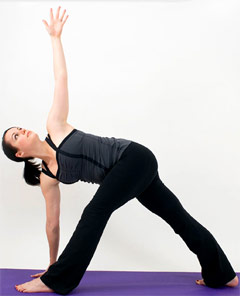 Parivrtta Trikonasana is usually sequenced just after (as a counterpose to) Trikonasana. You can also use this pose as a standing preparation for seated forward bends and twists.
Benefits
- Strengthens and stretches the legs
- Stretches the hips and spine
- Opens the chest to improve breathing
- Relieves mild back pain
- Stimulates the abdominal organs
- Improves sense of balance
Avoid this pose if you have:
|
Instructions:
- Stand in Tadasana. With an exhalation, step or lightly jump your feet 3½ to 4 feet apart. Raise your arms parallel to the floor and reach them actively out to the sides, shoulder blades wide, palms down. Turn your left foot in 45 to 60 degrees to the right and your right foot out to the right 90 degrees. Align the right heel with the left heel. Firm your thighs and turn your right thigh outward, so that the center of the right kneecap is in line with the center of the right ankle.
- With an exhalation, turn your torso to the right, and square your hip points as much as possible with the front edge of your sticky mat. As you bring the left hip around to the right, resist the head of the left thigh bone back and firmly ground the left heel.
- With another exhalation, turn your torso further to the right and lean forward over the front leg. Reach your left hand down, either to the floor (inside or outside the foot) or, if the floor is too far away, onto a block positioned against your inner right foot. Allow the left hip to drop slightly toward the floor. You may feel the right hip slip out to the side and lift up toward the shoulder, and the torso hunch over the front leg. To counteract this, press the outer right thigh actively to the left and release the right hip away from the right shoulder. Use your right hand, if necessary, to create these two movements, hooking the thumb into the right hip crease.
- Beginning students should keep their head in a neutral position, looking straight forward, or turn it to look at the floor. More experienced students can turn the head and gaze up at the top thumb. From the center of the back, between the shoulder blades, press the arms away from the torso. Bring most of your weight to bear on the back heel and the front hand.
- Stay in this pose anywhere from 30 seconds to one minute. Exhale, release the twist, and bring your torso back to upright with an inhalation. Repeat for the same length of time with the legs reversed, twisting to the left.
Yoga is just one component to fighting IBS. When symptoms recur, experts have found that IBS responds best to a care plan that incorporates anxiety relief, exercise, and a diet that eliminates aggravating foods and includes nutritional or herbal supplements. The deep breathing and meditative aspects of yoga can reduce stress and tension, which often contribute to IBS. Try to practice yoga on a regular basis (every day is ideal) to combat the stress of IBS.
Disclaimer
The Content is not intended to be a substitute for professional medical advice, diagnosis, or treatment. Always seek the advice of your physician or other qualified health provider with any questions you may have regarding a medical condition.
