The ankle is one of the most frequently injured joints for those who participate in sports. An ankle sprain is an injury of one of the supporting ligaments, usually due to overstretching or tearing.
Anatomy of Ankle
Your ankle joint includes the bottom of the shin bone (the tibia), representing the inner portion of the ankle, the smaller leg bone (the fibula), the outer portion of the ankle, and the Talus (below the ankle joint) bone of the foot. The joint allows for the upwards (dorsiflexion) and downwards (plantarflexion) motion. Joint instability may develop after damage occurs to one or more of the bones surrounding the joint. This type of damage is termed a fracture. The joint may also become unstable when the surrounding ligaments are damaged.
There are three major ligaments of the ankle that hold these bones together:
- Anterior talo-fibular ligament (goes from the talus to the fibula)
- Calcaneo-fibular ligament (goes from the calcaneus to the fibula)
- Posterior talo-fibular ligament (goes from the talus to the fibula).
These ligaments also allow ankle motion, but only within certain limits.
When does it occur?
Ankle Sprains, more often occurs in sports where there is side-to-side movement, such as basketball, soccer, tennis, squash, and racquetball. But it occurs in other activities, especially when the ground is uneven and the ankle turns on itself.
The risk of ankle injuries varies by sport; they make up 45% of all injuries in basketball, 31% in soccer, and 25% in volleyball. In professional, college, and high school football, ankle sprains account for 10% to 15% of all time lost to injury. Yet these injuries are often minimized
Symptoms
When this occurs, there is
- Pain,
- Blood vessels can rupture and
- Bleed around the joint, and
- The ankle becomes less stable.
- Also, tendons from the muscles of the leg can be stretched and damaged, and
- A fracture of the ends of the tibia and/or fibula and the metatarsal foot bones can occur.
Diagnosis
Diagnosis of the injury is determined by examination of the location of the bruising (ecchymosis), swelling, and tenderness. It is also necessary to perform stress testing of the ligaments to determine whether the ligament has been torn. Stress testing of the ligaments is done by pushing on the ankle and attempting to determine if there is any abnormal motion at the joint which would indicate that a ligament has been torn. In addition, x-rays are often performed to check for the possibility of a chipped bone or fracture.
When performing a stress test of the ligaments, a posterior directed force is applied to the front of the tibia (shin bone). If the ankle ligaments are completely torn, the tibia will visibly shift backwards at the ankle joint. When the force is removed, the tibia will snap back into its proper position at the ankle joint. When this abnormal motion occurs, the anterior talo-fibular ligament (ATFL) has been torn.
Useful Tests for Various Ankle Injuries
| Injury Location | Specific Injury | Useful Test |
| Lateral | Inversion sprain Lateral malleolus fracture Osteochondritis dissecans Peroneal tendon subluxation Bifurcate ligament avulsion |
Anterior drawer, talar tilt X-ray as per Ottawa ankle rules Mortise view ankle x-rays Resisted dorsiflexion and eversion X-rays |
| Medial | Medial ankle sprain Medial malleolus fracture Posterior tibialis tendon injury Flexor hallucis longus tendinitis |
Eversion stress X-ray as per Ottawa ankle rules Single heel-rise test Resisted first-toe flexion |
| Posterior | Achilles tendon rupture Os trigonum fracture |
Thompson’s Weight-bearing lateral x-ray, tenderness on passive plantar flexion |
| Anterior | Syndesmosis sprain Dorsiflexion injuries Anterior tibialis tendon injury |
“Squeeze,” external rotation Side-to-side Resisted dorsiflexion |
| Other | Avulsion fracture, 5th metatarsal Maisonneuve fracture |
Palpation tenderness, foot x-rays Palpation tenderness, fibula x-rays |
Levels of ankle sprains
There are three different levels of ankle sprains, based on the severity of damage. Returning to the activity should be done only when you are pain free, have regained a full range of motion, and have sufficient ankle strength. It is very important to strengthen your ankle after a sprain to help prevent another ankle injury.
- Grade I – stretch and/or minor tear of the ligament without laxity (loosening)
- Grade II – tear of ligament plus some laxity
- Grade III – complete tear of the affected ligament (very loose)
Grade I ankle sprains involve excessive stretching of one or more ankle ligaments, but the ligament is not torn. Usually blood vessels are not damaged, and there is no bruising around your ankle. Rest, icing the ankle with a compression bandage (like an ace wrap), and elevating your ankle on several pillows is all that is necessary. When the sprain first occurs, apply the ice for 10 to 15 minutes, then allow another 10 to 15 minutes to pass without ice. Re-apply the ice to your ankle, off and on for 10 to 15 minutes for the next several hours. This is called RICE therapy (rest, ice, compression, elevation), and it will reduce swelling and limit pain. The time of recovery depends on the extent of the damage. Usually a few days to two weeks of healing are needed, followed by ankle strengthening and stretching exercises.
Grade II
ankle sprain means there is a tear of one or more of your ankle ligaments, but the ankle is not unstable. Some ligaments of your leg are often injured or torn. Bleeding occurs with this injury and you will see bluish bruising by one day after the sprain. RICE therapy should be the initial treatment, similar to grade I sprains. However, for many grade II sprains, a removable splint or brace that prevents excessive side-to-side ankle movement is often used for four to five days. Avoid placing weight on your injured ankle if there is significant pain. Use of crutches for a few days may help speed the healing process by giving your ankle some needed rest. As the ankle pain diminishes, remove the splint or brace and begin range of motion exercises. But do not force your ankle to move in pain.
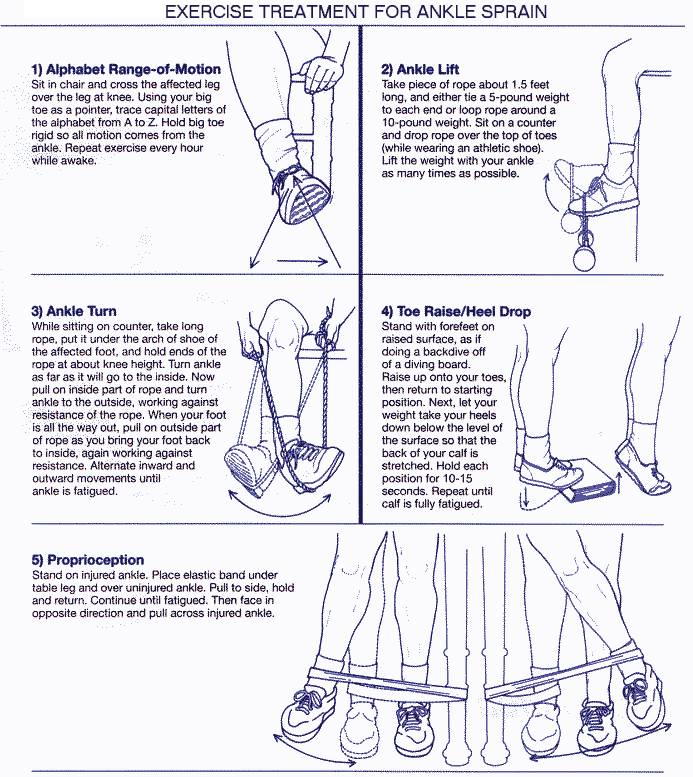
Start by moving your joint up and down, as if you were stepping on and easing off the gas pedal of an automobile. As your ankle joint becomes more limber, moving your foot in small circles and increasing the size of the circles will help restore mobility. As healing progresses, try drawing numbers (1 through 9) in the air with your toes, keeping your knee and hip motionless. Other exercises (Table A.2) can be done, using surgical tubing that is available at most drug and athletic stores. A physical therapist or your physician can help you initiate this type of training. Swimming is a great way to improve strength and aid in ankle flexibility before you attempt running or participation in other sports.
Grade III sprains are the most severe: you have ligament tear and an unstable ankle. A physician needs to immobilize your ankle joint. The ankle is usually positioned so as to enhance correct healing of the ligaments. A walking cast is often used, with weight placed on the cast as tolerated. After the cast is removed, about three weeks later, rehabilitation of the ankle is started to regain motion and strength. In addition, because we can lose the sense of where our ankle is after a severe ankle sprain, specialized exercises are used with a shifting flat surface, known as a BAPS, or biomechanic ankle proprioceptive system board, as one of the rehabilitation devices. This type of exercise can help you prevent your next ankle sprain. Swimming before weight-bearing exercise often is recommended. This will aid ankle flexibility and strengthening, without excessive stress.
Remember, you should be pain free with normal ankle movement before progressing exercises such as rope skipping and jogging on level ground. Surgery is rarely needed after ankle sprains, but may be necessary to repair severely damaged ligaments and tendons.
Depending on the severity of the sprain, treatment may range from simply wearing a supportive brace, to using a walking cast, or even having the ankle operated on. The type of treatment depends on several factors including severity of injury, presence of associated injuries, the routine stresses that are placed upon the ankle, and the general medical condition of the injured patient
Treatment
All lateral sprains can be treated conservatively with protection, rest, ice, compression, and elevation (PRICEMMM)
Protection with ankle bracing to prevent reinjury while ligament heals
Rest for injured ankle until normal heel-toe gait is restored
Ice on ankle to decrease swelling and relieve pain
Compression as soon as possible to decrease swelling
Elevation: the initial step for reducing swelling
Medication: NSAIDs or acetominophen for pain relief
Mobilization early on when pain free to expedite return to play
Modalities: exercise and proprioception training to prevent re-injury
Crutches may be beneficial until pain-free weight bearing is achieved. A felt horseshoe, taped with an open basket weave technique or secured with elastic bandage, around the ankle initially will decrease swelling and aid in recovery. Ankle taping or bracing and proprioception retraining are often needed.
Preventing Ankle Sprain
To prevent recurrent ankle injuries in the future, ankle supports, or wearing high-top athletic shoes can help. This is especially true for activities that call for rapid changes in direction or training on uneven ground. If you have had ankle sprains before, prevent recurrent problems by using an ankle support along with ankle-strengthening exercises.
Exercises to Strengthen Your Ankles
While sitting in a chair, loop one end of the elastic tubing around the ball of your foot, keeping your heel on the floor and hold the ends of the tubing in your hand. Push on the tubing with the ball of your foot as if you are stepping on the gas pedal of your automobile. Repeat this 10 times, rest for 60 seconds. Do this four times, three times each day. Increase the number of repetitions as your ankle strength improves.
Tie surgical tubing in a knot and place it around the leg of a table. Sit on a chair and loop the surgical tubing around the top of your foot, just below your toes, keeping your heel on the floor. Pull back your foot, as if you were easing off the gas pedal of your automobile, keeping tension on the tubing. Repeat this 10 times, rest for 60 seconds. Do this four times, three times each day. Increase the number of repetitions as your ankle strength improves.
Take the tied surgical tubing, as in exercise 2 and loop it around the leg of a table. Sit on a chair, looping the tubing around the outside of your foot just below your toes, keeping your foot flat on the floor. Stretch the tubing by moving your foot sideways, away from your other leg using your foot flat on the floor. Stretch the tubing by moving your foot sideways toward your other leg, using your heel as a pivot. As in exercises 1 and 2, perform each exercise 10 times and repeat three more times, four times each day, increasing the number of repetitions as your ankle strength improves.
Click here for more exercises…
Safe Return to Play
Many ankle injuries will not prevent an immediate return to action, but return to play is a case-specific decision. Occasionally, when the ligaments heal, they are weaker or looser then prior to the injury. This results in an ankle that is more likely to be unstable and twist more easily. A few guidelines will help with this complex decision:
- A patient who has a stable injury should not return to play if that injury may become unstable.
- Pain-free range of motion is important.
- The athlete needs to complete functional testing pain free. Example:walking, jogging (forward and backward), figure eights, zigzags, and one-foot hops.
Using these guidelines and knowing the differential diagnosis, the team physician will be able to return a player to competition safely.
Disclaimer
The Content is not intended to be a substitute for professional medical advice, diagnosis, or treatment. Always seek the advice of your physician or other qualified health provider with any questions you may have regarding a medical condition.