Most babies are born headfirst, but at the end of pregnancy, around 3-4% are found to be breech. Before term, which is defined as 37 weeks, it doesn’t matter if the baby is breech, as there is always a good chance that she will turn spontaneously.
During birth, the baby is usually positioned head down and facing back. In 3 to 4 percent of deliveries, the baby is in the breech position with its buttocks against the cervix. When a baby is in this position, a vaginal delivery may be possible but a doctor is likely to discuss with the woman the possibility of cesarean delivery as an alternative. Breech presentation is more common when a baby is smaller than average, the uterus is an abnormal shape, there is more than one baby, or the woman has already has children and her uterus is relaxed.
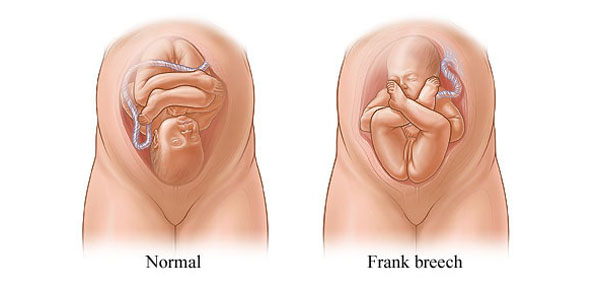
There are three types of breech presentations, frank, complete, and incomplete. With a frank breech the legs are flexed at the hips and extended at the knees so the feet are up by the head. With a complete breech presentation one or both of the legs are extended If the baby is in the incomplete breech position one or both hips are not flexed and the feet and knees are often below the buttocks. The frank breech presentation is the most common of the three and the safest position for a baby to be in if a vaginal delivery is to be attempted.
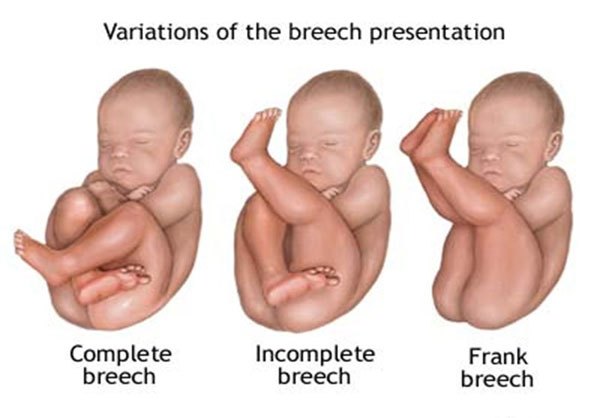
A fetus is said to be in a breech presentation when the buttocks of the baby are presenting first at the bottom of the uterus, and the head is in the upper part, or fundus of the uterus.
In some cases, a baby in the breech position can be delivered vaginally; when the legs and lower half of the body are out, the doctor when completes the delivery of the shoulders and head, sometimes using forceps. Because of the potential risk of complications in a vaginal delivery of a baby in a breech position, many doctors now regularly deliver such babies by cesarean. If a vaginal delivery is done, electronic fetal monitoring and episiotomy are usually used.
Situations that make a breech presentation at the time of labor more likely include:
- Preterm labor and birth – if labor starts when the baby is still small enough to move rather freely in the uterus.
- A placenta in the fundus – the placenta takes up some of the space in the top of the uterus.
- An unusual shape of the mother’s uterus, or fibroids in the lower part of the uterus.
- More than one fetus (such as twins)
- A very relaxed uterus from many previous children
- Too much or too little amniotic fluid
A vaginal delivery may be attempted for a baby in the breech position if:
- The baby is in a frank breech position its hips are bent and its legs extend up.
- The baby is small enough (usually under 8 pounds) to pass easily through the vagina.
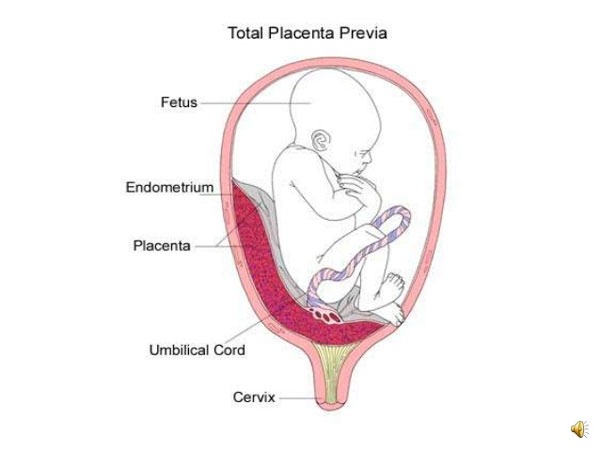
- The pregnant woman has no obstetrical problems, such as placenta previa, that might complicate the delivery.
- The pregnant woman’s pelvis is a normal or above average size.
- The baby has already descended well into the pelvis as labor begins.
- The baby’s head is tucked down toward its chest – not extended.
In some cases of breech presentation, a doctor can try to reposition the baby (called external version) late in pregnancy. Usually guided by ultrasound, the doctor uses his or her hands on the outside of the woman’s abdomen to try to manipulate the baby inside the uterus into the normal birth position, with head down. Although this procedure can be uncomfortable for the woman, it is sometimes a viable alternative to cesarean delivery. Because of the slight possibility of rupturing the membranes or causing labor to begin, external version is attempted only when the baby is mature enough or delivery.
Anything I can do to make him turn?
There has been a suggestion that spending 15 minutes every 2 hours of the waking day in the knee-chest position will help the baby to turn (Elkin’s manoeuvre). Although the first report of this was very encouraging, subsequent studies have not found it to be useful. There is some evidence that hypnotherapy may be useful, though only one study has looked at this. Acupuncture has been suggested and the results of a more formal study are awaited.
NOTE: Babies who are delivered after a breech presentation should have their hips checked carefully for potential hip dislocation.
Disclaimer
The Content is not intended to be a substitute for professional medical advice, diagnosis, or treatment. Always seek the advice of your physician or other qualified health provider with any questions you may have regarding a medical condition.