Walking is enough for many women, but others perhaps even you, begin to feel like a horse that longs to break into a trot. Women have always run, but in recent years jogging and running have become almost a national pastime.

Once you decide to take up running as a part of your cardiovascular routine, a good way to gently move into it is by jogging, which is a slow, recreational form of running. Running, of course, is not for everyone. It is a high-impact activity that is not always suitable for over-weight or older women, whose joints just can’t take the constant pounding.
BENEFITS
You can derive a number of pleasures from running.
- The sport helps in raising your Basal metabolic rate resting metabolism (chemical activities of the body’s cells.) Click here to check your Basal Metabolic Rate
- Running increases strength in the legs and leads to improved cardiovascular and respiratory systems. It is also an excellent calorie burning activity.
- Running consistently helps you to cope better with the stress and frustrations of everyday life.
- If you eat, drink, or smoke too much, it is worth trying running as a substitute.
- The good news is that, running does not cause bone or joint degeneration. Infact, like other weight-bearing exercises, it helps build bone density.
TRAINING TIPS
- Always maintain a heel-toe action when running.
- Always build up the distance and the time that you run in small increments, particularly if you are new to running.
- When you want to quicken your pace, ensure that you work the arms harder as well as the legs.
- When running up hills, alter your body weight forward in the stride to allow for the steeper gradient.
- When sprinting, alter your running action so that you run on the balls of your feet, rather than maintaining the heel-toe action.
- Where possible, run on grass rather than tarmac so that there is greater shock absorption for the legs.
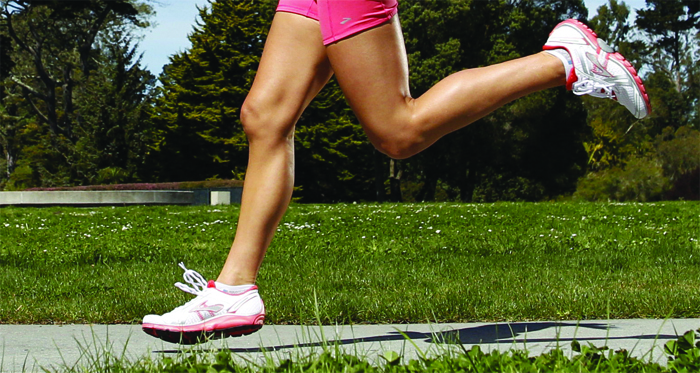
- Seek advice from a good sports shop about the trainers that are most suitable for the way that you run.
- Always wear cotton socks that allow your feet to breathe.
SELECTING A ROUTE
- Look for stable and smooth surfaces to run on when you plan your route. The soft-dirt surface will be kinder to your joints than concrete or asphalt. Avoid running on
a hilly area. - Choose low-traffic areas.
- If you run at night, outfit yourself with brightly colored clothing or reflective running gear and try to find a course that is well lit.
- Avoid slippery, wet or icy surfaces.
INSTRUCTIONS
- As with any aerobic activity, you should warm up for a few minutes by walking or jogging SLOWLY. Once you’re warmed-up, try to maintain your pace for the entire run. Do not, however, push yourself to the point where you cannot breathe. Your pace will become faster with time. Pushing yourself beyond your limit too soon can result in serious injury! Home runs/walks are as important as your long runs. If you’re short on time, run/walk for 20 – 30 minutes. You are worth a little time everyday; so don’t talk yourself out of it — JUST DO IT!
- To build on running as a cardiovascular workout to burn fat begin by alternatively walking half a lap and jogging half a lap.
- Gradually, increase your jogging time in relation to your walking time.
Jog three quarters of a lap and walk the rest.
- Then alternate running a lap and walking fractions of laps.
- Finally, eliminate the walk, until you can jog for about 45 minutes. Once done, you are ready for running.
- Try run – walking 1-3 miles/5 days a week to start, and gradually increase until you can run 3 miles, 5 days a week. After that you can start trying to increase mileage, but pay attention to any aches or pains and back off a little if you experience any.
- The number of calories that you burn per minute depends upon your weight, the activity, your intensity, the duration of your run and whether you follow a hilly or flat route.
- On an average an individual can burn 100 calories per mile.

REQUIREMENTS
- Properly fitting shoes that are broken in but not broken down and cushioning socks are crucial, especially if you use hard surfaces.
- Other accessories include sports watches and heart-rate monitors.
- Always make the warm up and cool down part of your program, and practice the stretching and strengthening exercises suited to jogging and running.
- Hitting the road with a companion is excellent motivation.
- Proper Hydration-The National Athletic Trainers’ Association’s new hydration guidelines call for drinking 17 to 20 ounces of water or a sports drink two to three hours before exercise and another 7 to 10 ounces 10 to 20 minutes before the running event. To replenish, they recommend drinking 16 ounces for every pound lost.
- Improving running strength-The University of Bourgogne in France points out an often neglected part of strength training for runners. The university found that distance running can weaken quadricep muscles used to push off. It recommends a strength-training program that includes lowering the weight slowly to help build the quad support muscles.
To present an overall view, running is an excellent cardiovascular exercise and helps in toning your body, burning calories and maintaining hearty blood circulation.
For more on nutritional needs of Runners, log on to:
Disclaimer
The Content is not intended to be a substitute for professional medical advice, diagnosis, or treatment. Always seek the advice of your physician or other qualified health provider with any questions you may have regarding a medical condition.