Toned shoulders and sculpted arms make dressing an absolute pleasure, and they also make your upper body leaner and stronger. They take time to achieve, but rest assured it can be done – here’s how.
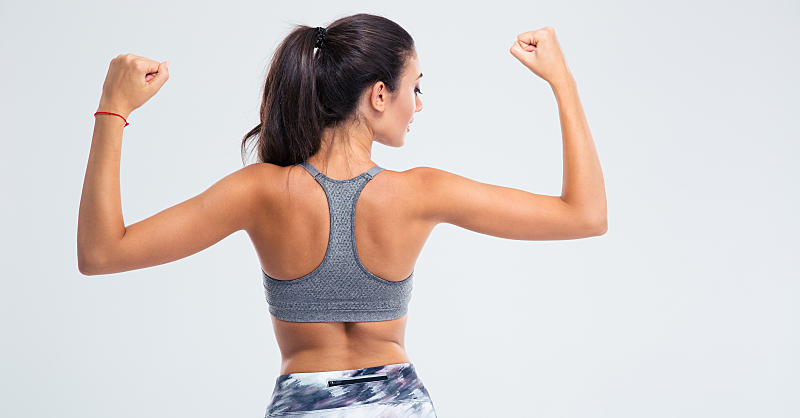
As with almost any other part of the body, un-toned arms are more likely to be caused by excess fat than by untrained muscles – and the tops of the arms, like thehips, are flab storages sites that are particularly common to women. In the first instance, it’s important to try and shift as much of this extra weight as possible – which is, of course, easier said than done. But there are subtle extra ways in which you can enhance both your everyday movements and your exercise routine to move things along. Maybe now is the time to renew your interest in gardening: all that digging, raking and weeding can do wonders for the upper arms!
Some aerobics classes can be stepped-up a gear by using free weights in some routines, and gym machines like cross trainers score a double whammy by working arms and legs at the same time. In the daytime, when you’re walking briskly, try and swing your arms a little to get some momentum going. The increased aerobic exercise will benefit your whole body but the resistance work will help your arms particularly. In the gym, try and do this on the treadmill, too.
If your excuse is your ever-present bag, it could be time to break this habit, too. Rucksacks may call to mind camping trips, but you can get seriously stylish, mini ones that will leave your arms free to move (and help your spine and posture by distributing the extra weight evenly).
Biceps & Triceps
If it’s not so much flabby as contour-less arms that’s the problem, that’s when spot-treating exercise comes into its own. However, when many women start this, they notice that while the tone of their upper arms improves, the underneath just carries on jiggling around. That’s because many strengthening exercises concentrate indirectly on the biceps and ignore the triceps (the two-part muscle to the front of the upper arms that help you to pull), so they’re already getting a workout. For the triceps try the lat machine in the gym; you pull or push down a weighted bar that hangs from a cable. At home, just doing plain old push-ups will really help. Beware of over-working your arm muscles: they’re a small muscle group and you want to stimulate, not exhaust the muscles. At first, do only between five and fifteen repetitions.
Arm exercises are one of the few types that really do benefit from investing in extra equipment, such as dumbbells (free weights) and the newer ‘tubes’, which are like big rubber skipping ropes. You stand with both feet on the tube and then take the ends in each hand, slowly pulling up to perform a bicep curl. Dumbbells, as opposed to barbells, are great for beginners because they allow natural movement and reduce stress on arm joints. They can also be used sitting down!
A Sample Routine
As with any exercise, it’s best to keep your routine as varied as possible. This routine has been devised to work by following the exercises indicated below; alternatively, you can pick and choose.
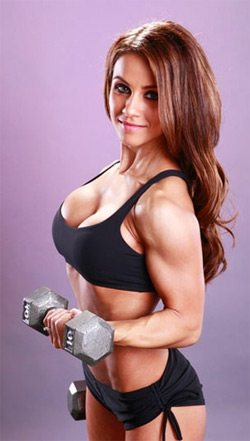 1. Curls (for biceps)
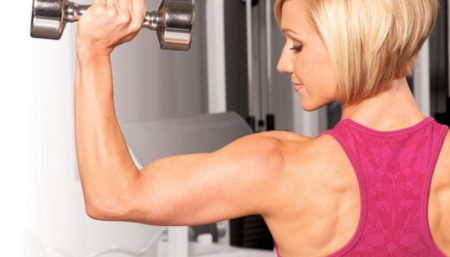
For this you need dumbbells two of equal weight – one in each hand. Hold them palms out in front of you and one at a time curl the arms up towards the shoulder. Begin with light weights and just ten or twelve repetitions, and increase over time. Once you’re proficient, vary the exercise so that you do one set with palms out and one set with palms in, so that you work both the biceps and triceps equally.
2. Arm raises (for biceps and shoulders)
Similar to the curls in that you need two dumbbells. Stand up straight, dumbbells by your sides, arms relaxed. Take it in turns to lift each arm straight out to the side in a nice, flowing movement. Stop when the arm is in line with the shoulder, hold, and slowly lower. Repeat ten times. That’s ‘lateral’ arm raise, and you can also do a ‘front’ arm raise by adopting the same start position except with your palms facing down, and alternately bringing each arm up in front of you until it is outstretched.
3. One-arm row (for biceps, shoulders and middle back)
Put your left foot one step in front of the other. Bend the left leg and extend your right leg back as if stretching out your calf muscles. Let your left forearm lean on your left leg, and lean for wards so your left arm is taking the weight. Take a dumbbell in your right hand and let it hang down, palm inwards. Slowly squeeze your right shoulder blade back, then relax. Swap sides. Repeat each side five times.
4. Dips (for triceps)
Sit right on the edge of a chair, so that you’re comfortably balanced but your hips are over the edge. Place your palms on the chair on either side your hips, with your fingers hanging over the edge. Feet should be flat to the floor but knees soft and back comfortably straight. With your knees still bent, lower your bottom to the floor until your upper arms are parallel to the floor (keep your back straight and feet flat on the floor throughout). Then concentrate on raising yourself back up, using your upper arms as the lead. Do three sets of between ten and twenty.
5. Fall (for triceps and shoulders)
Stand about 3 feet (1m) away from a wall. Fall in towards it and take the strain of your body weight in your arms. Push off from the wall to help you achieve a standing position again (this one is also good for strengthening the hands).
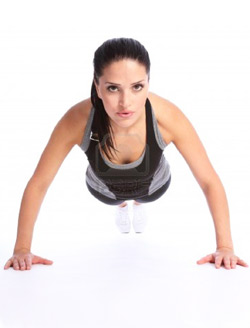 6. Push-ups (triceps, shoulders and abdominals)
Push-ups are also recommended for toning the abdominal muscles-that’s no surprise, since there’s no surprise, since there’s often a link between abs and arm exercise. This push-up is modified, however, to give the backs of the arms a turbo-charged workout, by raising the feet off the floor – either with an exercise step if you have one, or a bench, or the bottom rung of a chair. Repeat twenty times.
Remember that if it’s the top of your arms you’re concerned about, concentrate on exercises for your biceps, but if it’s wobbly underarms, go for the triceps moves. Finally, don’t overdo it: the arm muscles are small, and overworking them will cause them to shut down, not expand.
Disclaimer
The Content is not intended to be a substitute for professional medical advice, diagnosis, or treatment. Always seek the advice of your physician or other qualified health provider with any questions you may have regarding a medical condition.