Female from all walks of life can be seen heading to the gym with meager knowledge on how to perform their workout consisting of exercises that focus on strengthening the quadriceps, glutes, and hamstring muscles. What many fail to recognize is the importance of building strength in the hip stabilizers to prevent injury and improve balance. Our bodies have two types of muscle: movers and stabilizers (other than those in the internal organs).
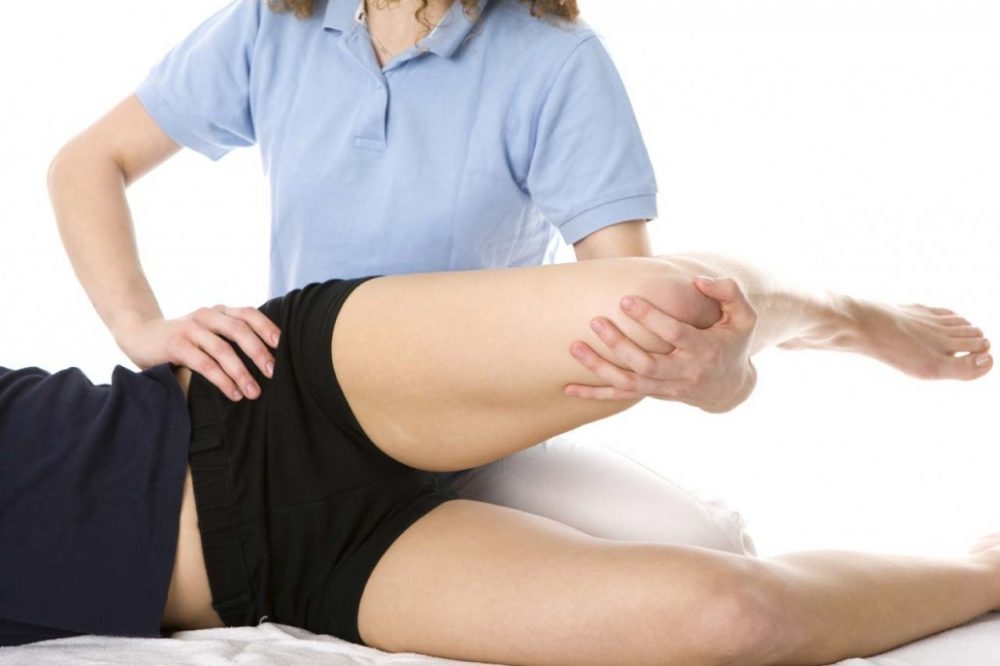
- Movers: muscles that move us, which are the muscles we tend to exercise in the gyms
- Stabilizer: muscles that hold our joints, maintaining proper axis of rotation during movement at the joint. These muscle systems are quite different in how they work.
According to the American Council on Exercise, “Stabilizing muscle contractions are generally isometric contractions that act to support the trunk, limit movement in a joint, or control balance.” In other words, muscles acting in a stabilizing role aren’t directly involved in lifting a weight, but instead keep certain parts of the body steady so that the primary working muscles can do their job properly. Inadequately developed stabilizer muscles can lead to pain in the knee, back, or Snapping Hip Syndrome.
Every joint in our body that allows for mobility is equally equipped with stabilizers that allow for controlled motion, the ability to shift our center of gravity, and the handling of various loads.
Snapping Hip Syndrome
Sometimes called dancer’s hip, is a condition in which you hear a snapping sound or feel a snapping sensation in your hip when you walk, run, get up from a chair, or swing your leg around.
Causes:
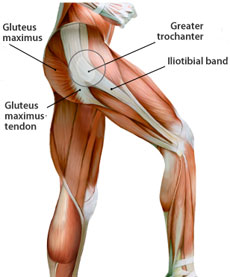
The most common cause of a snapping hip is the iliotibial band snapping over the greater trochanter. Sudden loading of the hip (eg, landing after a jump) may reproduce this sensation of the iliotibial band subluxing over the greater trochanter. With sudden loading, the hip typically is flexed, causing the iliotibial band to move anteriorly followed by the tendon snapping backward as the individual recovers and extends the hip.
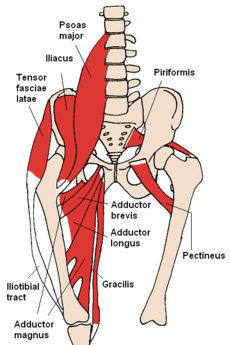
The iliopsoas tendon, which connects to the inner part of the upper thigh, can also snap with hip movement.
Another site of snapping is where the ball at the top of the thigh bone fits into the socket in the pelvis to form the hip joint. The snapping occurs when the rectus femoris tendon, which runs from inside the thighbone up through the pelvis, moves back and forth across the ball when the hip is bent and straightened.
|
(Source : mendmyhip.com) External snapping hip syndrome is caused by either the iliotibial band or gluteus maximus snapping over the greater trochanter. Common in, gymnastics, rebounding in basketball, long jumping in track-and-field competitions.
(Source : Wikipedia) Internal snapping hip syndrome is most commonly caused by a snapping of the iliopsoas tendon over the iliopectineal eminence. As an overuse phenomenon, this condition may occur in any activity resulting in repeated hip flexion or external rotation of the femur. Activities that may predispose to iliopsoas tendinitis include dancing, ballet, resistance training (eg, squats), rowing, running (particularly uphill), track and field, soccer, and gymnastics. |
In the sub acute (3 days to 3 weeks) and the chronic stage (3 weeks to 2 years) it is important that training should be adapted to avoid jumping or any exercises that put excessive strain on the patellar tendon.
Prevention:
Exercises to treat and prevent snapping hip syndrome vary depending on the type of snapping hip syndrome (external or internal) you have. The stretching and strengthening exercises may include:
- Quad Stretch: Stand arm length from a wall, place the hand opposite the hip against the wall for support. With your other hand, take hold of the ankle of the painful leg and, keeping your knees together, pull your ankle up toward your buttocks. Hold for 30 to 60 seconds and release. Repeat three times with both the legs.
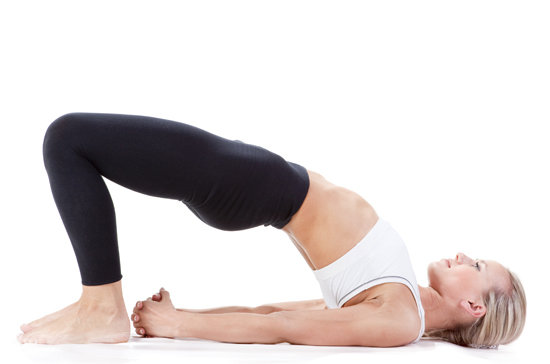
- The bridge: Lie on your back with your hands by your sides, your knees bent and feet flat on the floor. Make sure your feet are under your knees. Tighten your abdominal and buttock muscles.
Raise your hips up to create a straight line from your knees to shoulders. Squeeze your core and try to pull your belly button back toward your spine. If your hips sag or drop, lower yourself back on the floor. The goal is to maintain a straight line from your shoulders to your knees and hold for 20 to 30 seconds.
- The piriformis stretch: Lie flat on your back with bent knees so you can place the ankle of the other leg on top of the opposite knee for the stretch. Hold the back of the thigh for 30-40 sec.
- Chair-sitting Stretch: Sit up straight and pull one leg up, resting your ankle on your opposite knee. Make sure your leg is parallel to the floor. Slowly bring your chest forward until you feel your hips begin to stretch. Make sure your back remains straight through the whole stretch. Stay in that position for 20 to 30 seconds then slowly raise your body back up. Once you have finished one leg, move on to the other leg and repeat the same.
- Iliotibial band stretch: Stand with your legs together, cross your (uninjured) leg in front of the (painful) leg, then bend down and touch your toes. Hold for 30 seconds, then return to starting position. Repeat three times.
It is important that when exercise is resumed, the athlete warms up and cools down sufficiently to prevent the ITB, TFL and Glutes tightening up and causing friction as they run over the Great Trochanter.
Note:
- For legs and hips, try squats, deadlifts and weighted lunges instead of leg press and leg extension. The former exercises require the muscles of your back and shoulder to support and steady a barbell, while the latter exercises allow you to shift much of the stabilization responsibility to the seat on which you recline.
- Similarly, pull-ups are better than machine pull-downs
- Dips are better than bench presses, and
- Standing military presses are better than the seated equivalent.
For more:
Disclaimer
The Content is not intended to be a substitute for professional medical advice, diagnosis, or treatment. Always seek the advice of your physician or other qualified health provider with any questions you may have regarding a medical condition.