Do you feel a slight twinge at the outside portion of the upper arm, near the elbow, for this could be sign of tennis elbow or tendinitis of the lateral epicondyle. This condition is caused by continual small strains and microscopic tears of tissue near the elbow, resulting in inflammation and pain. Specifically, the tendon and muscles(especially the extensor carpi redialis muscle) that extend the wrist by bending your hand back, as if you were to push against the wall, are affected. It commonly occurs while playing tennis because of overextension of the wrist during a backhand stroke. But you do not have to play tennis to develop tennis elbow. You can cause lateral epicondylitis by wielding a hammer or other tool. It is the repeated motion over time that eventually causes the injury. This is why people who are in their forties and fifties are more likely to develop tennis elbow.
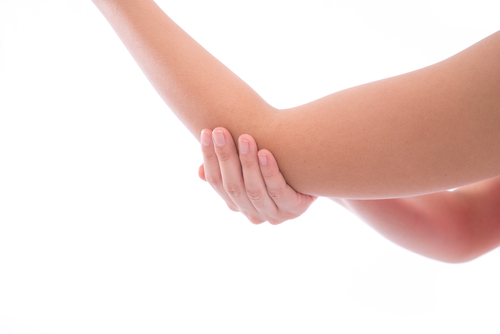
Tennis Elbow Symptoms
Patients with tennis elbow experience pain on the outside of the elbow that is worsened by grasping objects and cocking back the wrist. The most common symptoms of tennis elbow are:
- Pain over the outside of the elbow
- Pain when lifting objects
- Pain radiating down the forearm
The pain associated with tennis elbow usually has a gradual onset, but it may also come on suddenly. Most patients with tennis elbow are between the ages of 35 and 65 years old, and it affects about an equal number of men and women. Tennis elbow occurs in the dominant arm in about 75 percent of people.
Therapeutic options for Tennis Elbow
- Treatment starts with rest, ice, and gentle stretching. Using a forearm (tennis elbow) band that slips around the upper forearm takes tension off of the elbow and can reduce discomfort.
- Pain can last from a few days to a few weeks. Occasionally, anti-inflammatory medications such as ibuprofen and naproxen can be used. A cortisone injection can be helpful in some cases, but should be reserved for the persistent pain that last more than six weeks, and it must not be done more than three times. There always is a risk of tendon rupture and breakdown of surrounding tissues as a result of a cortisone injection. After the inflammation subsides, heat,massage, and ultrasound treatment by a physiotherapist can speed up the rehabilitation process.
-
- Wrist flexion: Slowly pull back the fingers and wrist into an extended position (like you would push against a wall), then pull the fingers down and back into a fully flexed position. Each stretch should last about 10 seconds and is repeated between 8 and 12 times, three to four times every day. This stretch should not be painful. So if it hurts, don’t do it! After the pain is relieved, it is important to prevent future recurrences of tennis elbow. This is first done by gently stretching the muscles and tendons of the forearm.
 Another way to perform these two stretches is to place your hands together, as if you are praying and elevate your elbows, then place the back of your hands together, in front of your chest, flexing the wrist, and raising your elbows. Hold these positions for 10 seconds and repeat 8 to 12 times.
 - Wrist Extension: After two to three weeks, wrist exercises can be started. You can do this by holding a light 3 to 5 pound dumbbell weight or grabbing a can of soup with your forearm on a counter top and your wrist dangling just over the edge of the counter. With your palm facing the floor and your elbow bent at 90 degrees, extend the wrist while holding the weight (or can) and repeat 10 to 15 times, increasing the number of repetitions as you become stronger. Then turn your hand so it faces the ceiling. Holding the weight, flex your wrist 10 to 15 times.
- Finger Extension: Place a rubber band around all five finger tips. Spread fingers 25 times, repeat 3 times. If resistance is not enough, add a second rubber band or use a rubber band of greater thickness which will provide more resistance.
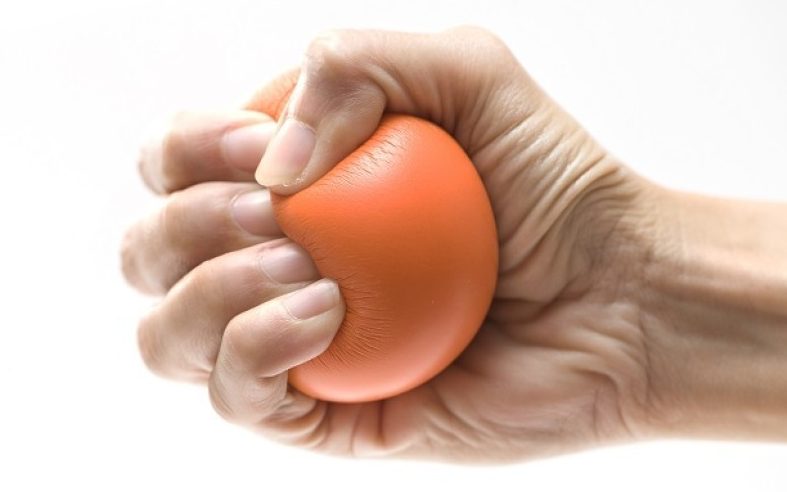
- Ball Squeeze: Place rubber ball or tennis ball in palm of hand, squeeze 25 times, repeat 3 times. If pain is reproduced squeeze a folded sponge or piece of foam.
- Forearm Pronation/Supination: Grasp hammer (wrench, or some similar device) in hand with forearm supported. Rotate hand to palm down position, return to start position (hammer perpendicular to floor), rotate to palm up position, repeat. To increase or decrease resistance, by move hand farther away or closer towards the head of the hammer.For all of the exercises perform 10 repetitions 3-5 times a day. With all exercises use pain as your guide – all exercises should be pain free.
When to progress. Begin with a 1 lb. weight and perform 3 sets of 10 repetitions. When this becomes easy, work up to 15 repetitions. Increase the weight only when you can complete 15 repetitions 3 times without difficulty. The axiom “No Pain No Gain” does NOT apply here.
- Wrist flexion: Slowly pull back the fingers and wrist into an extended position (like you would push against a wall), then pull the fingers down and back into a fully flexed position. Each stretch should last about 10 seconds and is repeated between 8 and 12 times, three to four times every day. This stretch should not be painful. So if it hurts, don’t do it! After the pain is relieved, it is important to prevent future recurrences of tennis elbow. This is first done by gently stretching the muscles and tendons of the forearm.
- Surgery is considered a last resort and is done only if there is persistent pain and loss of function that lasts at least six months to a year. A common surgical procedure used for those with continued pain and disability consists of removing the scar tissue from the tendon, smoothing the bone, and reattaching the tendon. This is often done as an outpatient procedure. Recovery takes about 8 to 12 weeks.
Non-surgical Treatment of Tennis Elbow
- Rest- Avoid any activity that will overuse the elbow.
- Ice the area just below and to the side of the elbow.
- Compress your forearm with a support band, just below the elbow.
- Gently stretch the wrist.
- Take anti-inflammatory medication and pain relieving drugs.
- Physiotherapy treatment, including heat and /or ultrasound therapy can aid rehabilitation.
- Occasionally an injection of a cortisone (steroid) can help (but never more than three injections).
- Strengthen the muscles and tendons that move wrist using light weights.
- Employ smooth movement of the elbow.
Related Links
- Top 10 to Wrist & Hand Workout
- Minimizing Sore Muscles
- Massage Therapy
- Uncovering the Formula for Strengthening
Disclaimer
The Content is not intended to be a substitute for professional medical advice, diagnosis, or treatment. Always seek the advice of your physician or other qualified health provider with any questions you may have regarding a medical condition.