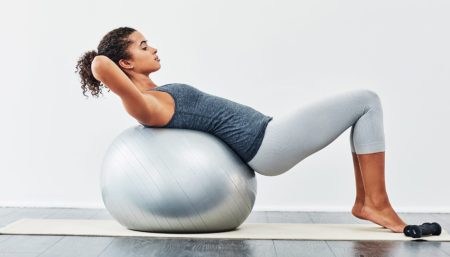
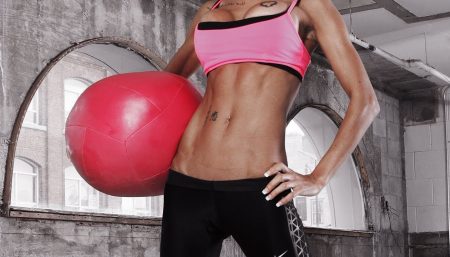
The fitness ball – basically a big, somewhat bouncy ball – was supposedly developed by a physical therapist to rehabilitate back, knee, and hip injuries, but they can do a whole lot more.
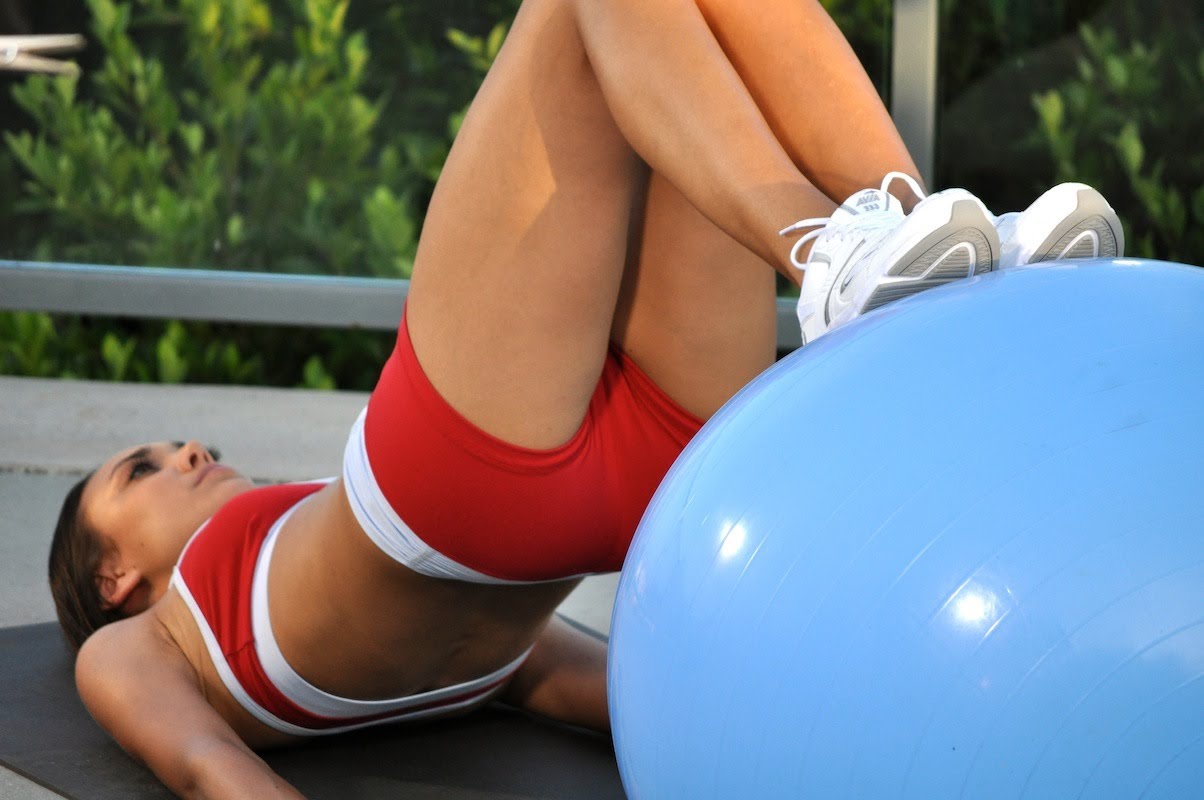
Benefits of using an exercise ball
- Excellent tool to build stability: The ball rolls around easily, so core strength and balance are required to keep it still. The challenge of keeping the ball still makes the ball an excellent tool to teach stability and rehabilitation.
- Great tool to help you master good posture: When you sit on a ball, you’re forced to sit up with good posture because you have nothing to lean back on. Also, because the ball rolls around, it keeps you on your toes and keeps your body moving, which help prevent the stiffness and back pain that you can get from being too sedentary.
- An exercise ball aims to strengthen all of the muscles in the abs and back including the rectus abdominis, transverse abdominis, internal/external obliques and the erector spinae.
- Using a ball can give your workout a little more variety and extra challenge.
- Initially the ball was supposedly developed by a physical therapist in Europe to provide injured patients some aerobic conditioning. The therapist put patients on the ball and had them bounce. Eureka — the patients got a great workout without impacting their injuries.
Right Size of ball for you
The following list matches you up with the right size ball, based on your height:
- 55 centimeters if you’re under 5 feet tall
- 65 centimeters if you’re between 5 feet and 5 feet 7 inches tall
- 75 centimeters if you’re between 5 feet 8 inches and 6 feet 2 inches tall
- 85 centimeters if you’re over 6 feet 2 inches tall
Ball Exercises
Upper Abdominal Curls
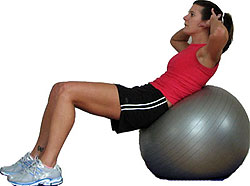 Lie back with your mid back making contact with the ball, your feet planted firmly on the floor a little more than hip distance apart, and your knees facing slightly away from each other. Squeeze your butt and pull your belly in to keep your hips at the same height as your shoulders. Make your torso as stable as possible.
- Interlace your fingers and put your hands behind your head.
- Raise your head just high enough that your shoulder blades are off the ball. Don’t let your hips drop down as you roll your upper body up.
- Don’t bounce up and down, but go slowly to really get the benefits of this exercise.
- Complete 8 repetitions slowly
Ball Side Crunch
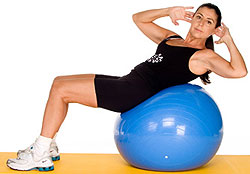 Lie on your side against the exercise ball, arms across your chest, legs extended and feet wide apart to give you balance.
- Raise your upper body up from the ball and lower it back down after a short pause. Alternate sides after each completed set.
- Breathe out while contracting your ab muscles and breathe in while returning to starting position.
Ball Reverse Crunch
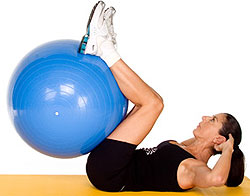 Lie on your back, calves and hamstrings pressed against the exercise ball and arms spread out.
- Squeeze the ball with your legs and roll your knees towards your chest then roll back down after a short pause.
- To avoid straining your neck, look straight up instead of looking at your knees.
Plank With a Leg Lift
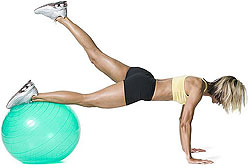 Place the ball under the shins or toes (harder) and the hands about shoulder-width apart on the floor.
- Contract the abs to hold the body in a straight line from head to toe.
- Keeping the abs contracted, lift the right leg off the ball a few inches, hold for a few seconds and lower. Repeat on the left leg, alternating feet for 8-16 reps on each side.
Knee Tucks
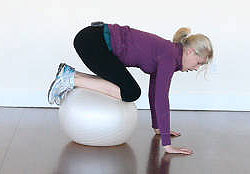 Get into a pushup position with the ball under the shins/ankles (easier) or the tops of the feet (harder).
- Make sure the body is straight, back flat and the abs engaged.
- Roll the ball in, bending the knees towards the chest as you squeeze the abs.
- Try not to push back with your arms but, instead, keep all the movement in the knees.
- Don’t collapse the back as you roll the knees in.
- Return to start and repeat for 10-16 reps.
Note: A good stretch prior to your workout is essential in avoiding injury. Stretching your muscles when they’re cold, however, could potentially cause injury. For this reason, always warm up with a walk or with some very gentle stretching.
Disclaimer
The Content is not intended to be a substitute for professional medical advice, diagnosis, or treatment. Always seek the advice of your physician or other qualified health provider with any questions you may have regarding a medical condition.