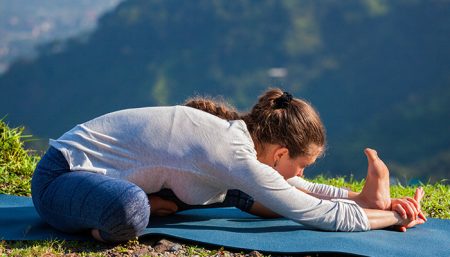
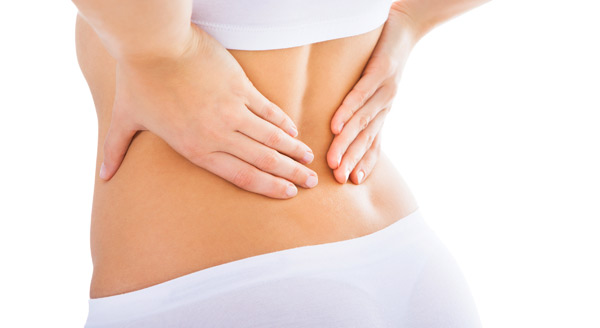
Sciatica is due to compression and inflammation of the spinal nerves. A sharp pain radiates from the lower back to to the leg and foot in a pattern determined by the nerve that is affected. It feels like an electric shock, and increases with standing or walking. A list of top ten yoga exercises that may help in providing relief from sciatica are detailed below:

-
Place a mat against a wall. Sit in Dandasana ( staff pose ) facing the wall. Keep a yoga belt beside you. The soles of your feet should touch the wall comfortably, with your toes pointing upward. Press both your palms down on the mat.
-
Lower your back onto the mat, supporting your torso on your palms until your head rests on the mat. Bend your right knee, and bring it to your chest. Keep your left sole pressed against the wall. Loop the belt around the sole of your right foot. Hold one end of the belt in each hand. Make sure that you hold the yoga belt as close to your foot as possible. This opens your chest, and keeps your breathing regular and even. Keep your extended leg pressed down on the mat.
-
Inhale, and raise your right leg until it is perpendicular to the floor. Hold both ends of the belt with the right hand. Place your left arm beside your left arm beside your left hip. Press the left foot against the wall, and the left thigh on the mat. Stretch your right leg up further, simultaneously pulling your toes toward you with the belt. Feel the stretch in your right calf. Keep your left leg firmly pressed to the floor. Do not bend either knee or allow the left leg to tilt out. Initially, stay in this position for 20 -30 seconds. With practice, increase the time to 1 minute. Repeat the pose on the other side.
Do not practice this Asana if you are recovering from cardiac condition, or if you have blocked arteries, asthma, bronchitis, migraine, stress related headache, eyestrain or diarrhea. |
 SUPTA PADANGUSTHASANA :
Variation (foot on the block)
The block under the foot makes the pose easier for those who are stiff in the pelvic area.
SPECIFIC CAUTIONYou must keep you leg straight as you lower it to bend during this action might lead to injury. |
GETTING INTO THE POSE
Place the wooden block on your right. Follow steps 1,2, and 3 of the main asana. After you raise your right leg, exhale, then lower your leg to the right, keeping it absolutely straight. Place your right foot on the block. Pull on the belt and stretch your leg. Hold the pose for 20 – 30 seconds. Repeat the pose on the other side.
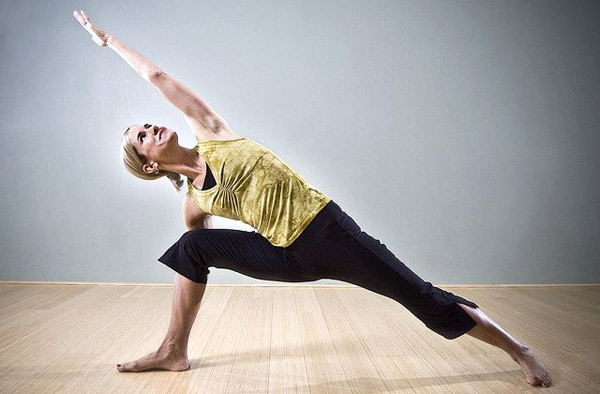
 UTTHITA PARSVAKONASANA (INTENSE SIDE STRETCH) :
-
Stand in Tadasana (mountain pose ) against a wall, with your heels and your buttocks touching it. Place the block on the floor behind your right foot. Inhale, and spread your feet 1 m (3.5 ft) apart. Turn your right foot out to the right, until it is parallel to the wall.
-
Turn your left foot in slightly to the right. Press the outer edge of your left foot firmly on the floor, and bend the right knee, pushing your thigh down until your calf is at right angles to the floor. Stretch your left arm away from your left shoulder.
-
Bend to the right, and place your right palm on the block. Stretch the left arm up, with the palm facing forward. Now rotate the arm and bring it toward your left ear. Your left thumb should touch the wall. turn your head and look at your left arm. Maintain a continuous stretch from the left ankle to the left wrist. Press your outer left foot into the floor. Move your shoulder blades into your body, and extended your spine toward your head. Hold the pose for 30 seconds. Repeat the pose on the other side.
 ARDHA CHANDRASANA (HALF-MOON POSE) :
-
Stand in Tadasana (mountain pose) Place a block on its short side against the wall. Inhale, spread your feet 1m (3.5ft) apart. Raise your arms to shoulder – level.
-
Turn your right foot out to the right, parallel to the wall, and turn your left foot in, slightly to the right. Bend your right knee, and place the right palm on the block. Raise your left arm.
-
Straighten your right leg. Raise your left leg, until it is parallel to the floor. eep your left arm stretched up, in line with the right arm. The back of your left hand should touch the wall.
-
Look up at your left thumb. Keep your weight on the right foot, thigh, and hip, not on your right palm. Hold the pose for 20 seconds. Repeat the pose on the other side.
Do not perform this asana if you have stress-related headaches, migrane, eye strain, varicose veins, diarrhoea, insomnia, or chronic fatigue syndrome. |
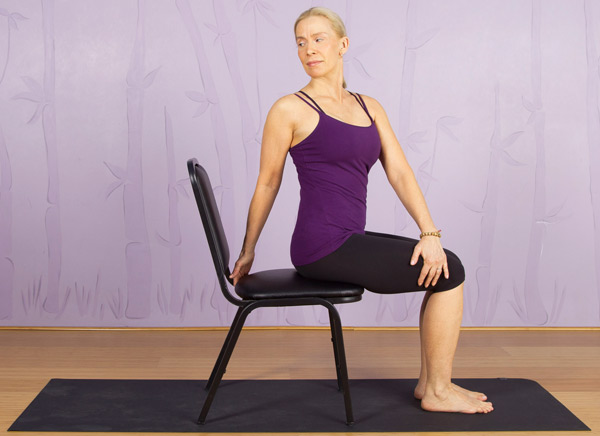
 BHARADVAJASANA (TORSO TWIST) :
-
Sit sideways on the chair with the right side of your body against the chair back.r> Sit erect and exhale. Hold the outer sides of the chair back.
-
Widen your elbows. Push the right side of the chair back away from your body, exerting pressure, while pulling the left side toward you. Exhale as you rotate, but do not hold your breath. Look over your right shoulder. Hold the pose for 20 – 30 seconds. Repeat the pose on the other side.
Avoid this asana if you have blocked arteries, high or low blood pressure, bronchitis, headaches, migraine, eyestrain, Diarrhoea, insomnia, fatigue, osteoarthritis or during mensuration. |
 BHARADVAJASANA :
GETTING INTO THE POSE
Step your legs between the chair back and the seat. Hold the seat with your right hand, and the back of the chair with your left hand. Lift and rotate your torso to the right. Hold for 20 – 30 seconds. Repeat the pose on the other side.
Avoid this pose if you have varicose veins. |
 SALAMBA SARVANGASANA (SHOULDER STAND) :
-
Place a bolster parallel to the front legs of the chair. Drape a blanket on the chair seat, so that it overlaps its front edge. Sit sideways on the chair with your chest facing the chair back. Hold the chair back, and place your legs on it, one by one. Slide your hands down the chair back and move your buttocks toward the back of the seat.
-
Lower your back onto the chair seat, and press your elbows down on it. Hold the chair back, then slide your back and buttocks over the edge of the seat. Rest your shoulders on the bolster, and your head on the floor. Pass your hands, one by one, through the front legs of the chair and hold the back legs. Straighten your legs and pause for 1 minute..
-
Rest your head comfortably on the floor, and keep your neck and shoulders on the bolster. Hold the back edges of the chair seat. Bend your knees and place your feet on the top edge of the chair back. Make sure that your buttocks rest on the front edges of the chair.
-
Maintain your grip on the chair seat and straighten your legs, one by one. Your buttocks, lower back, and wait should rest on the front edge of the chair seat. Lift your dorsal spine and shoulder blades. Intensify your grip on the chair seat. Extend your inner legs from the groin to the heels. Rotate your thighs inward. Keep your neck soft. Do not hold your breath. Hold the pose for 5 minutes.
Avoid this asana if you have headaches, migraine or during menstruation. |
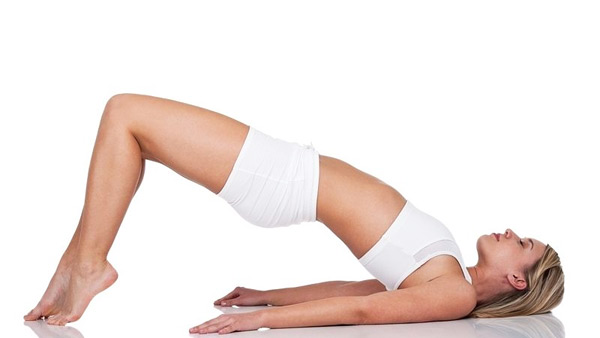
 SETUBANDHA SARVANGASANA (BRIDGE POSE) :
-
Place a folded blanket on the end of the bench. Place a bolster on the floor in line with the bench, and touching one end of it. Place a folded blanket on the bolster. Then sit on the blanket on the bench, with your legs stretched out. Place a yoga belt under your thighs and bind it round the middle of your thighs..
-
Exhale, and lower your back toward the bolster. Press each palm down on the floor on either side of the bolster, your fingers pointing forward. Both arms should support your upper back. Keep your thighs, knees, and feet close together, your heels on the bench, and your toes pointing upward. Lower your arms to the floor.
-
Slide further down, until the back of your head and your shoulders rest on the bolster. Straighten your legs, keeping your feet together. Stretch the heels and toes away from the torso to increase the stretch of the legs. Extend your arms to the sides on the floor, with the palms facing the ceiling. Hold the pose for 3 minutes. Gradually increase the time to 5 -8 minutes.
Make sure that your lower back touches the edge of the bench in the final pose. Your buttocks should not touch the edge of the bench, but should not be far from it, otherwise your shoulder will lift, causing neck strain. |
 SAVASANA (CORPSE POSE):
-
Spread the mat on the floor. Place a bolster on the mat, with its long sides parallel to the long sides of the mat. Sit in Dandasana (Staff pose) with the short end of the bolster against your buttocks, and place the folded blanket on the far end. If you have osteoarthritis of the knees or if your legs are feeling tired, place a bolster under your knees.
-
Wrap the bandage around your forehead, following the instructions for Ujjayi Pranayama. Now place your elbows and forearms on the mat. Lower your back, vertebra by vertebra, onto the bolster until your head rests comfortably on the folded blanket. Position your buttocks evenly on the centre of the mat. Spread out your arms to the sides, palms facing up, and rest them on the floor.
-
Straighten your legs and stretch them evenly away from each other, without disturbing the extension of your waist. Exhale, focusing on your breathing, then lift and stretch your diaphragm, keeping it free of tension. Keep your arms at a comfortable distance from your body. If they are placed too near or too far away, your shoulders will lift off the bolster.
-
Stretch your shoulders away from your neck. The centre of your back should be on the centre of the bolster, keep your abdomen soft and relaxed. Expand your chest and relax your throat. Until you feel a soothing sensation in the neck. Ensure that your head does not tilt back. Relax your facial muscles and your jaw. Do not clench your teeth.
-
Keep your breathing smooth and free of tension, but do not breathe deeply. Let your eyeballs relax into their sockets, and allow external surroundings to recede. Feel the energy flow from your brain to your body body as the physical, physiological, mental, intellectual, and spiritual lanes come together. Stay in the pose for 5 – 10 minutes.
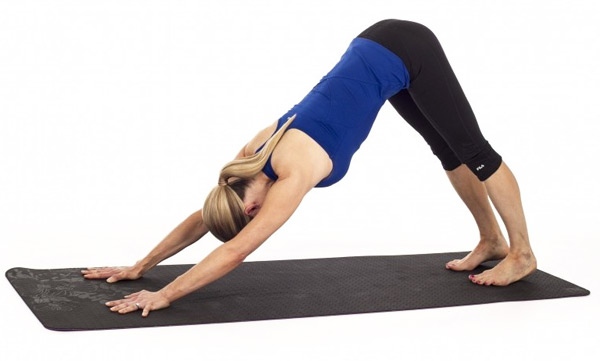
 ADHOMUKHA SVANASANA (Downward Facing Dog Stretch) :
-
Stand in Tadasana facing a wall, about 1 m(3.5 ft) away from it. Place 2 of the blocks on their broad sides, shoulder-width apart,against the wall. Place the third block on its long side, 45 cm (18 in) away from the wall. Separate your feet to a distance of 45cm (18 in). Kneel, and place your palms on the two blocks against the wall.
-
Press your palms down on the blocks and walk your feet back, until they are 1.2 m (4 ft) away from your hands. Make sure that your feet are in line with your hands and the same distance apart. Raise both the heels, stretch your legs, then lower your heels to the floor. Stretch your arms fully.
-
Consciously stretch each leg from heel to buttock, and from the front of the ankle to the top of the thigh. Raise your buttocks, stretch your chest, and push your sternum toward your hands. Exhale, then rest your head on the third block. Press your hands down on the blocks, extending your arms fully. Stretch your spine and expand your chest. Keep your throat soft and elongated. Relax your eyes and keep your brain passive.
Do not practice this asana if you have diarrhoea or varicose veins. If you have a stiff spine, or high blood pressure or are prone to recurring headaches, always practice all these variations with head supported by a block. Do not hold the pose for more than 30 sec to 1 min. |
These sciatica exercises are recommended for specific conditions. They must be done regularly (typically two times daily) and correctly to be effective. Close attention to posture and body mechanics is key to getting maximum benefit from the exercises.
Adapted from Yoga: The path to holistic health by B.K.S. Iyengar.
Disclaimer
The Content is not intended to be a substitute for professional medical advice, diagnosis, or treatment. Always seek the advice of your physician or other qualified health provider with any questions you may have regarding a medical condition.