The first thing you do when you are born is breathe, and it’s the last thing you’ll do when you exit. Oxygen is the most vital nutrient for our bodies and is essential for all of our organs and tissues. If we don’t get enough of it, the result is mental sluggishness, negative thoughts, depression and various other health concerns. The act of breathing seems pretty simple and mindless, but most of us will find when we think about it that our breathe is very shallow and quick and we often hold it. Think about how your breathing changes if you’re angry, sad, stressed or afraid.
Benefits of proper breathing
By practicing deep breathing you can expect:
- Improved quality in the blood, due to its increased oxygenation in the lungs.
- Increased digestion and assimilation of food. The digestive organs such as the stomach receive more oxygen and hence operate more efficiently.
- Improved health in the nervous system, including the brain, spinal cord and nerve centers. This in turn improves your overall health, as the nervous system communicates with all parts of the body.
- Rejuvenated skin.
- Stimulated blood circulation as the movements of the diaphragm during deep breathing massage the abdominal organs.
- Healthier and more powerful lungs.
- Reduced workload for the heart. This results in a stronger, more efficient heart, reduced blood pressure and less heart disease.
- Relaxation of the mind and body. Deep breathing causes a reflex relaxation of the mind. In addition, oxygenation of the brain tends to normalize brain function, reducing excessive anxiety levels.
 Breathing Exercises
When you’re in need of a mental break, try the following exercises:
Deep Breathing
- Inhaling
- Push your stomach forward as you breathe in through your nose.
- Push your ribs sideways while still breathing in. Your stomach will automatically go inward slightly.
- Lift your chest and collarbone while still breathing in.
- Exhaling
- Allow your collarbone, chest and ribs to relax. The air will go out automatically.
- When all the air seems to be out, push your stomach in slightly to expel any remaining air.
Diaphragmatic Breathing
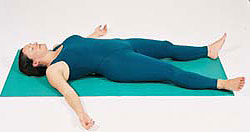 Lie down on a rug or blanket, your legs straight and slightly apart, toes pointed comfortably outward, arms at your sides, not touching your body and palms up, eyes closed.
- Bring your attention to your breathing and place your hand on the spot that seems to rise and fall most as you breathe.
- Gently place both of your hands on your abdomen and become aware of your breathing.
- Breathe through your nose.
- As you breathe in, allow the abdomen to expand without forcing or arching the back.
- Exhale, emptying the abdomen completely.
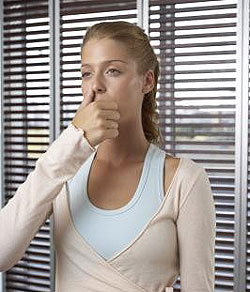
Alternate Nostril Breathing
- Sit in a comfortable position, with good posture.
- Close your right nostril with your right thumb.
- Inhale slowly and soundlessly through your left nostril.
- Immediately close the left nostril with your right ring finger and little finger. At the same time, remove your thumb from the right nostril.
- Exhale slowly and soundlessly through your right nostril.
- Inhale through your right nostril.
- Close your right nostril with your thumb and open your left nostril.
- Exhale through your left nostril.
- Inhale through your left nostril. Repeat the cycle.
Breathe of Fire
- Kneel on the floor or sit in a comfortable position.
- Keep your back straight, with shoulders back and down. Place your hands on your abdomen.
- Take a deep breathe. Round your lips and begin to blow the breath out through your mouth by strongly contracting your abdominal wall.
- As you release your abdomen, the breath will be drawn in.
- Each exhalation should be directed and careful. The inhalation will take care of itself.
Contract/Relax
Take a moment to contract and tense all the muscles in your body. Immediately relax them. Repeat this three to five times. You can do this drill with your entire body all at once, or body part by body part.
Take a Minutes Vacation
Stop what you’re doing. Close your eyes. Take a few deep breathes. Imagine a scene from nature that relaxes and calms you. Perhaps take yourself to a deserted island, to the top of a mountain or to an ocean beach.
Here and Now
Stop what you’re doing. Close your eyes. Take a few deep breathes. Become aware of your environment. What do your hear? What do you smell? What do you feel? Open your eyes. What do you see?
Laugh
Having a sense of humor affects us on several levels. From a physiological standpoint, laughter stimulates many of the same positive physiological changes we experience after exercise: deeper breathing, lower heart rate, decreased blood pressure and an influx of endorphins. On a psychological level, humor creates a sense of lightheartedness and play.
How can you incorporate humor into your life?
|
Remember, “It is magnificent to grow old, if one keeps young…” -Harry E. Fosdick
Related Links
- Minimizing Sore Muscles
- Every Breath You Take
- Depression: the silent epidemic
- Pranayam: a universal self-healing technique
- Yoga & Stress
Disclaimer
The Content is not intended to be a substitute for professional medical advice, diagnosis, or treatment. Always seek the advice of your physician or other qualified health provider with any questions you may have regarding a medical condition.