All that we do like writing, eating, playing an instrument, etc. are not the work of our hands alone. Without the shoulder, the mobility of ourhands would be limited, the arms would just fall limply on our sides. Even the simple motion of reaching your hand to your mouth would be quite impossible. This is why we need to maintain the condition of this body parts through exercise, particularly yoga.
The shoulders, are somewhat vulnerable & unstable joints. Like the pelvis, the shoulder is a joint composed of a ball and socket. But unlike the pelvic joint, the socket on the shoulder is relatively not as deep. The reason for this is for mobility, allowing your arm freedom of movement. With it you can reach your arm in any direction 360 degrees. These kind of movements are impossible to make with your legs.
This innate unstableness makes the shoulder dependent on connective tissues to keep the link together. These soft tissues are composed of tendons, which connect bones to muscles; ligaments, which attach bones to other bones; andmuscles, which keep the bones stable and produce movement. There are four muscles that keep the shoulder together and this group is referred to as the rotator cuff. They are wrapped around the joint producing movement every which way.
The rotator cuff is made up of the Supraspinatus, the Subscapularis, the Infraspinatus, and the Teres Minor. Aside from keeping the ball of the humerus within the socket of the scapula, each of the muscles are in charge of a particular arm movement. The shoulder is also braced by the clavicle. The Supraspinatus muscle keeps the head (ball) of the humerus from sliding off partially out of the socket. This painful condition is referred to as subluxation which happens when the supraspinatus is under paralysis due to a stroke.
The Tadasana or Mountain Pose, which is standing with the arms to the sides then lifting the arms parallel to the ground, Virabhadrasana II or Warrior Pose II, strengthens the Supraspinatus. If you stand in the Tasadana position, then with palms toward your body turn the creases of your elbow forward, this rotates your shoulder outwardly strengthening the Infraspinatus & the Teres Minor.
Tadasana or Mountain Pose
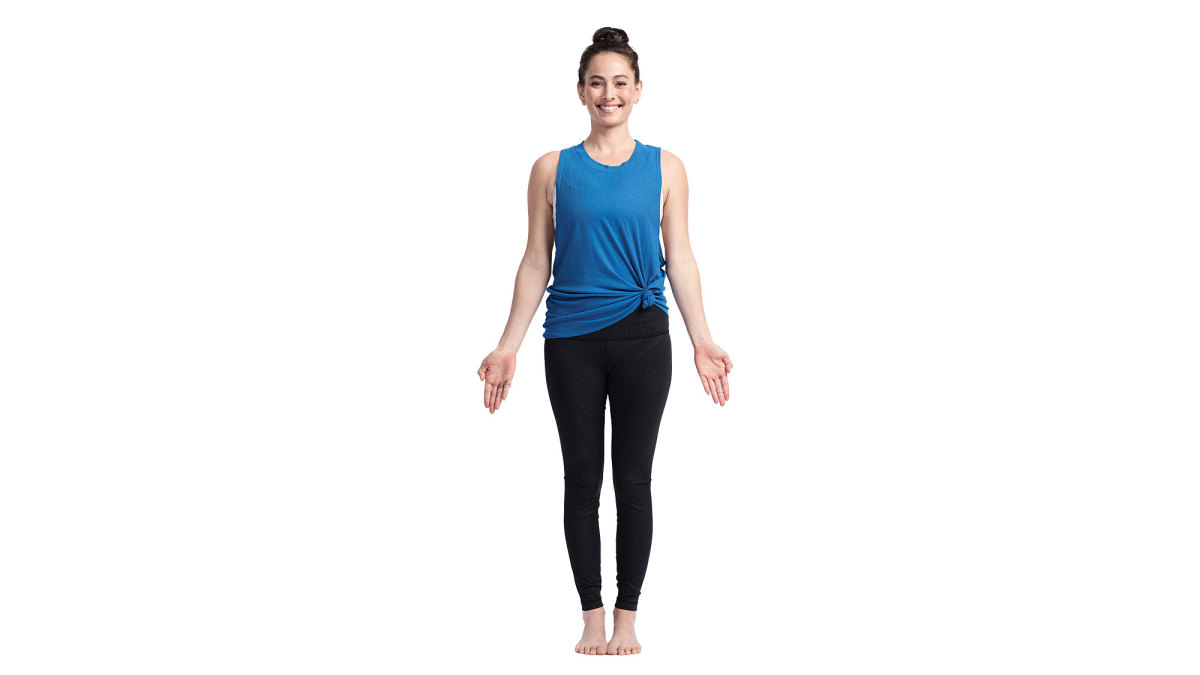
- Stand in your bare feet on a smooth and even surface. Keep your feet together, with your heels touching the wall. Beginners may find it easier to keep their feet 5 cm (2in) apart.
- Stretch your arms along your sides, with the palms facing your thighs, and your fingers pointing to the floor. Stretch your neck upward, keeping the muscles soft and passive.
- Distribute your weight evenly on the inner and outer edges of your feet, and on your toes and heels. Tighten your kneecaps and open the back of each knee. Turn in the front of your thighs. Tighten your buttocks. Pull in your lowerabdomen, and lift your chest.
- Keep your head erect and look straight ahead. Breathe evenly and with awareness. Experience your body and mind as an integrated whole and feel the surge of energy. Stay in the pose for 30 – 60 seconds.
Virabhadra (Warrior Pose)
This challenging pose strengthens the entire body while improving mental capacity and self control.
- Stand in mountain pose continuing with your smooth flowing breath.
- Jump your feet sides ways and sweep your arms out to the side so your ankles are below your wrists. Establish your foundation, by pulling your knees and thighs up, tucking your tailbone under, pushing your feet firmly into the floor. Visualize an imaginary line running vertically down the centre of your body, dropping your shoulders. Squeeze your arms and legs away from the centerline. Keep an awareness of this line as you turn your right foot out to 90 degrees and turn your left foot in to 70 degrees. Ensure the heel of your front foot aligns with arch of your back foot, hips facing forward.
- If your body wants to turn off centre, counter-act it by pushing simultaneously in opposite directions from the centre line.
- Inhale, an as you exhale bend your right leg, pulling up with the outside and inside of the thigh to form a right angle at the knee. Only go as low as you can with out turning your hips off centre. Ideally you want your knee directly above your ankle with you leg coming vertically out of the floor like pillar. Keep the power flowing through the back leg into the floor. Inhale, lift the spine; exhale turn your head to look over your right arm. Take a few deep breaths through the nose.
- Hold the pose and breathe smooth.
- Reverse the procedure back to mountain pose and repeat back to the other side.
Chaturanga Dandasana
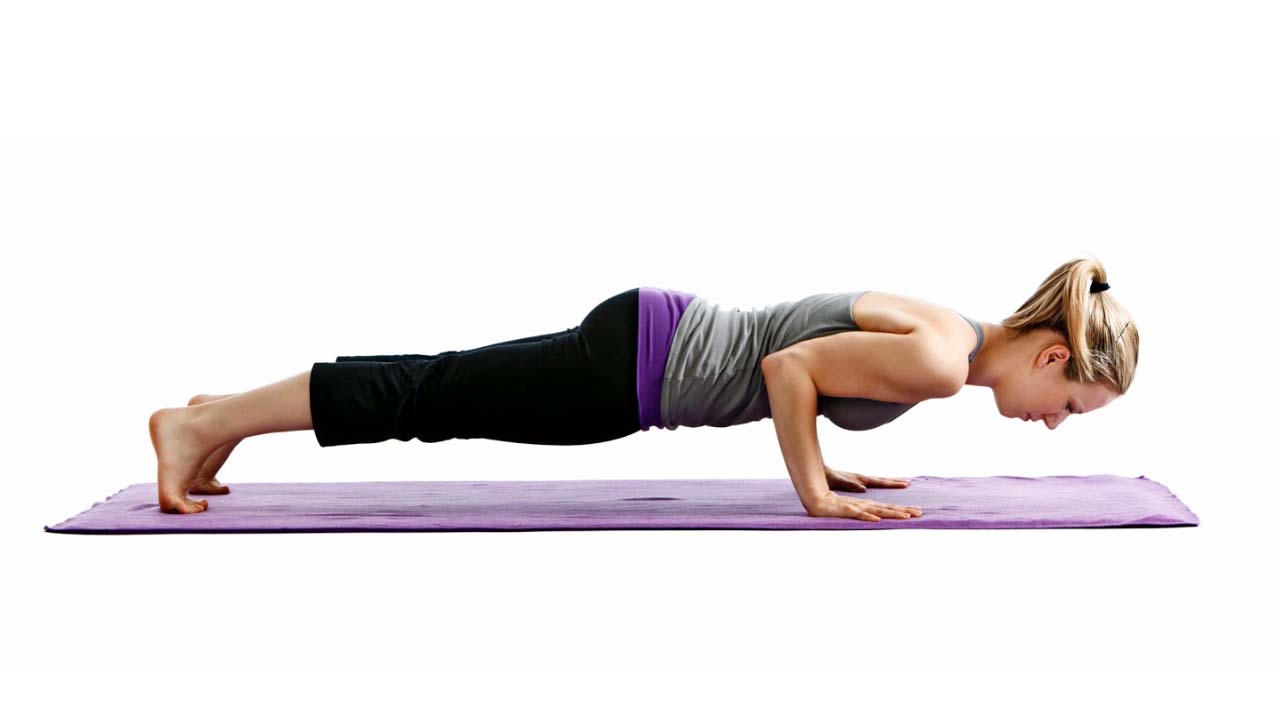
Chaturanga is like a push-up, and as such is a great arm strengthener. It is part of the Sun Salutation vinyasa sequence of poses.
- From Plank position, bend the arms straight back, keeping the upper arms hugging into your sides.
- Lower down toward the floor, stopping when your forearms and upper arms are at a right angle.
- Keep the whole body very level.
- Push back into the heels.
- Roll over the toes coming into Upward Facing Dog.
Dandayamana-Dhanurasana (Standing Bow Pulling Pose)
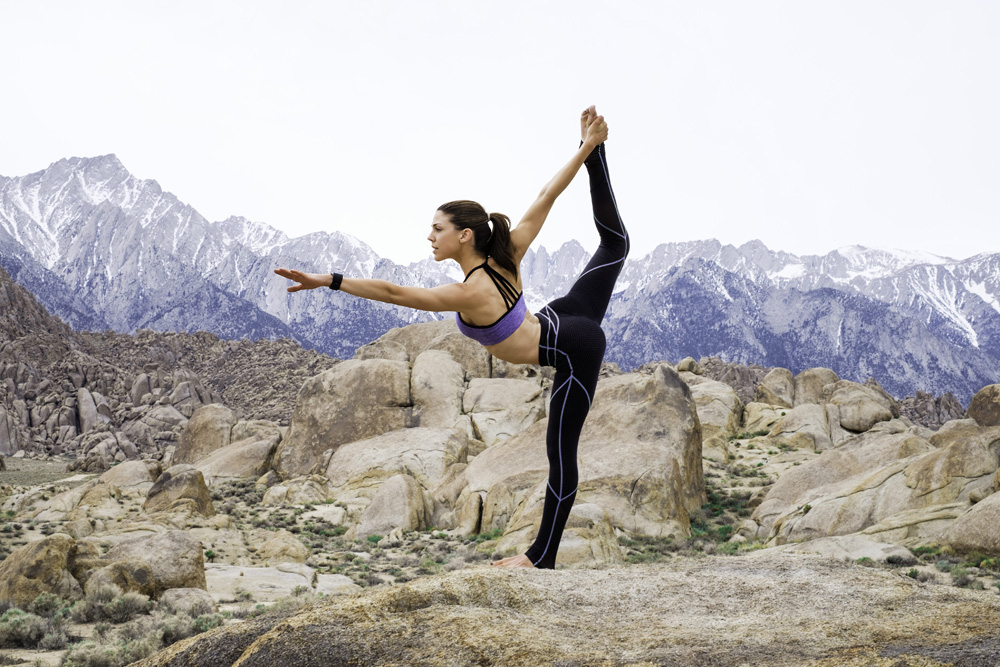
- Begin in Tadasana, Mountain Pose
- Inhale the right arm up keeping it rooted in the shoulder socket but extending through the finger tips.
- Bend the left arm so the elbow is close in to the body and the finger tips are away from the body, palm faces the sky.
- Engage the muscles of your right leg as you bend the left leg behind you and catch the inside of your foot with your left hand.
- Draw both knees together while keeping the tailbone tucked.
- Exhale, press your left foot into your hand extending from the left top thigh. As the leg raises begin to hinge at your hips bringing your upper body parallel to the ground.
- Allow the heart to melt as the left hip bone and shoulder softens and surrenders.
- Reach through the ball mounds of your left foot as your upper body reaches forward.
- Find the arch in the spine to be equal through out by extending though the heart and rooting the tailbone down, away from the body.
- To release: Exhale, come back through standing and repeat on the other side.
Avoid shoulder exercises if you are recovering from or have a shoulder injury or suffer from back problems. Check with your doctor before performing any of the following exercises, especially if you have a health problem or are nursing or pregnant.
Disclaimer
The Content is not intended to be a substitute for professional medical advice, diagnosis, or treatment. Always seek the advice of your physician or other qualified health provider with any questions you may have regarding a medical condition.