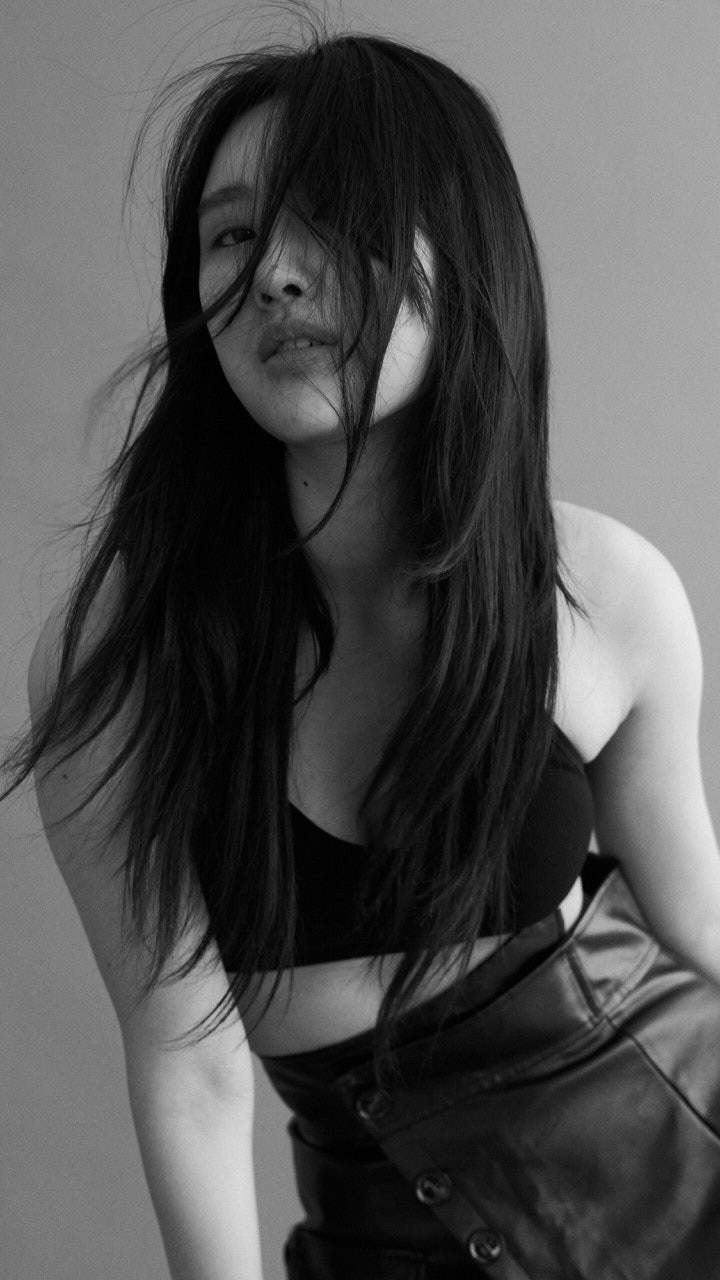
Namita Nayyar:
You’ve walked consistent seasons in both Paris (FW 2024-26) and Seoul (SS 2024-26). How does the psychological expectation of a European vs. an Asian audience change your physical performance on the runway?
Yeong Kim:
The difference between European and Asian audiences is not always overt, but it is deeply psychological, and it inevitably shapes the way I approach performance.
In cities like Paris, there is a strong expectation of authorship. A model is not simply presenting a garment but is invited, in a subtle way, to interpret it. There is room for ambiguity, for silence, for tension that is not fully resolved. The audience, in turn, engages with that ambiguity—they are comfortable projecting meaning rather than receiving it in a fixed form.
In contrast, in Seoul and many Asian contexts, there is a heightened sensitivity to precision, cohesion, and clarity. The performance is expected to align more closely with the collective vision of the show. The emphasis is often on harmony—how each movement contributes to the overall composition.
As a result, my internal calibration shifts. In Paris, I allow more space within the performance. My walk tends to hold a certain restraint, leaving room for interpretation, almost as if I am presenting a question rather than an answer. In Seoul, I refine the execution to a greater degree, ensuring that every gesture is aligned with the intended structure and flow of the show.
Neither approach is inherently more complex or valuable than the other. Rather, they require different forms of awareness. As a model, I see my role as moving fluidly between these modes—understanding not only how to perform, but how to adapt my presence to the psychological expectations of the audience.
Namita Nayyar:
As an Executive Director on high-budget editorial projects, you bridge “Old Money” elegance with modern structuralism. Walk us through a specific conflict during production—perhaps between a designer’s vision and budget reality—and how you resolved it using psychological principles.
Yeong Kim:
There was a project in which the designer envisioned a highly complex structural silhouette, but the reality of the budget made it impossible to fully realize every element as originally intended. Situations like this can easily become framed as compromise, but I approached it differently.
From a psychological perspective, not all elements of a visual composition carry equal weight. Certain features function as perceptual anchors—they define how the entire work is interpreted. My first step was to identify that anchor: the element that held the conceptual and emotional core of the design.
Once that was clearly defined, the conversation shifted. Instead of focusing on what we could not achieve, we began to ask what must absolutely remain intact. This reframing allowed the team to protect the essence of the piece while reinterpreting secondary components in a more resource-efficient way.
The key was not to eliminate limitation, but to redirect attention. By aligning everyone around intention rather than loss, we were able to preserve the integrity of the original vision.
In the end, the final result did not feel diminished. On the contrary, it felt more precise—because every element that remained had a clear purpose.

Namita Nayyar:
Your aesthetic is described as minimal, structural, and luxurious. If you were to cast a philosopher (dead or alive) as the face of a structuralist fashion campaign, who would it be and why?
Yeong Kim:
If I were to cast a philosopher as the face of a structuralist fashion campaign, I would choose Michel Foucault. His work consistently examines the invisible frameworks that shape human behavior—systems of power, surveillance, and internalized control that operate beneath the surface of what we perceive as freedom.
Fashion, in many ways, mirrors this dynamic. It constructs identities, regulates visibility, and defines what is considered acceptable or desirable within a given context. These structures are often internalized to the point where they feel natural, even inevitable.
What draws me to Foucault is not only his theoretical contribution, but the tension within his ideas—the way visibility can both empower and constrain, the way structure can both define and limit the self.
Translating that into a visual language would create a campaign that does not simply present beauty, but interrogates it.
In that sense, the image would not seek to be immediately consumed. Instead, it would invite reflection, perhaps even discomfort. And for me, that is where a certain form of luxury emerges—not from excess, but from depth.
Namita Nayyar:
Looking ahead to International Mother’s Day on May 10, 2026, how does your understanding of “attachment theory” (from your Psychology M.A.) shape your perspective on the mother-daughter dynamic within the often high-pressure, high-glamour fashion world?
Yeong Kim:
My understanding of attachment theory has inevitably shaped the way I perceive relationships within the fashion industry, particularly the mother-daughter dynamic. At its core, attachment is about the formation of an internal sense of security—something that allows an individual to navigate external instability without losing coherence.
Fashion, however, is an environment defined by constant movement, evaluation, and transformation. In such a context, relational dynamics can become intensified. The mother-daughter relationship often carries both protection and projection—support intertwined with expectation.
What I find important is the development of an internal base that is not entirely dependent on external validation. A secure attachment does not necessarily mean the absence of pressure, but rather the ability to metabolize it without fragmentation.
In practice, this means understanding where one’s sense of worth originates. If it is overly externalized, the industry can become destabilizing. But if there is an internalized sense of grounding, then even within high-pressure environments, one can engage, perform, and evolve without losing continuity of self.
Ultimately, I see attachment not as something fixed in early life, but as something that can be reinterpreted and strengthened over time. And in an industry like fashion, that ongoing process becomes essential.
Disclaimer
The Content is not intended to be a substitute for professional medical advice, diagnosis, or treatment. Always seek the advice of your physician or other qualified health provider with any questions you may have regarding a medical condition.
