Surprise origin of stomach cancer
Friday, 26 November, 2004
Stomach cancer may not originate from 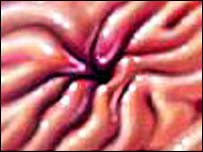 the tissue of the organ itself, but from bone marrow cells, researchers have found.
The cells appear to migrate to the stomach to try to repair damage caused by a bacterial infection.
The finding challenges many of the previous assumptions about how cancers originate, and could lead to new treatments, the scientists say.
The Columbia University research is published in the journal Science.
Stomach cancer has long been associated with infection by the bacterium Helicobacter pylori, which is also known to cause ulcers.
It was thought that the bacteria irritated the lining of the stomach wall, causing tissue damage, inflammation and stimulating the cells to become cancerous.
The Columbia research, on mice, suggests that the presence of H. pylori is indeed a trigger for cancer.
But rather than malignancy originating in the cells of the stomach wall, it was traced to immature bone marrow cells.
It seems that these cells migrate to the stomach in response to the damage caused by H. pylori infection.
They try to repair the lining, but actually appear to be responsible for the onset of cancer.
Bone marrow cells in the mice were seen to start grafting on to their stomach lining after 20 weeks of infection.
The cells then started to mutate into abnormal shapes, similar to those in the early stages of cancerous transformation.
Re-evaluation needed
Researcher Professor Timothy Wang said: “This was an unexpected finding, which may lead to a re-evaluation of current assumptions about how all cancers originate.
“The implications of this study may lead to new methods of diagnosis and treatment of many cancers – particularly those that have been linked to chronic inflammation such as stomach, oesophagus, lung, pancreas, liver, etc.”
Some scientists doubt the theory and suggest the cells could just be fusing with existing cells in the stomach.
Professor Wang accepted more evidence is needed to pin down exactly what is going on.
Dr Emad El-Omar, a Helicobacter researcher at the University of Aberdeen, said: “It’s really quite a novel concept.
“It will set people to thinking quite hard about the origins of stomach cancer.”
Professor Robert Souhami, of Cancer Research UK, said: “Helicobacter is known to be associated with cancer in humans so this very original and unexpected finding gives us a new insight into how gastric cancer might originate.”
