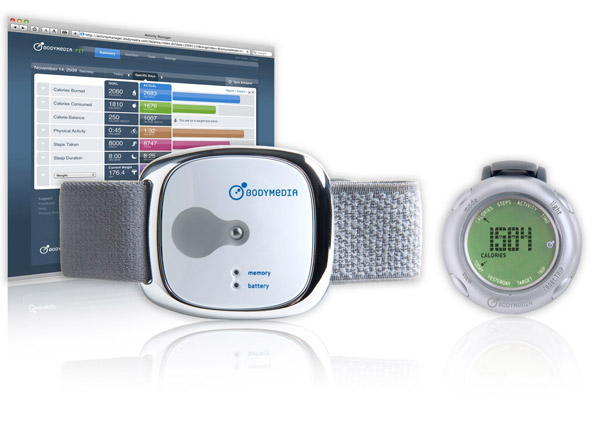
Fitness bands make it easy for anyone with weight loss or other health goals to track their physical activity and calories burned. The bands, like any accessory, come in a variety of shapes, colors and sizes, but an Iowa State University study found not all devices are created equal. Researchers tested eight different activity monitors to determine the accuracy of each model.
Gregory Welk, a professor of kinesiology, says a majority of the devices provided reasonably accurate estimates (within 10 to 15 percent) of calories burned. The BodyMedia FIT was the top performer with a 9.3 percent error rating, which is comparable to research models, Welk said. The Fitbit Zip and Fitbit One were next with a 10.1 and 10.4 percent error rating, respectively. Here is how the other monitors performed: Jawbone Up (12.2 percent), Actigraph (12.6 percent), Directlife (12.8 percent), Nike Fuel Band (13.0 percent) and Basis Band (23.5 percent).
Welk says activity monitors were once a tool used only by researchers. Now the market has exploded in response to consumer demand. The monitors can be a motivational tool for some, while others like the convenience for tracking. Researchers know that people tend to overestimate their activity levels, so it is important that the monitors are accurate to eliminate that human error.
“People buy these activity monitors assuming they work, but some of them are not that accurate or have never been tested before. These companies just produce a nice-looking device with a fancy display and people buy it,” Welk said.
To test the devices, 30 men and 30 women wore all eight monitors during a 69-minute workout that included a series of 13 different activities, ranging from writing at a computer and playing Wii tennis to playing basketball and running. Participants also wore a portable metabolic analyzer that researchers used for comparison to test the accuracy of each device.
The research, published in the journal Medicine & Science in Sports & Exercise, assessed how the devices performed for a sustained period of monitoring, instead of evaluating individual activities, to better reflect how they would perform in real-world conditions. Welk also points out that the monitors, regardless of accuracy, cannot guarantee results in reaching fitness goals, and what works for one person may not work for another.
“The point that a lot of people miss is that they think these devices will solve their activity problems and make them active on their own,” Welk said. “The device can be a nudge or a prompt, but it is not going to make them more active unless they change their behavior and learn from their experience. A $25 pedometer is as good of a behavior change tool as a FitBit.”
Welk’s former Ph.D. student Jung-Min Lee, now an assistant professor at the University of Nebraska-Omaha, conducted the study as part of his dissertation research. This work also demonstrated the potential of calibrating the built-in accelerometers in cell phones for use as activity monitors. This component of the study was presented at the American College of Sports Medicine conference in May. Current Ph.D. students Yang Bai and Youngwon Kim are continuing to advance this line of work.
Improving science by correcting for recall errors
Activity monitors are also widely used by researchers to study physical activity behavior. Welk and his team frequently use research-grade monitors to try to improve the accuracy of self-report measures widely used for public health studies. One of the fundamental challenges with self-reports is that people have a hard time recalling their activity. Welk says there is a lot of interest in reducing this error to provide more accurate results and improve the quality of programs developed from the research.
A team of Iowa State researchers, led by Welk, conducted a four-year study to measure and correct for human error based on people’s weight, age, gender and socioeconomic status. The study, funded by a National Institutes of Health grant, included 1,500 people who wore a monitor for a day to track their activity. The following day they completed a phone survey about their activity for comparison.
“We know that overweight people are more inclined to overestimate their activity than normal weight people, because it’s harder for them or they’re not used to doing as much physical activity. We know the same is true for diet that people tend to underestimate what they eat,” Welk said. “The key innovation of the project is that we’re using the data we have to understand the error in order to quantify and model the error and correct for it down the road.”
The research led by Welk, Sarah Nusser, current vice president for research and professor of statistics; Alicia Carriquiry, Distinguished Professor of statistics; and a team of doctoral students, Bryan Stanfill, David Osthus, Youngwon Kim and Andres Calabro, is generating interest from the National Cancer Institute and other research groups. The study is also published in the journal Medicine & Science in Sports & Exercise.
The study done by Iowa State University.
