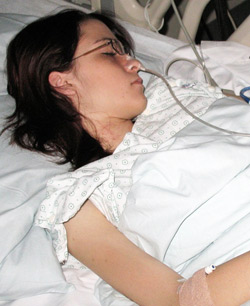
 A new study led by Johns Hopkins Medicine researchers of patients hospitalized with anorexia nervosa shows that a faster weight gain during inpatient treatment — well beyond what national standards recommend — is safe and effective.
The work, recently published online in International Journal of Eating Disorders, challenges long-held guidelines for dangerously underweight patients with the eating disorder set by the American Psychiatric Association, the American Dietetic Association and other major international organizations for “refeeding” and stabilizing eating and nutrition.
The researchers collected data over eight years from 361 patients from patients with anorexia nervosa and related disorders, each of whom spent a week or more on an inpatient weight gain regimen.
“We were able to get patients with anorexia to safely gain around 4 pounds a week. That’s twice the national average,” says psychiatrist Graham Redgrave, M.D., the study’s first author and an expert in eating disorders at Johns Hopkins Medicine. “The higher rate is important, because it means that most patients left the hospital at a normal weight. Studies show that patients who gain more weight in treatment are less likely to relapse in the first two years after treatment, when they’re most vulnerable.”
Relapse after intensive, hospital-based treatment for anorexia is a common, challenging problem. U.S. guidelines recommend weight gain of about 1 to 3 pounds per week, and many treatment programs may have low rates of weight gain, in part because of safety concerns about faster refeeding, Redgrave says.
At issue is refeeding syndrome, a metabolic disturbance that can affect severely underweight patients with cancer, starved war survivors and patients with anorexia nervosa who return too quickly to high calorie meals. During starvation, a malnourished body falls into a metabolic holding pattern that drains available glucose, phosphate and other mineral reserves. When eating is rapidly restored, some of the body’s major organs draw on these same reserves to resume normal functioning, depleting them even more.
“The initial drop in available phosphate puts patients at risk of a lethal heart arrhythmia and failure, the most serious aspect of refeeding syndrome,” says senior author Angela Guarda, M.D., director of the Johns Hopkins Eating Disorders Program. Other effects can include confusion, convulsions and coma.
“So ‘slower is safer’ has been the clinical view. But at what price?” Guarda asks. “If a patient is severely ill and needs to gain 50 pounds, but only gains 10 pounds in the hospital, you achieve little other than a temporary improvement. Worse still, recent research actually shows that under traditional protocols, people can lose weight in the hospital.”
The Johns Hopkins study suggests that careful monitoring of patients in an inpatient treatment program can sidestep refeeding syndrome. Those who entered the program with a dangerously low body mass index — a measure that shows whether a person’s weight and height are within healthy proportions — were tested daily for levels of phosphate and glucose in their blood. The monitoring continued until nutritional treatments restored normal levels, Guarda says. Less than one-fifth of patients had a drop in phosphates during more rapid refeeding, and no one developed refeeding syndrome. “Abnormal phosphate levels were more closely tied to how underweight patients were when entering the hospital than to the rate of weight gain,” Redgrave says.
At the end of the Johns Hopkins program, more than 70 percent of adult patients reached a normal BMI of 19 or higher, and 80 percent of adolescents were within 5 pounds of their target weight.
“Reversing starvation and reaching a healthy weight is critical for therapy to work,” Redgrave says. “Patients at a very low weight don’t think clearly. Their judgment becomes impaired; they’re more obsessional, anxious and depressed. Weight restoration reverses that.”
The study included patients ranging in age from 11 to 78 and suffering from both major types of anorexia nervosa — food-restricting or bingeing and purging — with varying severity. Many had additional psychiatric diagnoses.
Redgrave thinks the study’s positive results are linked to the highly structured nature of the Johns Hopkins program, which relies on behavior-focused therapy to change patients’ thinking and motivate them. “Our study shows what’s actually possible. Now we’d like national guidelines and practices to reflect that,” he says. The study done by Johns Hopkins Medicine.
