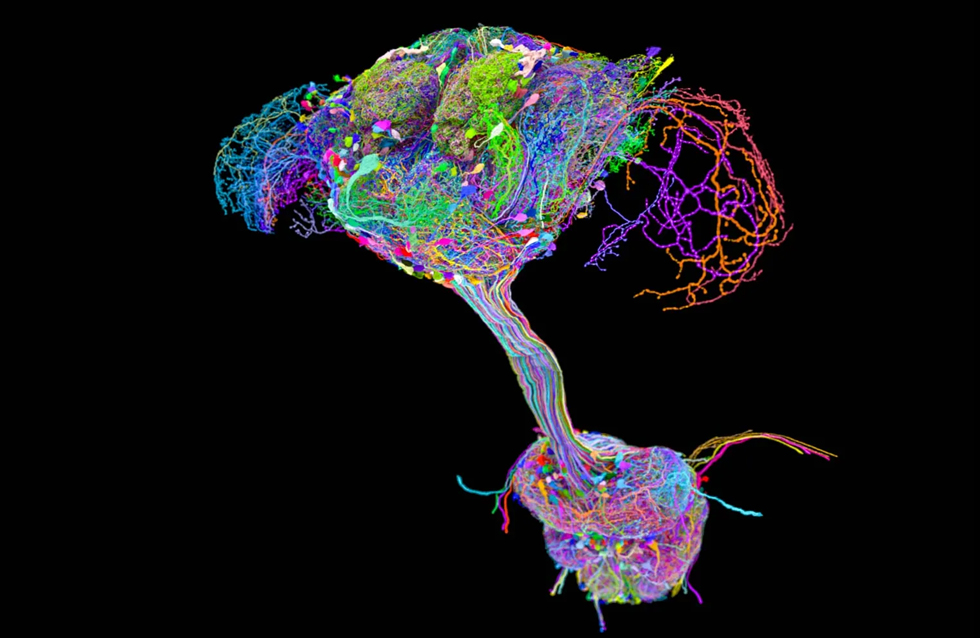
A large international research team led by groups at Harvard Medical School and Princeton University has reached a major neuroscience milestone by publishing a complete map of every connection between neurons in the central nervous system of an adult fruit fly.
The achievement gives scientists a new way to examine how the brain and body work together to produce complex actions, including walking and flying. It also opens the door to broader studies of the core rules that govern nervous systems.
“We can see all of the neurons and their connections as a complete unit for the first time and ask, ‘What do we learn from that?'” said study co-senior author Rachel Wilson, the Joseph B. Martin Professor of Basic Research in the Field of Neurobiology in the Blavatnik Institute at HMS.
First Complete Fruit Fly Brain and Body Wiring Map
The new map of neural connections, known as a connectome, extends a previously published fruit fly brain connectome by adding the fly’s spinal cord equivalent, called the nerve cord.
“It is really important to have a central nervous system connectome that is as complete as possible so we can link up the brain and body and start thinking about behavior holistically,” said study co-senior author Wei-Chung Allen Lee, associate professor of neurobiology at HMS and HMS professor of neurology at Boston Children’s Hospital.
When the team studied the connectome, they discovered that many fruit fly behaviors appear to be directed by local neural circuits in the relevant body parts, rather than by one central command area in the brain.
The full connectome is now freely available online, giving researchers around the world a powerful new resource for neuroscience studies. The work, published June 8 in Nature, received support in part from U.S. federal funding, including the BRAIN Initiative (Brain Research Through Advancing Innovative Neurotechnologies), National Institutes of Health, and National Science Foundation.
Why Fruit Flies Matter in Neuroscience
One of neuroscience’s major unanswered questions is how neurons in the brain and body connect and coordinate to generate behavior. The fruit fly Drosophila melanogaster is a valuable model for exploring that problem.
Fruit flies are simple to breed and keep in the lab. Although their nervous system contains only about 160,000 neurons, they can still perform complex behaviors such as navigating, interacting socially, learning, and reacting to sensory signals. They also have what Lee describes as an incredibly sophisticated genetic toolkit, which allows scientists to access, control, and record activity from single neurons or groups of neurons.
In 2024, the FlyWire Consortium, led by Mala Murthy and Sebastian Seung at Princeton, who are also co-authors of the new study, published a complete connectome of a fruit fly brain. At the same time, Lee and his colleagues were building a connectome of the fruit fly nerve cord, which controls the legs, wings, and other appendages while also processing sensory information.
“The brain and nerve cord connectomes are each useful on their own, but until you can bridge the two, it’s hard to understand how information moves between the brain and the body,” said co-first author Helen Yang, a research fellow in neurobiology in the Wilson Lab.
Co-first author Alexander Bates, also a research fellow in neurobiology in the Wilson Lab, noted that the brain holds most of the neurons, but the nerve cord contains neurons that are “some of the most useful” because they are tied to sensation, movement, and functions that are often easier to interpret.
Connecting the Brain to the Nerve Cord
The FlyWire team was eager to shift toward the brain and neural cord, or BANC, dataset imaged in the Lee Lab, said co-senior author Murthy, the Karol and Marnie Marcin ’96 Professor of Neuroscience at Princeton and director of the Princeton Neuroscience Institute (PNI).
“The new connectome represents a major advance for the field, with the ability to understand how circuits in the brain receive feedback from and control the actions of the body,” she said.
“For the first time, we can follow information flow from sensation to action across an entire nervous system,” added co-author Arie Matsliah of the PNI.
How Scientists Built the Connectome
To create the connectome, researchers sliced a single fruit fly into thousands of extremely thin serial sections. They then used electron microscopy to capture millions of images showing neurons and their connections. AI tools helped align those images and assemble them into a unified 3D map.
The finished connectome shows how each neuron connects with other neurons in the brain and nerve cord at the level of individual synapses. The map does not cover the fly’s entire body, but the researchers used identifiable neurons and previous scientific literature to link central nervous system neurons with neurons in many appendages and sensory organs, effectively “embodying” the connectome.
Lee said scientists can use the connectome to develop new hypotheses for lab experiments. He compares it to having detailed Google Maps information while planning a route.
“The connectome has shown us that most of our hypotheses are too simple. Now, we can develop more complex hypotheses and move forward with experiments to test them,” Lee said.
A Surprise About How Movement Is Controlled
The researchers have already used the connectome to study motor control, especially how a fly moves its legs and other body parts.
A long-standing idea in neuroscience holds that the brain acts as a centralized controller that decides which actions an animal will perform. The fruit fly connectome pointed to a different answer.
The team found that motor control in fruit flies mostly occurs locally. For instance, movement of one leg is mainly governed by the neural circuits for that leg. Those circuits then communicate with circuits for the other legs to produce coordinated actions such as walking.
The same pattern appeared in circuits linked to the fly’s wings, mouth, and other body parts. The researchers also found that motor circuits connect with other circuit types, including those in the visual and endocrine systems, which supply extra information that helps shape behavior.
“Our findings suggest that control for actions is highly distributed in local modules that link up and work together in different ways,” Bates said.
What Comes Next for Connectome Research
The researchers say the connectome could support many future lines of investigation. Yang compares it to the Human Genome Project, another large-scale open resource that has been used in many different ways.
Soon, the team plans to add more information to the connectome, including details about neuropeptides, the small, protein-like molecules that neurons use to communicate.
The connectome may also reveal basic principles that apply to nervous systems across species, including humans. Bates said many discoveries from fruit fly neuroscience have carried over from invertebrates to mammals, including findings related to navigation, olfaction, and memory.
Another goal is “to bring full-connectome mapping to much more complex organisms,” said Matsliah. He noted that progress in AI, computing, and open collaborative science is making this kind of research increasingly possible.
A major question now is whether the distributed neural control observed in fruit flies is also found in other animals. Lee is currently investigating that possibility in mice.
“I would be shocked if this is unique to the fly,” Yang said. “We don’t have this level of resolution in other animals, but we know that they have a lot of these local circuits.”
Lessons for Artificial Intelligence
The work could also have implications for artificial intelligence. The connectome offers real biological data that may help guide the design of artificial agents that move through virtual worlds, systems that are increasingly used to study intelligence and improve AI training.
“One thing that always amazes me is that this tiny little fly does a hell of a lot; even our best AI agents and robots can’t do everything that a fly does,” Yang said. “There may be lessons for AI in how the nervous system is organized.”
