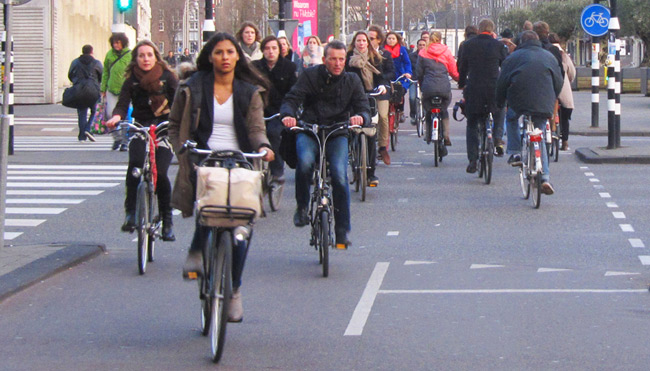
Adults who commute to work via cycling or walking have lower body fat percentage and body mass index (BMI) measures in mid-life compared to adults who commute via car, according to a new study in The Lancet Diabetes & Endocrinology journal.
Even people who commute via public transport also showed reductions in BMI and percentage body fat compared with those who commuted only by car. This suggests that even the incidental physical activity involved in public transport journeys may be important.
The study looked at data from over 150000 individuals from the UK Biobank data set, a large, observational study of 500000 individuals aged between 40 and 69 in the UK. The study is the largest to date to analyse the health benefits of active transport.
The strongest associations were seen for adults who commuted via bicycle, compared to those who commute via car. For the average man in the sample (age 53 years; height 176.7cm; weight 85.9kg), cycling to work rather than driving was associated with a weight difference of 5kg or 11lbs (BMI difference 1.71 kg/m2). For the average woman in the sample (age 52 years; height 163.6cm; weight 70.6kg), the weight difference was 4.4kg or 9.7lbs (BMI difference 1.65 kg/m2).*
After cycling, walking to work was associated with the greatest reduction in BMI and percentage body fat, compared to car-users (BMI difference 0.98 kg/m2 for men; 0.80 kg/m2 for women). For both cycling and walking, greater travelling distances were associated with greater reductions in BMI and percentage body fat.
Commuters who only used public transport also had lower BMI compared to car-users (BMI difference of 0.70kg/m2 for men), as did commuters who combined public transport with other active methods (BMI difference 1.00 kg/m2 for men; 0.67 kg/m2 for women). The effect of public transport on BMI was slightly greater than for commuters who combined car use with other active methods (BMI difference 0.56 kg/m2 for men).
The link between active commuting and BMI was independent of other factors such as income, area deprivation, urban or rural residence, education, alcohol intake, smoking, general physical activity and overall health and disability.
In England and Wales, 23.7 million individuals regularly commute to work, 67% of commuters by car. In the study sample, 64% of men and 61% of women commuted by car, and only 4% of men and 2% of women reported cycling only or a mix of cycling and walking. Previous studies that have looked at the association between active commuting have tended to fold cycling and walking together with other modes of active commuting, which perhaps understates the positive effects of cycling. With the majority of people in mid-life commuting via car, the authors say there are significant public health benefits in obesity reduction that could be realized by encouraging and incentivizing a more active lifestyle.
“We found that, compared with commuting by car, public transport, walking and cycling or a mix of all three are associated with reductions in body mass and body fat percentage, even when accounting for demographic and socioeconomic factors. Many people live too far from their workplace for walking or cycling to be feasible, but even the incidental physical activity involved in public transport can have an important effect” said study author Dr Ellen Flint, Lecturer in Population Health from the London School of Hygiene & Tropical Medicine, UK.
Dr Flint adds: “Physical inactivity is one of the leading causes of ill-health and premature mortality. In England, two thirds of adults do not meet recommended levels of physical activity. Encouraging public transport and active commuting, especially for those in mid-life when obesity becomes an increasing problem, could be an important part of the global policy response to population-level obesity prevention.”
Writing in a linked Comment, Dr. Lars Bo Andersen, Sogndal and Fjordane University College, Sogndal, Norway, says: “The finding of a positive effect from active commuting is important, because commuting to work is an everyday activity that lots of working people need to do. Many people are not attracted to recreational sports or other leisure time physical activities, which are proven to benefit health, and active transport might therefore be an important and easy choice to increase physical activity and the proportion of people achieving recommended levels of physical activity. Physical activity during commuting has health benefits even if its intensity is moderate and the commuting does not cause high heart rate and sweating.”
